5 Pillars of the Muslim Faith: A Complete Guide for Muslims in the USA
5 Pillars of the Muslim Faith: A Complete Guide for Muslims in the USA
Whether you're a new Muslim in the USA building your foundation or a parent looking for a clear way to explain the basics to your children, understanding the 5 pillars of the Muslim faith is where genuine Islamic practice starts. These five acts, testimony of faith, prayer, charity, fasting, and pilgrimage, form the practical structure every Muslim builds their worship around. This guide breaks each one down clearly, with their basis in the Quran and Hadith, plus why they matter beyond ritual alone.
The 5 Pillars of the Muslim Faith at a Glance
For readers who want the complete picture before the detailed breakdown, here's the core structure in one place: five obligatory acts, rooted in both Quran and Hadith, that every practicing Muslim builds their worship around, regardless of country or cultural background. Understanding them individually matters, but seeing them together first makes the connections between them clearer.
What Are the Five Pillars of Islam?
The five pillars are the five foundational acts of worship that structure a Muslim's practice of the faith: Shahada (testimony of faith), Salah (five daily prayers), Zakat (obligatory charity), Sawm (fasting during Ramadan), and Hajj (pilgrimage to Makkah). They come directly from a well-known Hadith where the Prophet Muhammad ﷺ described Islam as being "built upon five."
Where This Framework Actually Comes From
This Hadith, recorded in both Sahih al-Bukhari and Sahih Muslim, is one of the most frequently cited in Islamic teaching specifically because it organizes the entire practice of the religion into five clear, actionable acts rather than abstract theology alone.
The 5 Pillars of Islam
Here's each pillar in the order they're traditionally taught, with its Arabic name and what it actually requires.
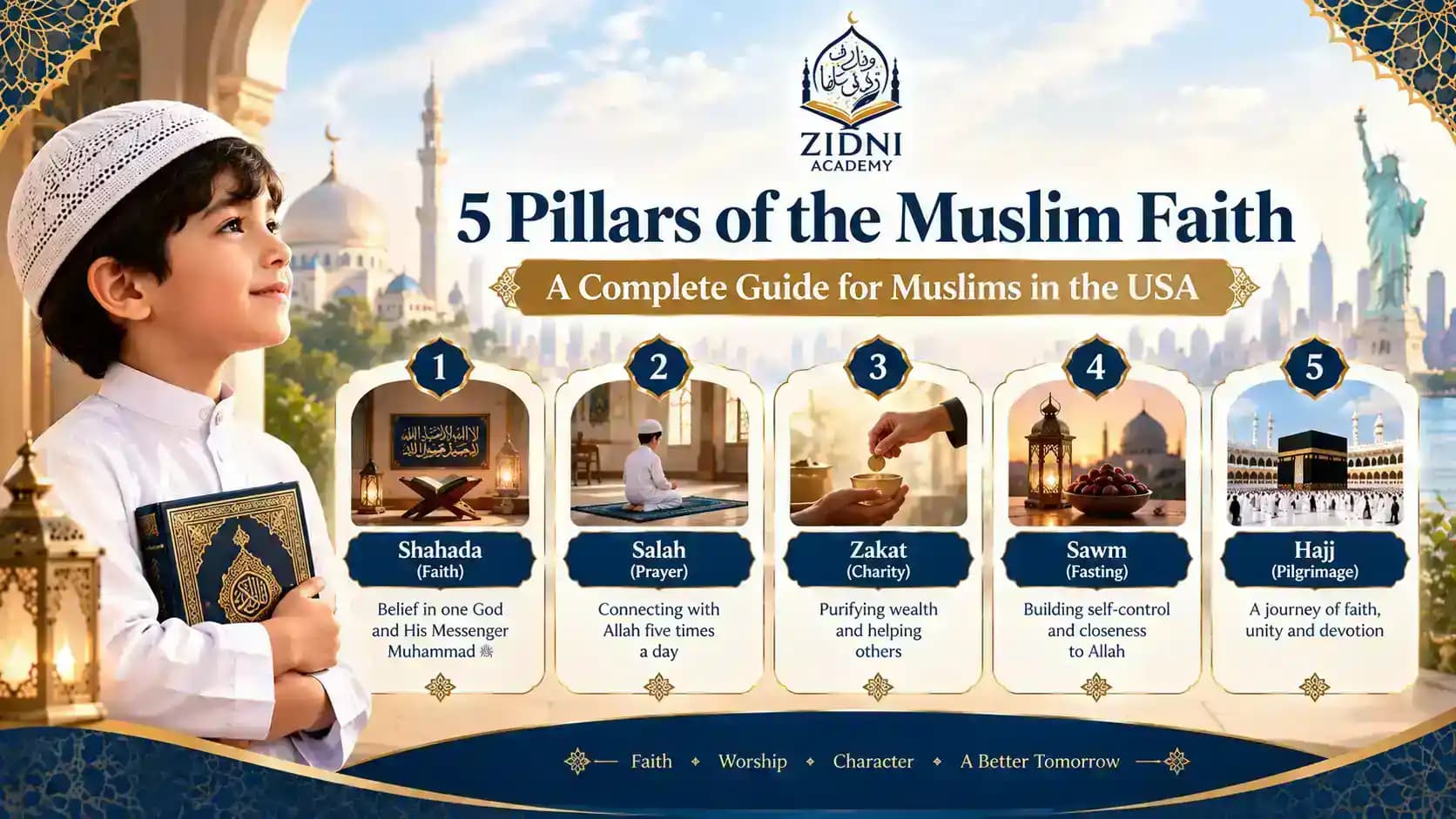
1. Shahada (الشَّهَادَة) — Declaring that there is no god but Allah, and that Muhammad ﷺ is His messenger. This is the entry point into Islam itself.
2. Salah (الصَّلَاة) — Performing five obligatory prayers daily at set times, facing the Kaaba in Makkah.
3. Zakat (الزَّكَاة) — Giving 2.5% of qualifying savings and wealth annually to those in need.
4. Sawm (الصَّوْم) — Fasting from dawn to sunset throughout the month of Ramadan.
5. Hajj (الْحَجّ) — Making the pilgrimage to Makkah at least once in a lifetime, for those physically and financially able.

The 5 Pillars of Islam in the Quran
While the famous Hadith names all five pillars together explicitly, the Quran itself references each one individually across different Surahs, and understanding these references matters for anyone who wants a Quran-based, not just Hadith-based, foundation.
Where Each Pillar Appears
Prayer is mentioned repeatedly, with specific prayer times referenced in Surah Ta-Ha (20:130). Charity is commanded alongside prayer in several verses, including Surah Al-Ma'idah (5:12). Fasting has a dedicated passage in Surah Al-Baqarah (2:183-187), explicitly naming Ramadan. Hajj is detailed extensively in Al-Baqarah (2:196-203), the Quran's longest single passage on any single pillar.
What Do the 5 Pillars of Islam Mean?
Each pillar represents a different dimension of submission to Allah, moving from declaration to daily practice to material sacrifice to physical discipline to collective devotion.
Beyond the Literal Actions
Shahada means intellectual and spiritual commitment; Salah means maintaining a constant, structured connection with Allah throughout each day; Zakat means recognizing that wealth carries social responsibility; Sawm means developing self-discipline and empathy for those with less; and Hajj means physically demonstrating unity with the entire global Muslim community, regardless of nationality or background.
Why Are the Five Pillars of Islam Important?
The pillars aren't simply rules to follow; they're a complete framework that touches every part of a believer's life, spiritual, financial, physical, and communal, ensuring no single dimension of faith is neglected in favor of another.
Understanding the 5 Pillars of the Muslim Faith as a Complete System
Practicing all five together, rather than emphasizing one while neglecting others, is what the Hadith's "built upon five" language actually implies: Islam functions as a structure, and removing any single pillar weakens the whole. This is precisely why the 5 pillars of the Muslim faith are taught together as a unit rather than as five disconnected practices.
Facts About the Five Pillars of Islam
A few details surprise even lifelong Muslims. The Shahada doesn't appear in the Quran as one single combined verse; its two parts are drawn from separate verses, including Surah Aal-e-Imran (3:18) and Surah Al-Fath (48:29), later combined into the phrase recited today.
Facts Worth Knowing for Daily Practice
Zakat is calculated specifically on wealth held for a full lunar year above a minimum threshold called Nisab, not on income directly. Hajj is required only once in a lifetime, though many Muslims choose to perform the lesser pilgrimage, Umrah, multiple times. And Ramadan fasting dates shift roughly eleven days earlier each year, since the Islamic calendar follows the lunar cycle rather than the solar one.
Practicing the Pillars as a Muslim in the USA
Living the five pillars in a country where Islam isn't the majority religion brings specific, real challenges most guides written for Muslim-majority countries simply don't address. Finding time and private space for Salah during a standard American workday, explaining Ramadan fasting to non-Muslim coworkers or classmates, and calculating Zakat correctly without a local community standard to reference all require adjustments most converts and even lifelong Muslims raised abroad don't anticipate.
Building Support Around These Challenges
Many USA mosques and Islamic centers now offer specific guidance for exactly these situations, from workplace prayer accommodation letters to community Zakat calculators. Connecting with a local or online Muslim community early makes navigating these practical questions considerably easier than working through them entirely alone.
Common Misunderstandings About the Five Pillars
A frequent misconception is that performing the five pillars mechanically, without sincerity or understanding, fulfills their purpose. Islamic teaching consistently emphasizes intention (niyyah) as central to every act of worship; the physical actions matter, but they're meant to reflect and reinforce genuine internal submission, not replace it.
The Pillars Aren't a Checklist to Rush Through
Another common misunderstanding, particularly among new Muslims, is treating the pillars as five separate, disconnected obligations to complete rather than an integrated system that shapes daily life continuously. Salah five times daily, for instance, isn't just a ritual box to check; it's designed to keep a person's connection to Allah present throughout an ordinary day, not confined to a single weekly or occasional moment.
Building a Deeper Foundation With Zidni Academy
Understanding the five pillars is the starting point, not the destination, and many US-based Muslims, particularly reverts and parents raising children in a non-Muslim-majority environment, want structured guidance beyond what a single article can cover. At Zidni Academy, every teacher is a native Arabic speaker and Al-Azhar graduate, trained specifically to explain Islamic foundations clearly to students without a prior religious education background.
Courses to Build Your Islamic Foundation
For adults wanting a structured, comprehensive path through Aqeedah, Fiqh, and Seerah alongside the pillars themselves, Islamic Studies for adults covers this foundation systematically rather than piecemeal.
For Families Raising Children in the USA
Parents wanting the same foundation taught specifically to children can enroll them in Islamic Studies for kids, using age-appropriate teaching methods rather than adult-level material simplified on the fly.
Students wanting to understand the Quranic verses behind each pillar in greater depth often pair this with a Tafseer course.
Teaching the Pillars to Children in a Non-Muslim-Majority Environment
Children growing up in the USA often absorb Islamic practice differently than children raised in a Muslim-majority country, where the pillars are reinforced constantly by the surrounding environment, the call to prayer, Ramadan school schedules, visible community practice. Without that ambient reinforcement, parents need to be more intentional about explaining not just what each pillar requires, but why it matters personally.
Making Abstract Concepts Concrete for Young Learners
Age-appropriate explanation matters enormously here; a five-year-old doesn't need a theological breakdown of Zakat's Nisab threshold, but can understand "we share what we have with people who need it because Allah asks us to." Building this understanding gradually, rather than presenting all five pillars in full adult complexity at once, helps children internalize the concepts rather than simply memorizing definitions. Qualified teachers experienced with this exact challenge are listed on the Zidni Academy teachers page.
Comparing Your Options
What matters | Zidni Academy | Self-Study Alone | Generic Online Content |
|---|---|---|---|
Live teacher guidance | Yes, one-to-one | No | No |
Qur'an and Hadith basis explained | Yes, in depth | Depends on source | Often surface-level |
Structured for beginners | Yes | Depends on research | Rarely sequential |
Free trial | Yes | Not applicable | Not applicable |
Frequently Asked Questions
What is the correct order of the five pillars of Islam?
The traditional order is Shahada, Salah, Zakat, Sawm, and Hajj, following the sequence in the well-known Hadith found in Sahih al-Bukhari and Sahih Muslim.
Can someone be Muslim without performing all five pillars?
Belief in the Shahada is the entry point into Islam itself; the remaining four pillars are obligatory practices a Muslim works toward and strives to fulfill according to individual ability and circumstance.
Why is Hajj only required once in a lifetime?
Hajj is physically and financially demanding, so Islamic teaching requires it once for those genuinely able, while additional pilgrimages, like Umrah, remain voluntary rather than obligatory.
How is Zakat different from general charity or Sadaqah?
Zakat is a specific, calculated obligation on qualifying wealth above a set threshold, while Sadaqah refers to any voluntary charitable giving beyond that fixed requirement.
Can someone who recently converted to Islam perform all five pillars immediately?
The Shahada is performed immediately upon conversion, while the other four pillars are learned and practiced gradually, with allowances for genuine circumstances, prior obligations, or health limitations as understanding and ability develop.
What happens if someone is unable to complete Hajj due to health or finances?
Hajj is only obligatory for those who are genuinely able, both physically and financially; someone unable to meet these conditions is not held responsible for not performing it, though the intention to do so when able still holds spiritual value.
Book Your Free Trial Session
Whether you're new to Islam or want a clearer, structured foundation for your family, a qualified teacher makes the difference between surface knowledge and genuine understanding. Book a free trial session and start building that foundation today.