
Best Online Quran Tutor for the US and UK: What to Look For
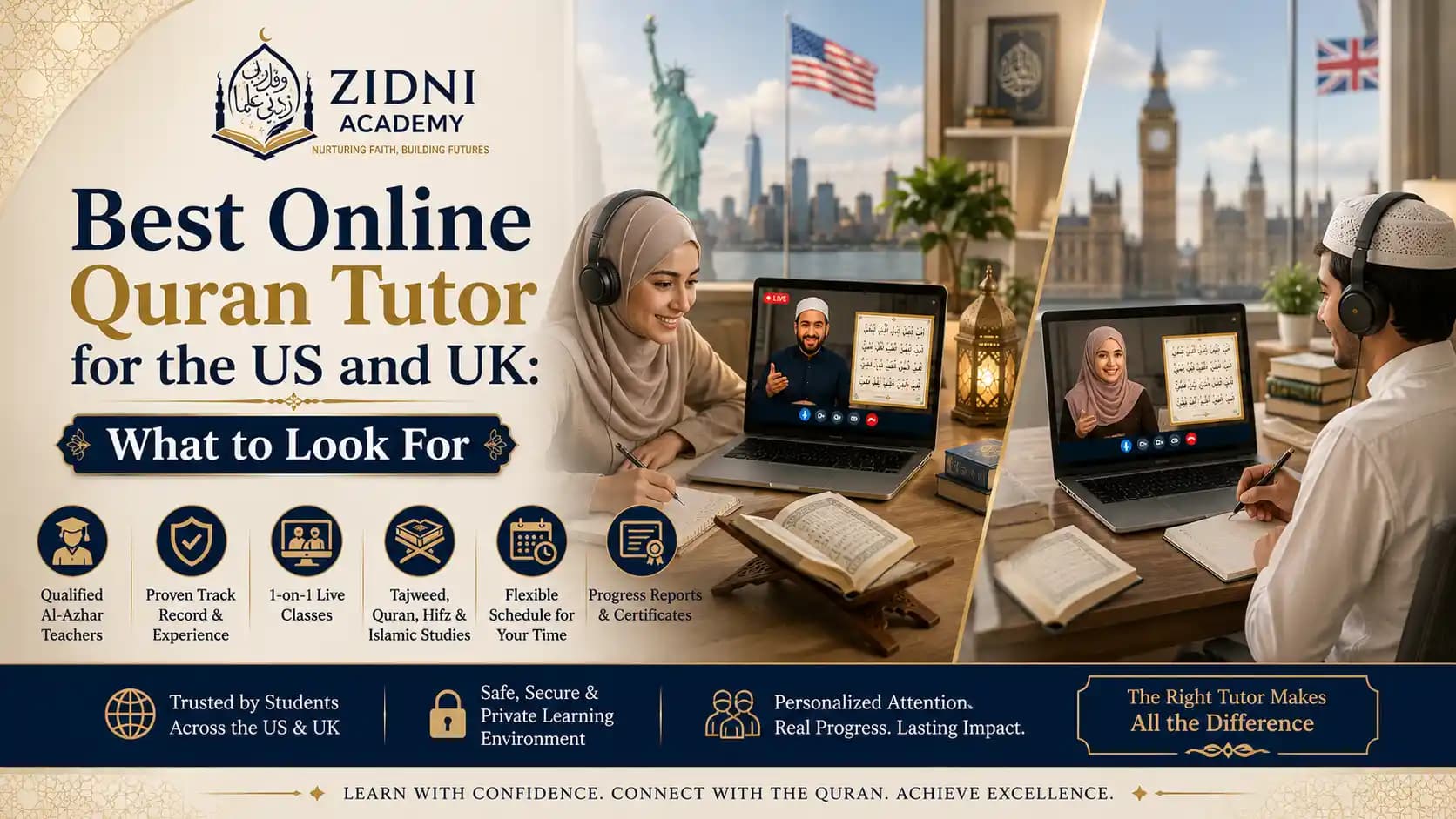
Best Online Quran Tutor for the US and UK: What to Look For
Searching for the best online Quran tutor usually turns up the same problem: dozens of platforms all claiming to be the best, with almost nothing to actually tell them apart. Some are marketplaces where anyone can list themselves as a teacher for a few dollars a session, others are dedicated academies with real vetting behind them, and the difference between the two matters far more than most families realise until after they've already enrolled. This guide breaks down what genuinely makes the best online Quran tutor, what it should cost in the US and UK, and how Zidni Academy approaches each of these points.
What Makes the Best Online Quran Tutor
Not every tutor advertising Quran lessons online is actually qualified to teach it properly, and the gap between a genuinely strong teacher and a mediocre one usually comes down to a short list of concrete things worth checking before you commit to anything.
Verifiable credentials come first. The best online Quran tutor typically holds an Ijazah, a formal certification connecting their own recitation to a documented chain of teachers, or a degree from a recognised institution like Al-Azhar University, rather than a vague claim of "years of experience" with nothing to confirm it. Strong command of Tajweed matters just as much, since a tutor can be a fluent reader without necessarily teaching the precise rules of pronunciation correctly, and that distinction shows up quickly in a student's progress.
Communication and patience round out the list. A teacher who explains rules clearly in English, adjusts pace to the student's level, and stays patient through repeated mistakes tends to produce far better long-term results than one who simply corrects and moves on. Sincerity and character matter here too, since Quran teaching is not a purely academic subject, and the best online Quran tutor treats it accordingly.
Why One-to-One Tutoring Beats Group Classes or Marketplace Freelancers
Group classes and crowded virtual classrooms divide a teacher's attention across several students at once, which means individual pronunciation mistakes often go uncorrected simply because there isn't time to catch every student's errors in a shared session. One-to-one sessions solve this directly, since the teacher's full attention stays on one student for the entire lesson.
Freelance marketplaces present a different problem. Anyone can list themselves as a Quran teacher for a few dollars a session with no verification process behind the listing, which means quality varies enormously and there's often no real way to confirm credentials before booking. This is precisely why finding the best online Quran tutor usually means looking past price alone and checking who is actually doing the vetting behind a platform.
Meet the Teachers
At Zidni Academy, every teacher is a native Arabic speaker, and most are graduates of Al-Azhar University, the institution most academies point to as the benchmark for Quranic education. Several hold Ijazah with a documented chain of transmission, and each teacher goes through an assessment covering Tajweed mastery, teaching methodology, and communication skills before ever being listed on the platform, rather than being added based on a self-reported bio alone.
Full teacher profiles, including specialisms and years of experience, are available on the Zidni Academy teachers page, which gives you a way to actually check credentials rather than relying on marketing language before booking a trial.
Courses You Can Take with Your Tutor
The best online Quran tutor should be able to guide a student through a genuine progression, not just repeat the same lesson format regardless of level. Most students begin with correct letter recognition and pronunciation, then move into a dedicated Tajweed course that covers elongation, nasal sounds, and stopping rules in proper depth.
For families enrolling children, a structured Quran course for kids is built specifically around shorter attention spans and age-appropriate teaching methods, while adult beginners generally move faster through a Quran course for adults designed for learners starting later in life. Students focused specifically on memorisation typically progress into a dedicated Quran memorisation course once foundational Tajweed is solid.
Scheduling: How the Best Online Quran Tutor Works Around US and UK Time Zones
Scheduling is where a surprising number of otherwise decent platforms fall short, since teachers based overseas don't always account properly for how disruptive an early morning or late night session feels to a family across US or UK time zones. The best online Quran tutor arrangement builds scheduling around Eastern, Central, Mountain, and Pacific time in the US, and around UK working hours and school schedules, rather than expecting families to adapt to a teacher's local clock.
Missed sessions should also be reschedulable rather than simply forfeited, since school runs, shift work, and family life genuinely interrupt a fixed weekly slot from time to time, and a rigid platform that penalises that reality tends to lose students within the first few months.
How Much Does the Best Online Quran Tutor Cost?
Pricing varies enormously depending on where you look. Freelance marketplaces often advertise sessions from as little as five to twenty dollars, but these rates typically reflect unverified tutors with no institutional vetting behind them, and quality is genuinely inconsistent from one listing to the next. Dedicated academies with Ijazah-certified, Al-Azhar-trained teachers generally charge more per session, which reflects both the credentials involved and the one-to-one structure of the lessons themselves.
In the UK specifically, monthly plans for one-to-one lessons commonly start from around £25 to £30 a month for a single weekly session, scaling up with additional sessions per week, while US pricing tends to follow a similar monthly-subscription model tied to session frequency. Most reputable academies offer sibling discounts for families enrolling more than one child, and a free trial session remains the clearest way to judge whether a given price genuinely reflects the quality of instruction on offer.
Best Online Quran Tutor for Kids vs Adults
Children and adults need meaningfully different teaching styles, and the best online Quran tutor for a five-year-old looks very different from the best fit for a working adult. For kids, short, engaging sessions with visual aids, repetition games, and a teacher specifically trained to hold a young child's attention over video call matter more than pure subject expertise alone. Parental monitoring, where a parent can sit in on or review sessions, also gives many families extra peace of mind, particularly in the early months.
Adults generally want faster pacing, direct explanation of the reasoning behind Tajweed rules, and flexibility that fits around work. A significant number of adult students are also starting from complete zero, whether as converts or as Muslims who never had access to formal Quran education growing up, and the best online Quran tutor treats that starting point with patience rather than assuming prior knowledge that isn't actually there.
Quran Apps vs a Real Online Tutor
A quick search for the best online Quran tutor almost always surfaces a wave of app recommendations alongside it, and it's worth being clear about what apps are actually good for before assuming they replace a teacher. Popular options like the Quran.com app, Muslim Pro, and Tarteel are genuinely useful for reading along, tracking memorisation progress, and even getting basic pronunciation feedback through AI recitation checking, and several well-known reciters and scholars, including Mufti Menk, have their recitations and lectures available through mainstream Quran apps and YouTube.
Where apps consistently fall short is live correction. An app can flag that a word sounds off using pattern matching, but it can't explain why, demonstrate the correct articulation point in your mouth, or catch the subtle Tajweed errors a trained human ear picks up immediately. The most effective students tend to use an app for daily reading practice and memorisation tracking between lessons, while relying on a real teacher for the actual correction that moves recitation from "close enough" to genuinely accurate.
Can You Learn the Quran by Yourself, and Where to Start for Free
Self-study is technically possible, and free resources do exist, including community mosque sessions, YouTube channels, and basic reading guides available online for beginners with no budget. For someone just starting to sound out Arabic letters, free resources can absolutely get you through the earliest stage.
The common mistakes that show up in self-taught learners are consistent: skipping the alphabet stage to jump straight into Surahs, mispronouncing letters that don't exist in English without realising it, and rushing recitation speed before accuracy is solid. None of these mistakes are obvious to the learner making them, which is precisely why most people who start self-taught eventually bring in a real teacher once progress stalls, rather than because free resources were the wrong starting point entirely.
Which Online Quran Academy Is Best in the UK and US?
There's no single universally "best" academy, since the right fit depends on whether you're prioritising credentials, price, scheduling, or a specific teaching style, but a few consistent markers separate genuinely strong UK and US academies from the rest. Look for Ijazah-certified, Al-Azhar-trained teachers, one-to-one rather than group sessions, scheduling built around your actual time zone rather than an overseas teacher's convenience, and a free trial that lets you judge fit before paying anything. Academies that meet all four consistently tend to outperform ones that only tick one or two boxes, regardless of how polished their marketing looks.
Comparing Your Options
What matters | Zidni Academy | Freelance Marketplace | Local Madrasah |
|---|---|---|---|
Verified credentials | Al-Azhar graduates, Ijazah-certified | Rarely verified | Varies by institution |
Class format | One-to-one | One-to-one, but unstructured | Usually group |
US and UK scheduling | Built around real time zones | Ad hoc, teacher-dependent | Fixed weekly slot |
Missed class policy | Reschedulable | Rarely offered | Rarely offered |
Free trial available | Yes | Rarely offered | Not applicable |
Questions to Ask Before Booking
How do I actually verify a tutor's credentials?
Ask directly for the institution behind their Ijazah or qualification, and check whether the platform itself vets teachers before listing them, rather than relying on a self-written bio with no external verification.
Is a cheaper marketplace tutor really worse than a dedicated academy?
Not always, but the risk is higher, since marketplace listings typically involve no formal vetting process, and quality can vary dramatically from one profile to the next with no way to confirm claims beforehand.
What if my child or I have never studied Arabic letters before?
That's the standard starting point for most new students, not an exception, and a properly structured beginner curriculum is built specifically around zero prior exposure.
Can I switch tutors if the fit isn't right?
A reputable academy allows this without penalty, since teaching style compatibility matters as much as raw qualification, and a mismatch in the first few sessions shouldn't lock a family into months of lessons that aren't working.
Book Your Free Trial Session
The only real way to judge whether a tutor is genuinely the right fit is to sit in a session with them yourself. Book a free trial session today and see the teaching style, pacing, and curriculum firsthand before committing to a paid plan.
Frequently Asked Questions
How can I find the best online Quran tutor for my family?
Check for verifiable credentials such as an Al-Azhar background or Ijazah, confirm sessions are genuinely one-to-one, and take a free trial class before committing, rather than judging based on price or marketing claims alone.
What is the best online Quran class in the UK?
The strongest options for UK families combine Ijazah-certified teachers, DBS-checked safeguarding where relevant for children, and scheduling built around UK time zones rather than an overseas teacher's local hours.
Are there free online Quran classes available in the UK?
Yes, some mosques and community organisations offer free sessions, though they typically involve larger groups, limited availability, and far less individual correction than a paid, one-to-one programme.
How much do online Quran classes cost in the UK? Monthly plans for one-to-one lessons commonly start from around £25 to £30 for a single weekly session, scaling up with additional weekly sessions and the teacher's level of qualification.
How much does a Quran teacher typically cost?
Rates vary widely by platform and qualification, from a few dollars a session on unverified marketplaces to considerably more for Ijazah-certified, Al-Azhar-trained teachers working with dedicated academies, with one-to-one sessions generally priced higher than shared group classes.
Is $50 an hour too much for tutoring?
For a genuinely qualified, Ijazah-certified teacher offering one-to-one instruction, that rate sits within a reasonable range in the US and UK market, though it's worth comparing against a teacher's specific credentials and experience rather than treating any single figure as a universal benchmark.
Can Quran teachers earn a full-time living from online teaching?
Experienced, credentialed teachers working with established academies can build a sustainable full-time income, particularly those with specialisms like the Ten Readings or advanced Tajweed certification that command higher rates than general instruction.
Is it possible to learn the Quran online as a complete beginner?
Yes, and it's one of the most common starting points among new students, whether children or adults, with a properly structured curriculum built specifically around zero prior exposure to Arabic script.
What are the most common mistakes people make when learning Quran online?
Skipping the alphabet and pronunciation stage to rush into full Surahs, relying entirely on an app without any live correction, and reciting too quickly before accuracy is solid are the three mistakes that show up most consistently among self-taught learners.