Learn Arabic for Non Native Speakers in the UK: A Complete Beginner's Guide
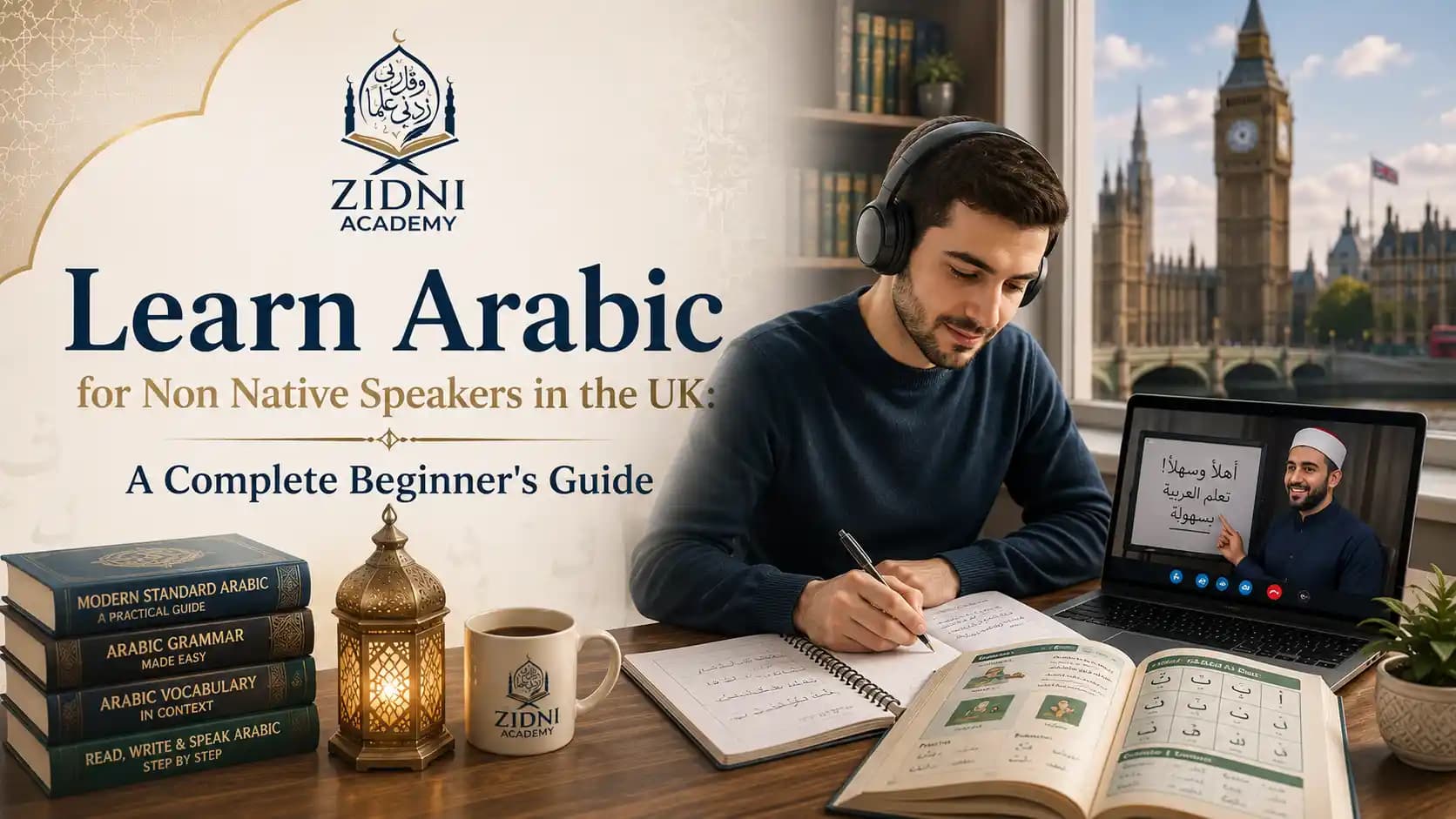
Learn Arabic for Non Native Speakers in the UK: A Complete Beginner's Guide
If you're in the UK and want to **learn Arabic for non native speakers**, you've probably tried apps that teach words but never get you speaking. At Zidni Academy, we teach adult English speakers from zero, live and one-to-one, with native teachers who know exactly where UK learners stall.
Whether you're in **London, Birmingham, Manchester, Bradford, Leicester, or Glasgow**, this guide covers **Arabic for beginners in the UK** — how the language sounds, why self-study fails, and what a structured programme with live correction actually looks like.
Learn Arabic for Non Native Speakers — What the Journey Actually Looks Like
When you decide to learn Arabic for non native speakers, the first thing to understand is that Arabic is not just another language with a different vocabulary. It is a language built on a root system where most words derive from three core letters, and it is written from right to left in a script that changes shape depending on where a letter sits in a word. For English speakers, this structural difference is the real challenge, not the difficulty of the sounds themselves. The good news is that with a certified native teacher providing live, one-to-one correction, these structural differences become manageable within the first few weeks, and learners typically move from complete unfamiliarity to basic reading confidence faster than they expected
How Does Arabic Actually Sound to a Non-Speaker?
To someone who has never studied it, Arabic often sounds fast, guttural, and completely unfamiliar, full of sounds that don't exist in English at all. For anyone looking to **learn Arabic for non native speakers**, this first impression is usually what causes hesitation before they've even started. That reaction is normal, and it's usually the first thing that puts people off before they've even started. But that initial unfamiliarity fades quickly once you understand the logic behind the sounds rather than trying to memorise them by ear alone.
Arabic has a small set of consonants produced from the back of the throat that simply don't have an English equivalent, which is why words can sound harsher or more clipped than they actually are when spoken by a native speaker. Once a learner is shown where each sound is produced and given a few weeks of guided repetition, the language stops sounding foreign and starts sounding structured, almost musical in its rhythm.
Why Pronunciation Matters from Day One
**Pronunciation** is not a detail you fix later — it is the foundation everything else builds on. The alphabet contains letters like ع, ح, خ, and غ, produced from parts of the throat and mouth that English simply doesn't use. Without a teacher showing you exactly where to place your tongue or tighten your throat, you will substitute English sounds without realising it. A certified native teacher catches these substitutions in the first session, before they become muscle memory.
Why Is Arabic Considered Difficult for English Speakers?
The UK Foreign Service and most language-difficulty rankings place Arabic in the hardest category for English speakers, largely because of three things: a different alphabet written right to left, grammar built on root letters rather than fixed word forms, and pronunciation that relies on parts of the mouth and throat English doesn't use. None of that means it's unlearnable, it means self-study alone rarely works.
This is exactly why live correction matters so much more in Arabic than in, say, French or Spanish. A learner can practise a sound incorrectly for months using an app and never know it, because there's no one there to correct the mistake in real time. With a dedicated teacher, small pronunciation errors get caught in the first few sessions rather than becoming a habit that's hard to unlearn later.
Can Arabic Be Self-Taught?
echnically yes, and plenty of people try, but most give up within the first few weeks because the **Arabic alphabet** alone can feel overwhelming without guidance, and there's no way to check if your pronunciation is actually correct. Self-study works reasonably well for vocabulary and grammar rules, both of which can be learned from a book or app at your own pace.
Where self-study consistently breaks down is speaking and listening, the two skills that actually let you hold a conversation. Without a teacher listening and correcting you live, it's very easy to build confidence in a version of Arabic that a native speaker would struggle to understand. That's the gap a structured, live course is designed to close, and it's why most successful self-taught learners eventually bring in a tutor once they hit that wall.
Meet Your Arabic Teachers
Every teacher at Zidni Academy is a native Arabic speaker, most are graduates of **Al-Azhar University's Faculty of Arabic Language**, and several hold certifications specifically in teaching Arabic to non-native speakers, including IELTS-equivalent teaching credentials. One of the platform's teachers has logged more than 5,000 hours of online teaching experience working exclusively with non-Arabic speakers, while another holds a degree in Simultaneous Interpretation and speaks four languages, which makes explaining grammar in a way English speakers actually understand second nature to them.
Before joining the platform, every teacher goes through an assessment covering pronunciation, teaching methodology, and their ability to explain Arabic grammar using comparisons an English speaker will recognise, rather than relying on rote memorisation. You can see the full list of teachers, their specialisms, and years of experience on the Zidni Academy teachers page before booking your first session.
What You'll Learn on the Course
The course is built around real communication rather than academic grammar drills, though grammar is taught properly as the foundation, not skipped. Learners typically start with the **Arabic alphabet** and correct pronunciation of every letter, since this single stage prevents most of the long-term mistakes people carry for years.
From there, the programme moves into everyday conversation: greetings, introducing yourself, asking questions, and building simple sentences you can actually use. Grammar is introduced gradually and tied directly to the vocabulary you're learning that week, rather than taught as an isolated topic. By the intermediate stage, learners are holding short conversations, reading simple texts, and building the kind of vocabulary that lets them follow along in real Arabic media rather than textbook dialogue.
For learners whose goal is specifically religious or classical Arabic rather than everyday conversation, the Islamic Studies course for adults runs alongside the language track and can be combined with it once basic fluency is in place.
The Learning Path Step by Step
The journey begins with a free assessment call, where a teacher gauges your current level, even if that level is genuinely zero, and identifies your goals, whether that's travel, religious study, business, or family connection. From there, you're matched with a teacher whose teaching style and specialism fit what you actually want to achieve.
Sessions are scheduled around your own timetable, which matters a great deal for UK-based learners juggling work or study across different time zones within the day. Each session builds directly on the last, with short review points every few weeks so progress is measurable rather than vague. Learners typically move from alphabet and pronunciation, through foundational grammar and daily vocabulary, into conversational fluency, with the pace adjusted individually rather than forced into a fixed group timetable.
How Long Does It Take to See Real Progress?
For **Arabic for beginners in the UK**, basic greetings and simple phrases are achievable within the first few weeks. Genuine conversational ability — the kind that lets you hold a real exchange with a native speaker — realistically takes 6 to 12 months of consistent one-to-one sessions. The key factor is not how many hours you study in total, but how consistently you practise with live correction from a qualified teacher.
Is Arabic Harder for Dyslexic Learners?
This is a question that comes up often, and the honest answer is that it depends far more on teaching method than on the language itself. Some research suggests Arabic's script, which changes letter shapes depending on position in a word, can present a different kind of challenge for dyslexic learners compared with Latin-alphabet languages, though findings on this are mixed and not something a course provider can responsibly generalise into a rule for every individual.
What does make a measurable difference is one-to-one teaching over group classes, since a teacher working with just one learner can adjust pace, repetition, and explanation style around exactly how that person processes written language, something no app or twenty-person classroom can offer. If you have dyslexia and are considering Arabic, mentioning it during the free trial session lets the teacher adapt their approach from the very first lesson.
Conversational Arabic or Quranic Arabic: Choosing Your Track
Not everyone learning Arabic wants the same outcome. Some UK learners want to hold a conversation on a trip to Cairo or Dubai, others want to understand family members, and a significant number are learning specifically to read and understand the Quran in its original language. These are genuinely different skill sets, even though they share the same alphabet and root grammar system.
The conversational track focuses on modern everyday vocabulary, spoken dialect awareness, and practical situations. Learners with a religious goal are usually better served starting with the Quran memorisation course or a dedicated Quranic Arabic path once basic reading fluency is in place, since Classical Arabic grammar and vocabulary diverge meaningfully from everyday spoken Arabic. A good teacher will ask about your goal in the first session and adjust the entire syllabus around it rather than teaching a one-size-fits-all curriculum.
Who This Course Is For
This programme suits complete beginners who've never seen Arabic script before, as well as UK learners who tried an app or a group class previously and stalled out. It works well for professionals who need Arabic for work, students preparing for study abroad, and people with family or cultural ties to the Arabic-speaking world who want to finally understand conversations they've been sitting outside of for years.
It's also a strong fit for anyone specifically searching for **Arabic classes for beginners** with a religious dimension, since teachers can weave in Quranic Arabic or classical texts for learners who want that alongside conversational skills, without forcing it on those who don't.
Zidni Academy vs Other Ways to Learn Arabic
What matters | Zidni Academy | Language Apps | Local Group Classes |
|---|---|---|---|
Live correction | Every session, one-to-one | None or minimal | Occasional, shared across the group |
Native teacher | Always | Rarely, mostly automated | Sometimes |
Scheduling | Fully flexible around you | Anytime, but no accountability | Fixed weekly slot |
Pace | Set to your level | Generic for everyone | Set by the slowest or fastest student |
Religious Arabic option | Available on request | Not available | Rarely available |
Questions Learners Ask Before Booking
Can I really learn Arabic in a few weeks?
No, and anyone promising that isn't being straight with you. Basic greetings and simple phrases, yes, within weeks. Genuine conversational ability realistically takes several months of consistent practice, which is exactly why one-to-one sessions matter, because progress compounds far faster than in a group where the pace is set by the slowest learner.
Is Arabic really one of the three hardest languages in the world to learn?
For English speakers specifically, yes, it's consistently ranked among the hardest due to the script, grammar structure, and pronunciation, though "hardest" is really shorthand for "takes longer without proper guidance," not "impossible."
Do I need to already know some Arabic to start?
Not at all. Most learners on the programme start from an absolute zero, including no familiarity with the alphabet, and that's factored into how the very first sessions are structured.
What if I've tried and failed to learn Arabic before?
That's actually one of the most common reasons people join, usually after an app or self-study attempt stalled around the alphabet or basic grammar stage. A teacher who can see exactly where you're struggling, live, tends to fix that stall within the first two or three sessions.
Book Your Free Trial Session
If you want to learn Arabic for non native speakers with real results, Book a free trial session and speak to a native Arabic teacher before committing to anything. You'll get an honest read on your starting level and a realistic plan for how long it will genuinely take you to reach your goal.
For students who want to explore structured Islamic education alongside their Arabic journey, our Islamic Studies Courses for Adults cover Aqeedah, Fiqh, and Sirah. If you're looking to **learn Arabic online in the UK** with a programme that combines language and religious study, Zidni Academy offers integrated paths taught by Al-Azhar graduates.
Frequently Asked Questions
Q: How can I learn Arabic for non-native speakers in the UK as a complete beginner?
Start with the **Arabic alphabet** and correct pronunciation under a certified native teacher. Use short daily practice sessions (20–30 minutes) between formal lessons. Choose either a conversational track or a Quranic track depending on your goal, and ensure every session includes live correction.
Q: Is there an online Arabic course for beginners in the UK?
Yes. Zidni Academy offers a structured programme specifically designed for **Arabic for beginners in the UK**, with one-to-one live sessions, flexible scheduling across GMT and BST, and certified native teachers who specialise in teaching non-native speakers.
Q: Can I learn Arabic online in the UK without previous experience?
Absolutely. Most learners start from absolute zero, with no knowledge of the **Arabic alphabet** or pronunciation. The programme is built for complete beginners, with the pace adjusted individually rather than forced into a group timetable.
Q: How long does it take to learn Arabic speaking and listening skills?
Basic greetings and phrases: a few weeks. Genuine conversational speaking and listening: 6 to 12 months of consistent one-to-one sessions with live correction. Consistency matters far more than session length — 20 minutes daily outperforms two hours weekly.
Q: Is Arabic harder for dyslexic learners?
It depends more on teaching method than the language itself. One-to-one teaching allows the teacher to adjust pace, repetition, and explanation style around exactly how you process written language, something no app or group class can offer.
Q: What's the difference between conversational Arabic and Quranic Arabic?
Conversational Arabic focuses on modern everyday vocabulary and spoken situations. Quranic Arabic uses Classical grammar and vocabulary that diverge meaningfully from everyday spoken Arabic. A qualified teacher will ask about your goal in the first session and adjust the syllabus accordingly.
Q: Can I try a class before committing to a full course?
Yes, every new learner starts with a free trial session with a real teacher, so you can judge the teaching style and format before booking anything further.
Q: What is the easiest way to start learning Arabic as a complete beginner?
Start with the **Arabic alphabet** and correct pronunciation before moving on to vocabulary. This approach produces the fewest long-term mistakes and is the first stage of the programme rather than something skipped over.