Online Teaching Quran for Non Arabic Speakers — The Complete Guide for 2026
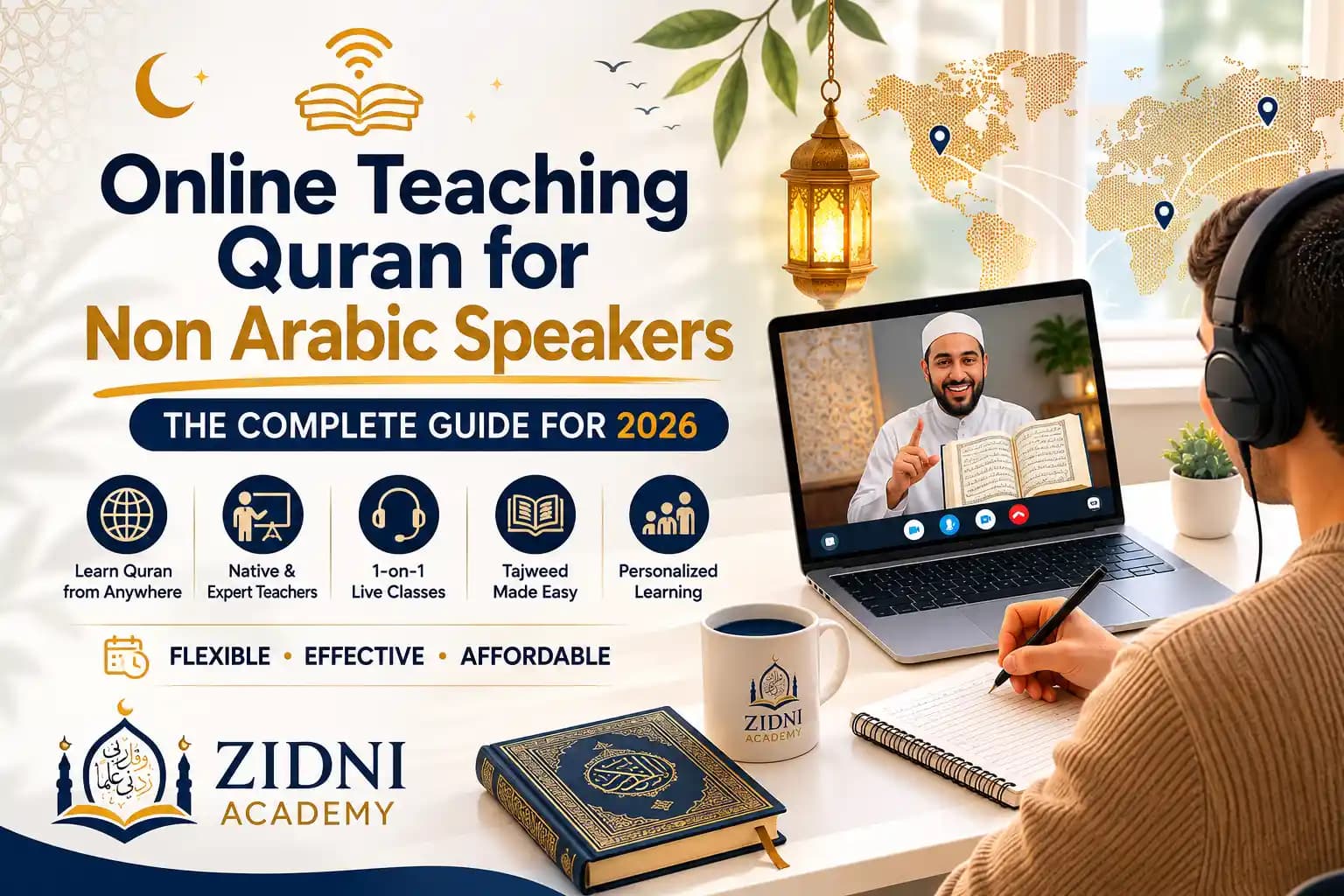
Online Teaching Quran for Non Arabic Speakers — The Complete Guide for 2026
Teaching Quran for non Arabic speakers has never been more accessible — or more important. Across the United States, United Kingdom, Canada, Australia, Belgium, and the Gulf, millions of Muslim families want their children and themselves to recite the Quran correctly, understand its meaning, and build a genuine connection with Allah's words — without Arabic being their first language. The challenge has always been finding the right teacher, the right method, and the right environment. This guide covers everything: the methods that work, the platforms to consider, how to choose a qualified tutor, and how to start today.
The Growing Need for Quran Education for Non-Arabic Speakers
The Muslim population in English-speaking countries is growing rapidly. In the United States alone, there are an estimated 3.45 million Muslims — many of them second and third generation immigrants whose first language is English, not Arabic. In the UK, Canada, Australia, and Belgium, the pattern is identical.
For these communities, access to authentic Quranic education has historically been limited to what was available locally — mosque circles, weekend Islamic schools, and community tutors of varying quality. The result: millions of Muslims who want to recite the Quran correctly but have never had access to a teacher qualified to make it happen.
Online teaching of Quran for non Arabic speakers solves this problem at its root. It removes the geographical barrier, the scheduling barrier, and often the quality barrier — connecting students directly with the most qualified teachers available, wherever those students happen to live.
Why Non-Arabic Speakers Face Unique Challenges in Quran Learning
Understanding why teaching Quran for non Arabic speakers requires a specialized approach is essential before choosing any program. The challenges are real — and a teacher who doesn't recognize them will not overcome them effectively.
Arabic is phonetically unfamiliar.
English has 26 letters. Arabic has 28 — several of which produce sounds that don't exist in English or most European languages. The letter ع (Ayn), ح (Ha), خ (Kha), غ (Ghayn), and ق (Qaf) require articulation from points in the throat that English speakers have never consciously used. Without a teacher who can demonstrate and correct these sounds live, non-Arabic speakers default to the closest English equivalent — which is always incorrect.
There are no visual cues from daily life.
Arabic-speaking children grow up surrounded by Arabic text — on signs, books, screens. Non-Arabic speakers have no such environmental support. Every exposure to Arabic script must come through deliberate study.
Motivation requires connection.
Non-Arabic speakers who are learning the Quran purely for recitation — without any connection to what the words mean — often struggle to maintain momentum. The best programs for teaching Quran for non Arabic speakers integrate meaning and context alongside recitation from the beginning.
Errors become habits quickly.
Without immediate correction from a qualified teacher, mispronounced letters and incorrect Tajweed applications become habitual within weeks. These habits are far harder to correct later than they are to prevent from forming in the first place.
How to Teach Quran to Non Arabic Speakers — The Right Method
Effective teaching of Quran for non Arabic speakers follows a clear, proven sequence. Here is the methodology that produces real, lasting results:
Phase 1 — Arabic Alphabet and Makharij (Articulation Points)
Before any Quran text, students learn the 28 Arabic letters — their names, their shapes in isolation and connected positions, and critically, their precise articulation points. This is not about memorizing a list. It is about training the mouth, tongue, throat, and lips to produce sounds they have never produced before. A skilled teacher demonstrates each sound, the student repeats, and the teacher corrects — in real time, in every session.
Phase 2 — Harakat and Basic Reading
The six vowel marks of Arabic (Fatha, Kasra, Damma, Sukun, Shadda, Tanween) are introduced and practiced on real Quranic words. By the end of this phase, students can read any fully vowelized Arabic text — including the Quran, which is always fully vowelized. This is the foundation of independent Quran reading.
Phase 3 — Tajweed Rules Applied in Context
Tajweed is introduced not as a separate advanced subject but as a natural part of reading from Phase 2 onward. The foundational rules — Nun Sakinah, Meem Sakinah, Madd, Waqf — are taught through actual Quranic verses. Non-Arabic speakers learn these rules with English explanations that connect each rule to its purpose, making them easier to remember and apply.
Phase 4 — Surah Recitation with Live Correction
Students recite from Juz Amma under their teacher's supervision. Every mispronunciation is caught and corrected immediately. Every Tajweed rule is applied in real recitation, not isolated exercises. By the end of this phase, students can recite short Surahs correctly and independently.
Phase 5 — Expanding to Longer Passages
Once foundational recitation is solid, students progress to longer Surahs and begin the optional path toward Hifz (memorization), Arabic language comprehension, or advanced Tajweed mastery.
5 Best Methods to Learn Quran for Non Arabic Speakers
1. One-on-One Live Sessions with a Certified Teacher
This is the gold standard for teaching Quran for non Arabic speakers — and for good reason. A private session with a qualified teacher means real-time correction, a curriculum adapted entirely to the student's level and pace, and the kind of focused attention that produces genuine progress. No other method produces the same results.
2. The Noorani Qaida Method
The Noorani Qaida is specifically designed for non-Arabic speakers learning to read the Quran. It introduces letters in a systematic, progressive sequence and teaches correct pronunciation from the very first lesson. Most certified online programs for teaching Quran for non Arabic speakers use the Noorani Qaida as the foundation for beginner instruction.
3. Transliteration as a Temporary Bridge
Transliteration — writing Arabic sounds in Latin letters — can be useful in the very early stages of learning, helping non-Arabic speakers begin to produce correct sounds before they can read Arabic script confidently. However, it must be used as a temporary bridge, not a permanent tool. Students who rely on transliteration long-term often struggle to transition to reading actual Arabic.
4. Audio Immersion with Active Repetition
Listening to high-quality Quranic recitations by certified Qaris — particularly Hafs 'an 'Asim, the most widely recited method — trains the ear before the tongue. Non-Arabic speakers who supplement their live sessions with regular listening to correct recitation progress significantly faster than those who only study theoretically.
5. Meaning-Connected Learning
The best programs for non-Arabic speakers connect recitation with basic meaning — explaining what is being recited, not just how to recite it. This builds motivation, deepens engagement, and creates the spiritual connection that makes Quran learning sustainable long-term.

Best Online Platforms for Teaching Quran to Non-Arabic Speakers
Choosing the right platform is the most important practical decision in the journey of teaching Quran for non Arabic speakers. Here is what to look for — and how the best platforms compare:
What matters most in a platform:
Teacher credentials
Does the platform employ teachers with formal qualifications from recognized institutions? Al-Azhar University in Egypt is the gold standard. An Al-Azhar degree means the teacher has studied Tajweed, Arabic, and Quranic sciences under a chain of transmission traceable back to the Prophet ﷺ.
Specialization in non-Arabic speakers
Not every Quran teacher is equipped to teach students who don't speak Arabic. A teacher who has spent years teaching Arabic-speaking students may not know how to explain Makharij in English, or how to bridge the phonetic gap for an American or British student.
1-on-1 private sessions
Group classes are significantly less effective for Quran learning, particularly for non-Arabic speakers who need individualized correction. A teacher who is listening to 10 students simultaneously cannot catch every pronunciation error from every student.
Bilingual instruction
Effective teaching of Quran for non Arabic speakers requires the ability to explain rules clearly in the student's language. Teachers who can switch fluidly between Arabic and English (or other languages) are far more effective for non-Arabic speaking students.
Flexible scheduling
Non-Arabic speakers in the US, UK, Canada, and Australia have time zone differences, work schedules, and family commitments that require genuine flexibility.
Zidni Academy
All 9 teachers hold Al-Azhar University degrees. Several specialize specifically in teaching non-native Arabic speakers, with thousands of hours of experience. All sessions are private 1-on-1, bilingual, and scheduled entirely around the student's availability. Starting from $7/hour with a free trial session.
How to Choose Quran Tutors for Non-Arabic Speaking Students
When selecting a tutor for teaching Quran for non Arabic speakers — whether for yourself, your child, or a family member — these are the questions that matter:
Does the tutor hold a formal qualification in Quranic sciences?
Ask specifically. "Experienced" is not a credential. An Al-Azhar degree, an Ijazah in Tajweed or Hifz, or an equivalent qualification from a recognized Islamic university is what verifies that the teacher's knowledge is authentic.
Has the tutor taught non-Arabic speakers specifically?
Ask how many non-Arabic speaking students the tutor has worked with, what their biggest challenges were, and how the tutor addressed them. A teacher with genuine experience in this area will answer these questions with specifics.
Does the tutor provide a structured curriculum or improvise?
Effective teaching of Quran for non Arabic speakers follows a clear progression. A tutor who cannot explain their curriculum — what you'll cover, in what order, and why — is unlikely to produce consistent results.
Is there a free trial available?
A qualified tutor with genuine experience teaching non-Arabic speakers is confident in their ability. Free trials are standard among the best platforms — and they give you direct experience of the teaching quality before any financial commitment.
At Zidni Academy, every sister and brother can book a free trial session with a certified Al-Azhar teacher — with no payment required and no commitment beyond the first session.
Top-Rated Digital Quran Courses for Beginners Who Don't Speak Arabic
For complete beginners — students who have never learned Arabic and have no prior Quran education — the following course types are the most effective starting points:
Qaida and Makharij Course — The foundational course for all non-Arabic speaking beginners. Covers the 28 Arabic letters, their articulation points, the Harakat, and basic reading fluency. This is the first step in every quality program for teaching Quran for non Arabic speakers.
Quran Recitation with Tajweed — Beginner — Introduces fundamental Tajweed rules through real Quranic verses. Designed for students who can already read Arabic letters but need structured Tajweed instruction.
Online Quran Classes for Kids — Child-specific beginner programs using the Noorani Qaida and age-appropriate teaching methods. Interactive, engaging, and designed around the learning patterns of young non-Arabic speaking students.
Arabic for Quran Understanding — For beginners who want to understand what they're reciting as well as how to recite it. Covers basic Quranic vocabulary and grammar alongside recitation instruction.
At Zidni Academy, every beginner course includes a free trial session, a personalized curriculum assessment in the first meeting, and monthly progress reports — making the path forward always clear, measurable, and motivating.
Affordable Quran Learning for English Speakers in the US, UK, Canada, and Australia
Cost is a genuine barrier for many families searching for quality Quran education for non Arabic speakers. Local Islamic schools and private tutors in major US and UK cities can charge $30–$80 per hour. Weekend Islamic school programs often cost $100–$300 per month for group instruction with limited individual attention.
Online certified instruction through platforms like Zidni Academy offers a genuinely different value proposition:
Plan | Rate | Best Suited For |
|---|---|---|
Starter | $8 / hour | Flexible sessions, first-time learners |
Advanced | $7.5 / hour | Committed students (10+ sessions/month) |
Family & Elite | $7 / hour | Families or 3+ month commitment |
For a family in New York, London, Toronto, or Sydney — $7–$8/hour for a certified Al-Azhar teacher in a private 1-on-1 session is significantly less than most locally available alternatives, while delivering higher teacher quality and greater scheduling flexibility.
✅ Free trial session with no upfront payment
✅ Male and female certified teachers available
✅ Monthly progress reports in writing
✅ Official completion certificate at end of every level
✅ Subscription freeze available when traveling
Interactive Software and Tools for Tajweed — What Actually Works
A wide range of apps and software claims to teach Tajweed to non-Arabic speakers. Understanding what these tools can and cannot do is essential for setting realistic expectations:
What apps and software can help with:
Learning letter shapes and names. Listening to correct Quranic recitations. Reviewing Tajweed rules in written form. Practicing Arabic letter recognition through games and exercises.
What apps and software cannot do:
Hear your recitation. Correct your pronunciation in real time. Identify the specific errors in your individual voice. Adapt to your learning pace, your weak areas, or your questions.
The most effective use of digital tools for teaching Quran to non Arabic speakers is as supplements to live instruction — not replacements. A student who uses apps to review between sessions and listen to correct recitations will progress faster. A student who relies on apps instead of a live teacher will develop incorrect habits that are difficult to undo.
Recommended supplementary tools:
Quran.com for following text alongside audio recitations. Tarteel AI for passive error feedback between sessions. Al Quran Studio for exploring Tajweed annotations in the Quranic text. These are all most effective when used alongside — not instead of — certified live instruction.
Subscription Services for Quran Memorization for Non-Arabs
Quran memorization (Hifz) presents unique challenges for non-Arabic speakers — and unique rewards. Memorizing the Quran in a language you don't natively speak requires more structured revision cycles, more frequent correction sessions, and a teacher who understands the specific memory patterns of non-Arabic speaking learners.
At Zidni Academy, the Hifz program for non-Arabic speakers follows the proven three-part structure:
Murajaah (Revision of Recent Memorization) — Every session opens with recitation of what was memorized in recent sessions, tested live by the teacher for accuracy, fluency, and correct Tajweed.
Sabt (Consolidation of Older Memorization) — Verses memorized weeks or months earlier are revisited on a rotating schedule to prevent decay. For non-Arabic speakers, this stage is particularly important — without it, memorized verses from unfamiliar language fade faster than they do for native speakers.
Hifz Jadid (New Memorization) — New verses are added only when the teacher confirms that existing memorization is solid. This protects the quality of the entire memorized portion.
For sisters pursuing Hifz, Zidni Academy's certified female teachers offer all of the above in fully private sessions — with an Ijazah pathway available for those who complete the advanced level and pass a full Quran review.
Choosing the Right Academy for Teaching Quran for Non Arabic Speakers
When evaluating any academy for teaching Quran for non Arabic speakers, use this checklist:
Teacher credentials verified?
All Zidni Academy teachers hold Al-Azhar University degrees — verifiable and documented.
Specialization in non-Arabic speakers?
Our teachers have collectively taught thousands of non-Arabic speaking students across the US, UK, Canada, Australia, UAE, Saudi Arabia, and the Gulf.
Private 1-on-1 sessions?
Every session at Zidni Academy is completely private — no group classes, no distractions.
Bilingual instruction?
All sessions conducted in both Arabic and English — full comprehension at every stage.
Female teachers for sisters?
Certified female Al-Azhar teachers available at all levels, in fully private sessions.
Free trial available?
One complete free trial session — no payment, no commitment.
Monthly progress reports?
Written progress reports every month — tracking mastered skills, corrected errors, and next steps.
Flexible scheduling across time zones?
Sessions available across all US, UK, Canadian, Australian, Gulf, and Arab world time zones.
How Zidni Academy Supports Non-Arabic Learners
Zidni Academy was built around one conviction: every Muslim who wants to recite the Quran correctly deserves access to a teacher qualified to make it happen — regardless of where they live, what language they speak natively, or what their budget is.
Our 9 Al-Azhar certified teachers include specialists in teaching non-native Arabic speakers at every level:
Teacher Hossam Othman — 7+ years, certified in the Ten Readings, has personally certified over 20 students in Quranic recitation.
Teacher Mohamed Yaseen — 9+ years, Al-Azhar graduate, Imam and preacher, certified in the Ten Readings and holds a TOT (Training of Trainers) certificate in memorization.
Dr. Yasser Bakri — Al-Azhar Faculty of Languages and Translation, ranked first in his class, certified in Prophetic Hadith — brings exceptional linguistic depth to Arabic sessions for non-native speakers.
Teacher Ahmed Mohamed — Faculty of Languages and Simultaneous Interpretation, fluent in four languages — bridges the language gap with particular effectiveness for English-speaking students.
Teacher Ilham Ahmed — Over 5,000 hours of online teaching experience, Al-Azhar graduate specializing in teaching Arabic and Quran to non-native speakers.
These are not general tutors. They are scholars — with the training, the credentials, and the specific experience to guide non-Arabic speakers from their very first Arabic letter to fluent, Tajweed-correct Quran recitation.
Conclusion — The Best Path for Non-Arabic Speakers Learning Quran
Teaching Quran for non Arabic speakers is not a compromise or a workaround. It is a full, authentic Islamic education — adapted for the phonetic starting point, the learning environment, and the life circumstances of students who were not raised with Arabic as their first language.
The tools are better than ever. The platforms are more accessible than ever. And the teachers — when you choose correctly — are as qualified as any who have ever taught the Quran.
What has not changed is the principle: the Quran is learned from a teacher. Not from an app. Not from a book. Not from a YouTube video. From a certified human being who hears your voice, knows your errors, and guides you — verse by verse — toward the recitation that every Muslim deserves to achieve.
At Zidni Academy, that teacher is ready for you. And your first session is free.
🔗 Explore Zidni Academy Courses for Non-Arabic Speakers
- Learn Quran With Tajweed Online — Beginner
- Learn To Read Quran Online — Beginner
- Online Quran Classes for Kids
- Online Quran Classes for Adults
- Online Quran Classes for Sisters
- Islamic Online Classes
Frequently Asked Questions
Q: What are the best online platforms for teaching Quran to non-Arabic speakers?
The best platforms combine certified Al-Azhar teachers, private 1-on-1 sessions, bilingual instruction, and flexible scheduling. Zidni Academy meets all four criteria — with 9 Al-Azhar certified teachers who specialize in teaching non-native Arabic speakers, available from $7/hour with a free trial session.
Q: What are the best online platforms for teaching Quranic Arabic to beginners?
Look for platforms that begin with the Arabic alphabet and Makharij — not with the Quran text directly. Zidni Academy's beginner program starts from the very first letter, using the Noorani Qaida and live 1-on-1 correction to build correct pronunciation from day one.
Q: Are there affordable Quran learning options for English speakers in the US?
Yes. Zidni Academy offers certified Al-Azhar instruction from $7/hour — significantly less than most private local tutors in US cities, with higher teacher quality and complete scheduling flexibility. A free trial session is available with no upfront payment.
Q: What are the best apps for learning Quranic pronunciation for English speakers?
Apps like Quran.com and Tarteel AI are useful supplements for listening and review. However, they cannot correct your pronunciation in real time. For genuine progress in Quranic pronunciation, a certified live teacher is essential. Apps work best as tools used between live sessions.
Q: How do I choose Quran tutors for non-Arabic speaking students?
Prioritize Al-Azhar certification or equivalent formal qualification. Ask specifically about experience teaching non-Arabic speakers. Ensure the tutor offers bilingual instruction and a structured curriculum. Book a free trial session before committing. Zidni Academy's teachers meet all of these criteria.
Q: How do I compare online Quran tutors for non-native Arabic speakers?
Compare teacher credentials (Al-Azhar or equivalent), session format (1-on-1 vs group), language of instruction (bilingual vs Arabic only), scheduling flexibility, and cost. Zidni Academy offers the highest standard across all five criteria for students in the US, UK, Canada, Australia, and the Gulf.
Q: Where can I find interactive Quran teaching tools for non-Arabic speakers?
Supplementary tools include Quran.com (for text and audio), Tarteel AI (for passive pronunciation feedback), and Al Quran Studio (for Tajweed annotation). These work best alongside live certified instruction — not as replacements for it.
Q: Are there subscription services for Quran memorization for non-Arabs?
Yes. Zidni Academy offers structured Hifz programs with certified teachers who use the proven three-part revision model (Murajaah, Sabt, Hifz Jadid) — adapted specifically for non-Arabic speakers. Plans start from $7/hour, with a free trial available.
Q: How long does teaching Quran for non Arabic speakers take to show results?
Most non-Arabic speaking beginners can read basic Arabic text within 4 to 8 weeks of consistent sessions. Foundational Tajweed rules and short Surah recitation typically take 3 to 6 months with 2 to 3 sessions per week. Your Zidni teacher provides a personalized timeline after the first assessment session.
Q: Can non-Arabic speakers pursue Ijazah in Quranic recitation?
Yes. Ijazah is not limited to native Arabic speakers. Several of Zidni Academy's teachers hold Ijazah with a connected Sanad and can guide non-Arabic speaking students through the full advanced program — toward formal Ijazah certification upon completing the required full Quran review.