
Moon Letters and Sun Letters in Arabic: A Simple Guide for Kids
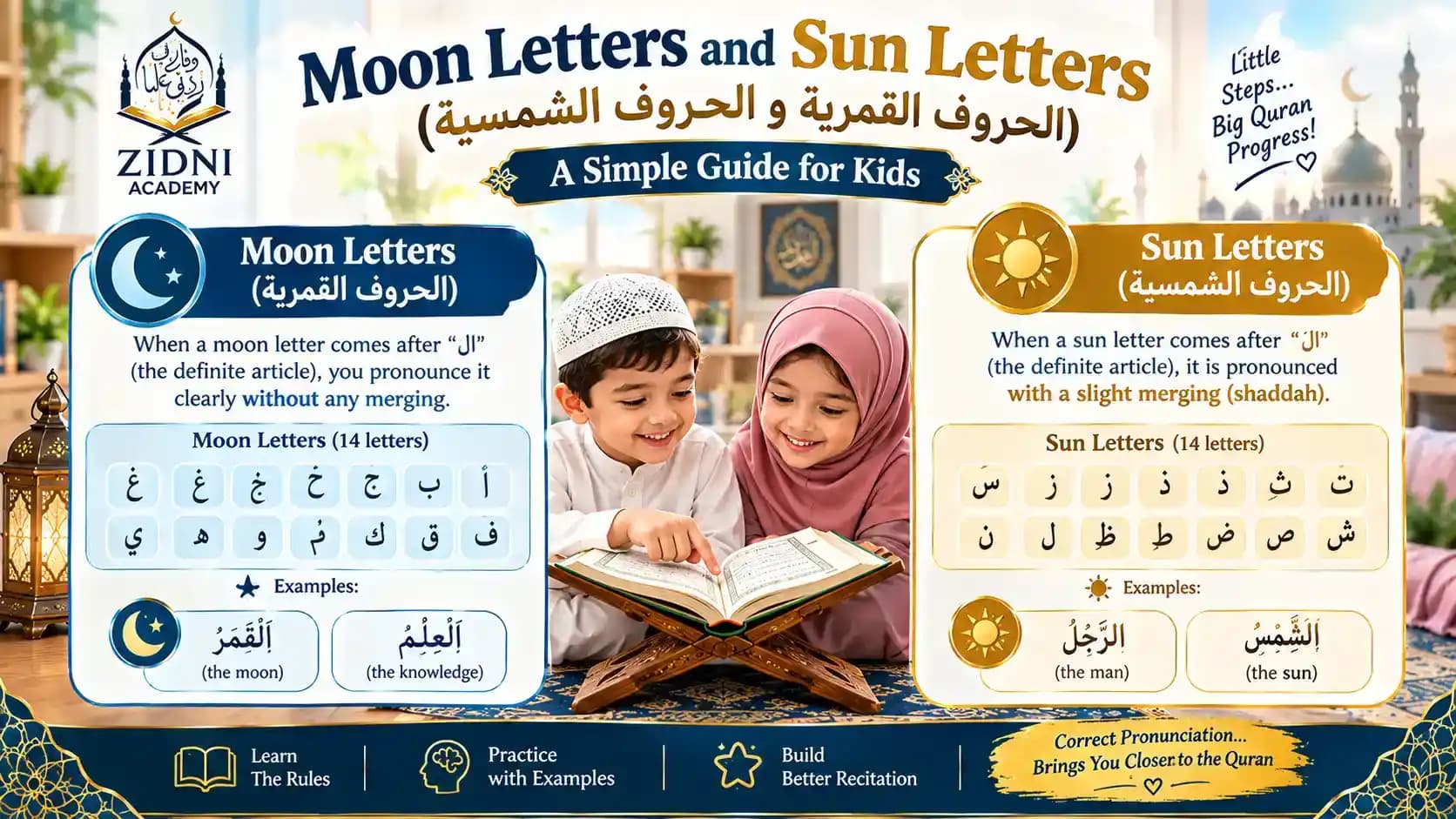
Moon Letters and Sun Letters in Arabic: A Simple Guide for Kids
Moon letters and sun letters in Arabic are one of the first pronunciation rules children encounter when they begin reading Arabic. They explain why the Arabic definite article ال sounds different in words such as الشَّمْس (ash-shams, “the sun”) and الْقَمَر (al-qamar, “the moon”). The good news is that the rule is much easier than it first appears: the 28 Arabic letters are divided into 14 sun letters and 14 moon letters. Once children understand what happens to the ل in ال, they can recognize and pronounce these words much more confidently.
What Are Moon Letters and Sun Letters in Arabic?
In Arabic, moon letters and sun letters describe how the definite article ال is pronounced when it comes before a word.
The Arabic alphabet contains 28 basic letters. These letters are traditionally divided into two equal groups:
- 14 sun letters — the ل in ال is not pronounced separately, and the following letter takes a shaddah.
- 14 moon letters — the ل in ال remains clearly pronounced.
This is a pronunciation rule, not a change in spelling.
For children, the easiest way to understand it is:
Moon letter = you hear the “l” in al-
Sun letter = the “l” merges into the next letter.
That simple distinction makes the rest of the lesson much easier.
What Is the Arabic Definite Article ال?
Before learning the two groups, children need to understand ال.
In English, we often use “the” to make a noun definite:
- a book → the book
- a house → the house
Arabic uses ال before many nouns to express the definite meaning:
- كِتَاب → الْكِتَاب — al-kitāb — the book
- بَيْت → الْبَيْت — al-bayt — the house
But the pronunciation of ال changes depending on the first letter of the word.
That is where sun letters and moon letters become important.

What Are the Moon Letters in Arabic?
Moon letters are the 14 Arabic letters that allow the ل in ال to be pronounced clearly.
The 14 moon letters are:
أ، ب، ج، ح، خ، ع، غ، ف، ق، ك، م، هـ، و، ي
A useful example is:
قَمَر → الْقَمَر
qamar → al-qamar
Meaning:
moon → the moon
The ل is clearly heard:
al-qamar
This is why قمر (qamar) is used as the classic memory example for the moon-letter group.
Moon Letters in Arabic With Examples and Meanings
Moon Letter | Arabic Example | Pronunciation | Meaning |
|---|---|---|---|
أ | الْأَسَد | al-asad | the lion |
ب | الْبَيْت | al-bayt | the house |
ج | الْجَمَل | al-jamal | the camel |
ح | الْحِصَان | al-hisān | the horse |
خ | الْخُبْز | al-khubz | the bread |
ع | الْعَيْن | al-ayn | the eye |
غ | الْغُرْفَة | al-ghurfah | the room |
ف | الْفَم | al-fam | the mouth |
ق | الْقَمَر | al-qamar | the moon |
ك | الْكِتَاب | al-kitāb | the book |
م | الْمَاء | al-mā’ | the water |
هـ | الْهِلَال | al-hilāl | the crescent |
و | الْوَرَق | al-waraq | the paper/leaves |
ي | الْيَد | al-yad | the hand |
The important pattern is the same in every example:
ال + moon letter → pronounce the ل clearly.
What Are the Sun Letters in Arabic?
Sun letters are the 14 Arabic letters that cause the ل in ال to assimilate into the following letter.
The 14 sun letters are:
ت، ث، د، ذ، ر، ز، س، ش، ص، ض، ط، ظ، ل، ن
When ال comes before one of these letters, the ل is written but is not pronounced as a separate l sound. The following letter receives a shaddah.
For example:
شَمْس → الشَّمْس
shams → ash-shams
Meaning:
sun → the sun
You do not pronounce it:
❌ al-shams
Instead, you hear:
✅ ash-shams
This is the classic example that gives the group its name.

Sun Letters in Arabic With Examples and Meanings
Sun Letter | Arabic Example | Pronunciation | Meaning |
|---|---|---|---|
ت | التِّين | at-tīn | the fig |
ث | الثَّوْب | ath-thawb | the garment |
د | الدَّار | ad-dār | the house |
ذ | الذَّهَب | adh-dhahab | the gold |
ر | الرَّجُل | ar-rajul | the man |
ز | الزَّهْرَة | az-zahrah | the flower |
س | السَّمَك | as-samak | the fish |
ش | الشَّمْس | ash-shams | the sun |
ص | الصَّبْر | as-sabr | patience |
ض | الضَّوْء | ad-daw’ | the light |
ط | الطَّرِيق | at-tarīq | the road |
ظ | الظَّل | az-zill | the shade |
ل | اللَّيْل | al-layl | the night |
ن | النُّور | an-nūr | the light |
The key pattern is:
ال + sun letter → the ل merges with the following letter.
How Many Sun Letters and Moon Letters Are There in Arabic?
There are:
- 14 sun letters
- 14 moon letters
- 28 Arabic letters in total
So the two groups are equal.
How many sun letters and moon letters are there in Arabic?
14 sun letters + 14 moon letters = 28 letters.
The division affects the pronunciation of ال, not the spelling of the Arabic alphabet itself.
Sun Letters and Moon Letters in Arabic: The Easiest Comparison
The entire rule can be understood with two words:
الشَّمْس — Ash-Shams
ش is a sun letter.
So:
ال + شمس → الشَّمْس
The ل is not pronounced separately.
الْقَمَر — Al-Qamar
ق is a moon letter.
So:
ال + قمر → الْقَمَر
The ل is pronounced clearly.
Sun Letter | Moon Letter | |
|---|---|---|
Arabic term | حروف شمسية | حروف قمرية |
Number | 14 | 14 |
What happens to ل? | It merges | It remains audible |
Shaddah? | On the following letter | No assimilation |
Example | الشَّمْس | الْقَمَر |
Pronunciation | ash-shams | al-qamar |
This is the most important table for a beginner to remember.
Why Are They Called Sun Letters and Moon Letters?
The names themselves provide a memory trick.
The Arabic word for sun is:
شَمْس — shams
When ال is added:
الشَّمْس — ash-shams
The ش is a sun letter.
The Arabic word for moon is:
قَمَر — qamar
When ال is added:
الْقَمَر — al-qamar
The ق is a moon letter.
So children can remember:
الشَّمْس → sun-letter example
الْقَمَر → moon-letter example
This is more useful than asking a young learner to memorize two unrelated lists.
How Can Children Remember the Sun Letters?
Memorizing 14 letters can seem difficult at first, so give children a system rather than asking them to repeat a list without context.
One traditional mnemonic for the sun letters is:
ت ث د ذ ر ز س ش ص ض ط ظ ل ن
A child can practice them in small groups rather than trying to memorize all 14 at once.
For example:
ت ث د ذ
then:
ر ز س ش
then:
ص ض ط ظ
then:
ل ن
After learning each group, practice it inside actual words.
That is much more effective than memorizing the letters without hearing them.
How Can Children Remember the Moon Letters?
The same approach works for moon letters:
أ ب ج ح خ
ع غ ف ق ك
م هـ و ي
Then give the child simple words:
- الْبَيْت
- الْجَمَل
- الْقَمَر
- الْكِتَاب
- الْوَلَد
- الْيَد
Ask:
Can you hear the “l” in al-?
If the child can hear it clearly, the word begins with a moon letter.
A Simple Trick for Kids: Look at the Shaddah
For young readers, the shaddah is one of the most useful visual clues.
Look at:
الشَّمْس
The ش has a shaddah.
Look at:
الْقَمَر
The ق does not have a shaddah caused by the sun-letter rule.
So children can learn this visual connection:
Sun letter → following letter has shaddah
Moon letter → ل is pronounced
This gives the child both an ear-based clue and a visual clue.
Sun Letters and Moon Letters in Arabic With Meaning
A common question from parents is whether these letters have special meanings themselves.
The answer is no.
“Sun letters” and “moon letters” are names for two pronunciation categories. The individual letters do not mean “sun” or “moon.”
For example:
- ش is a sun letter.
- ق is a moon letter.
But the letter ش does not mean “sun,” and ق does not mean “moon.”
The names come from the example words الشَّمْس and الْقَمَر.
This distinction is important for children because they should learn the rule as a pronunciation pattern rather than thinking the letters have special vocabulary meanings.
Does the Rule Change the Spelling?
No.
This is one of the most important points for children learning to read Arabic.
The ل in ال is still written.
For example:
الشَّمْس
The ل is visible.
But in pronunciation, it is assimilated into ش.
Likewise:
الطَّالِب
The ل is written, but the ط carries the shaddah.
With moon letters:
الْبَيْت
the ل is both written and pronounced.
So:
Writing stays consistent.
Pronunciation changes.
Is This Rule Important for Children Learning Quranic Arabic?
Yes.
Children encounter the definite article ال frequently when reading Arabic and the Quran. Learning the distinction early can help them recognize why the same written article may sound different in connected reading.
For children learning Quran recitation, the rule also connects naturally with the broader study of correct pronunciation and Tajweed.
But parents should avoid turning the lesson into a difficult grammar lecture.
A young learner usually benefits more from:
See → Hear → Repeat → Identify → Read
than from memorizing a long grammatical explanation.
How Sun and Moon Letters Help a Child Read the Quran
When a child reads Quranic Arabic, they repeatedly encounter words beginning with ال.
For example:
الشَّمْس
النَّاس
الرَّحْمَٰن
الْحَمْد
الْعَالَمِينَ
A child who understands the rule can begin to recognize the pronunciation pattern instead of treating every word as completely new.
This does not mean sun and moon letters are the whole of Tajweed. They are one foundational pronunciation concept among many others.
For a child who is still building Arabic reading skills, it makes sense to establish the alphabet, vowel marks, pronunciation, and basic reading foundation before expecting them to master more complex rules.
What Is the Best Age to Learn Sun and Moon Letters?
There is no single age that works for every child.
A child who already recognizes Arabic letters may be ready to learn the concept earlier than a child who is still learning the alphabet.
A practical progression is:
Ages 4–6
Focus on:
- Arabic letter recognition
- listening
- repetition
- simple vocabulary
- short, engaging activities
Ages 6–8
Introduce:
- the definite article ال
- simple sun and moon examples
- identifying the first letter
- hearing the difference between al- and assimilated pronunciation
Ages 8–12
Children can usually handle:
- full letter lists
- written examples
- pronunciation exercises
- reading short Quranic passages
- simple Tajweed connections
The important point is not the number on the child's birthday. It is whether the child is ready for the level of explanation and practice.
A 10-Minute Sun and Moon Letters Activity for Kids
Parents can turn the lesson into a short game.
Minute 1–2: Review
Ask the child:
What is ال?
Then explain:
It can mean “the” before a noun.
Minute 3–4: Two examples
Write:
الشَّمْس
الْقَمَر
Ask the child to listen.
Minute 5–6: Identify
Show:
الكتاب
Ask:
Moon or sun?
Answer:
Moon, because ك is a moon letter.
Minute 7–8: Another example
Show:
النور
Ask:
Moon or sun?
Answer:
Sun, because ن is a sun letter.
Minute 9–10: Reading
Let the child read five words aloud.
Do not correct every tiny detail at once.
Choose one or two errors and repeat them together.
That keeps the lesson educational without making the child anxious.
Sun and Moon Letters Quiz for Kids
Try these before looking at the answers.
Question 1
Is ش a sun letter or moon letter?
Question 2
Is ق a sun letter or moon letter?
Question 3
How do you pronounce:
الشَّمْس
Question 4
How do you pronounce:
الْقَمَر
Question 5
Is ك a sun letter or moon letter?
Question 6
Is ن a sun letter or moon letter?
Answers
- ش = Sun
- ق = Moon
- ash-shams
- al-qamar
- ك = Moon
- ن = Sun
If a child gets several wrong, that does not mean they are struggling with Arabic. It usually means they need more listening and repetition.
Common Mistakes Children Make
Saying al-shams instead of ash-shams
A child may see ال and automatically pronounce the ل.
The correction is to draw attention to the shaddah on ش.
Forgetting the shaddah
Children may pronounce the first consonant too lightly.
Practice:
شَمْس
then:
الشَّمْس
Memorizing the list without using words
A child may memorize 14 letters and still fail to recognize them during reading.
Always connect the letter to a real example.
Confusing spelling with pronunciation
Explain that the ل remains written even when it is not pronounced separately.
Learning too many rules at once
Sun and moon letters are easier when taught as one small skill before adding more Arabic grammar or Tajweed rules.
What Is the Best Way to Teach Moon Letters and Sun Letters in Arabic to Kids?
The best approach is not simply to give children a list of 28 letters.
Use a five-step process:
1. Introduce ال
Teach the child what the definite article does.
2. Teach the two examples
Use:
الشَّمْس
and
الْقَمَر
3. Explain the sound
Sun → ل merges
Moon → ل is heard
4. Practice with real words
Use familiar vocabulary.
5. Read short Arabic or Quranic examples
This transfers the rule from a worksheet into actual reading.
Children learn pronunciation skills through repeated listening and speaking, so correction matters just as much as explanation.
Why a Teacher Can Help With Arabic Pronunciation
A parent can explain the rule, but it is often difficult to hear every pronunciation problem in a child's Arabic reading.
A teacher can listen for:
- whether the ل is being pronounced correctly;
- whether the shaddah is clear;
- whether the child is confusing similar Arabic sounds;
- whether the child recognizes the first letter;
- whether the child is reading from understanding or simply memorizing patterns.
This is especially valuable for families in the USA and UK who may not have an Arabic-speaking teacher available locally.
For parents who want a structured Quran-reading foundation rather than isolated vocabulary exercises, Noorani Qaida classes for kids and adults can provide a more systematic starting point for Arabic letters, pronunciation, and essential Tajweed.
How Zidni Academy Can Help Your Child Learn Arabic Reading
Learning moon letters and sun letters in Arabic is much easier when the child learns the rule as part of a broader reading journey.
At Zidni Academy, children learn through private, live online lessons designed around their current level. The academy combines qualified Al-Azhar teachers with interactive teaching methods, personalized attention, flexible scheduling, and progress tracking for parents.
For a child who is still building the basics, the natural starting point is not advanced grammar. It is learning the Arabic letters, pronunciation, reading patterns, and then gradually applying rules such as sun and moon letters.
This is why a parent may choose a structured online Quran program for kids rather than trying to teach every Arabic pronunciation rule independently at home.
The goal is not simply for a child to memorize:
“14 sun letters and 14 moon letters.”
The real goal is for the child to look at:
الشَّمْس
and automatically read it correctly.
Then look at:
الْقَمَر
and automatically pronounce the ل.
That is the difference between memorizing a rule and actually learning it.
What Parents in the USA and UK Should Look For
When choosing online Arabic or Quran lessons for a child, parents should look beyond the lesson price.
Ask:
- Is the teacher experienced with children?
- Can the teacher communicate clearly in English when needed?
- Does the child receive individual attention?
- Is pronunciation corrected during the lesson?
- Is the curriculum structured?
- Does the teacher adapt the lesson to the child's age?
- Can parents see their child's progress?
- Are lesson times suitable for the family's time zone?
- Is there a trial lesson before making a commitment?
These questions matter because a child may understand a worksheet but still pronounce the Arabic incorrectly.
A live teacher can hear the difference immediately and correct it while the child is learning the rule.
From Sun and Moon Letters to Confident Arabic Reading
Sun and moon letters are only one step in the child's Arabic-learning journey.
A strong progression may look like this:
Arabic letters
↓
Letter sounds and pronunciation
↓
Harakat
↓
Reading simple words
↓
Moon and sun letters
↓
Basic Tajweed
↓
Reading Quranic words
↓
Short Surahs
↓
Confident Quran recitation
This progression helps prevent a common problem: asking a child to memorize Quran before they have a stable reading foundation.
Once the child can recognize Arabic letters and pronounce them correctly, later Quran learning becomes much more manageable.
Frequently Asked Questions
What are moon letters and sun letters in Arabic?
They are two groups of 14 Arabic letters that determine how the ل in the definite article ال is pronounced. With moon letters, the ل is pronounced clearly. With sun letters, it assimilates into the following letter, which carries a shaddah.
How many sun letters and moon letters are there in Arabic?
There are 14 sun letters and 14 moon letters, making 28 letters altogether.
What are the 14 sun letters in Arabic?
The 14 sun letters are:
ت، ث، د، ذ، ر، ز، س، ش، ص، ض، ط، ظ، ل، ن
What are the 14 moon letters in Arabic?
The 14 moon letters are:
أ، ب، ج، ح، خ، ع، غ، ف، ق، ك، م، هـ، و، ي
Why is it called a sun letter?
The name comes from the word الشَّمْس (ash-shams), meaning “the sun.” The first letter ش belongs to the sun-letter group and demonstrates the assimilation of the ل.
Why is it called a moon letter?
The name comes from الْقَمَر (al-qamar), meaning “the moon.” The first letter ق belongs to the moon-letter group, so the ل in ال remains clearly pronounced.
Do sun and moon letters change the spelling?
No. The letters are still written the same way. The difference is in pronunciation.
Are sun and moon letters important for Quran reading?
Yes. Children encounter many words beginning with ال when reading Arabic and Quranic text, so understanding the pronunciation pattern can support more accurate reading. It is one foundational concept among the broader skills required for Quran recitation.
Can a child learn sun and moon letters at home?
Yes. Parents can teach the basic concept through short games, examples, listening, and repetition. However, a teacher is useful when the child needs consistent pronunciation correction or is progressing into structured Quran reading and Tajweed.
What is the easiest way for children to remember sun and moon letters?
Start with the two anchor words:
الشَّمْس — sun
الْقَمَر — moon
Then teach the letters in small groups and practice them in real words rather than memorizing the entire list without context.
Is this the same as Lam Shamsiyyah and Lam Qamariyyah?
Yes. Lam Shamsiyyah refers to the assimilation of the ل before a sun letter, while Lam Qamariyyah refers to the clearly pronounced ل before a moon letter.
Help Your Child Build a Strong Arabic Reading Foundation
If your child is beginning Arabic or Quran reading, mastering one small rule at a time is far more effective than trying to memorize everything at once.
Moon letters and sun letters in Arabic are an excellent example: the rule is simple, but learning it through listening, speaking, reading, and correction helps turn it into an automatic skill.
At Zidni Academy, children can learn through private online lessons with qualified teachers, with lessons adapted to the child's level and regular progress tracking for parents. The academy specifically describes its children's programs as interactive, personalized, and suitable for families in the USA, UK, and other time zones.
If you're unsure whether your child should begin with Arabic letters, Noorani Qaida, Quran reading, or a more advanced level, a free trial lesson is a practical way to let a teacher assess the child's starting point before you choose a program.
Give your child the right foundation first — then let every new Arabic rule become easier.