
Online Quran Classes Australia: A Complete Guide for Families
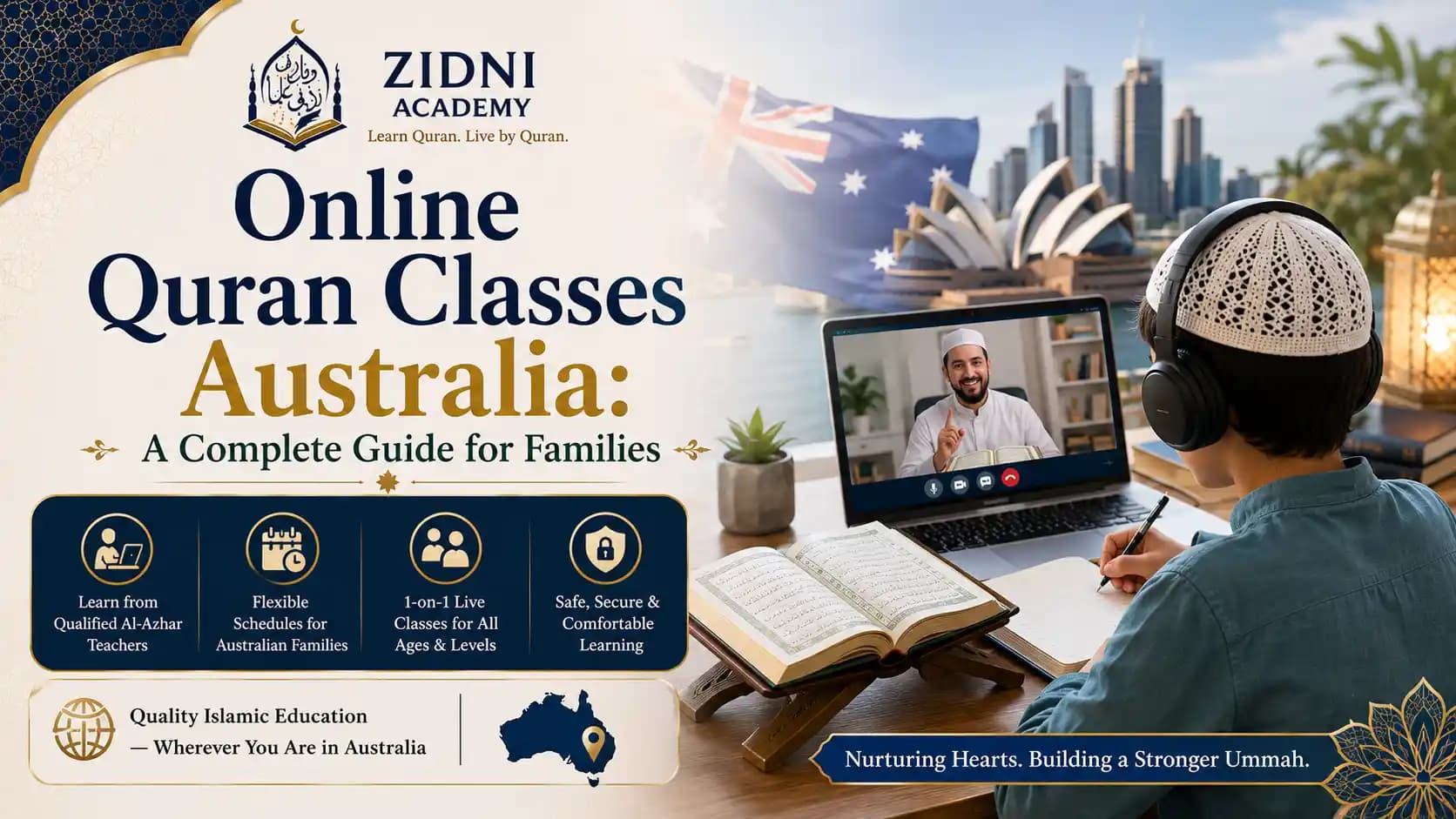
Online Quran Classes Australia: A Complete Guide for Families
Australia is home to over 800,000 Muslims, yet mosques and Islamic centres remain far apart across a genuinely vast country, which is exactly why online Quran classes Australia families rely on have grown so quickly. Between long commutes, regional isolation, and packed work schedules, learning from home has become the practical choice for both kids and adults. This guide covers what actually matters when choosing a provider, answers the Tajweed and app questions Australian families ask most, and shows how Zidni Academy approaches each of these points.
Online Quran Classes Australia: Why Families Are Choosing to Learn From Home
Families across Sydney, Melbourne, Brisbane, Perth, and Adelaide increasingly choose online learning not out of preference alone, but necessity. Many suburbs with strong Muslim communities, like Lakemba, Broadmeadows, and Logan, still sit a genuine drive from the nearest Islamic centre, and regional and rural families often have no local option at all.
The Real Barrier Isn't Interest, It's Access
Parents frequently want structured Quranic education for their children but can't manage the school run, work hours, and a weekend Islamic school schedule all at once. Online classes remove that logistical barrier entirely, bringing a qualified teacher directly into the home instead of requiring the family to travel to one.
Regional and rural families face this gap most acutely, since even a strong commitment to Quranic education doesn't help when the nearest qualified teacher is several hours away. Online classes level this out completely, giving a family in outback Queensland or regional Western Australia access to the same Al-Azhar-trained teachers available to a family in central Sydney.
Which App Is Best for Online Quran Teaching?
The most commonly recommended apps are the official Quran.com app, Muslim Pro, and Tarteel, each useful for daily reading, memorisation tracking, and basic AI-assisted pronunciation feedback. Several well-known reciters and scholars, including Mufti Menk, have their lectures and recitations available through mainstream Quran apps and YouTube, which is often what people are actually looking for when searching for a specific app.
Free Quran apps genuinely exist and work well for reading along and building a daily habit, but none of them replace live correction from a real teacher, since an app can flag that a word sounds off without ever explaining why or demonstrating the correct fix.
Can I Learn Tajweed Online for Free?
Free resources, including YouTube channels, community sessions, and basic reading guides, can get a motivated beginner through the earliest stages of learning Tajweed rules. Where free resources consistently fall short is live correction, since it's very difficult to hear your own pronunciation mistakes accurately without someone else listening in real time.
Most people who start with free resources eventually bring in a qualified teacher once progress plateaus, not because the free material was wrong, but because it can't catch mistakes a trained ear picks up immediately.
Can I Learn Tajweed by Myself?
Technically yes, and many people try, particularly using books and apps for the theory side of Tajweed rules. Self-study works reasonably well for memorising rule names and definitions, all of which can be learned independently at your own pace.
Why Self-Study Alone Has a Ceiling
Applying those rules correctly in live recitation is a different skill entirely, and it's where self-taught learners consistently get stuck. A learner can practise the same pronunciation error for months without realising it, since there's no one there to correct it in the moment, which is exactly the gap a qualified teacher closes.
What Are the Rules of Tajweed?
Tajweed rules are generally grouped into a few core categories rather than one fixed universal list of seven. These typically include the rules of Noon Sakinah and Tanween (Izhar, Idgham, Iqlab, and Ikhfa), the rules of Meem Sakinah, Qalqalah (the slight bounce on certain letters), rules of Madd (elongation), and Ghunnah (the nasal sound accompanying certain letters).
Understanding these categories helps explain why Tajweed is called "Tajweed" in English too, since there's no single-word English translation; it's typically described as "the rules of Quranic recitation" or simply kept as the Arabic term, since it refers to a specific, technical skill rather than a general concept.
Finding the Best Online Quran Classes in Australia
With so many platforms claiming to be the best online Quran classes Australia has to offer, a few concrete checks separate a strong provider from a weak one. Verifiable teacher credentials come first, ideally Al-Azhar training or a documented Ijazah, rather than a vague "certified" label with nothing behind it.
Confirm sessions are genuinely one-to-one rather than bundled into a larger group under a "personalised" label, and check that scheduling actually accounts for Australian time zones rather than assuming a single overseas time slot works nationwide. A free trial before any payment remains the clearest way to judge whether a provider's teaching actually matches its marketing.
Online Quran Classes for Kids in Australia
Children need a genuinely different teaching approach to adults, not simply a shorter version of the same lesson. The strongest programmes use short, engaging sessions with visual aids and repetition games, taught by teachers specifically trained to hold a young child's attention over video call.
Both male and female teachers are typically available, which matters to many Australian families, and a properly structured beginner curriculum starts with Noorani Qaida, building correct Arabic letter recognition before any actual Quran reading begins.
Online Quran Classes for Adults in Australia
Adult students generally want faster pacing and a direct explanation of the reasoning behind each Tajweed rule, rather than simplified analogies aimed at children. A significant number of adult learners in Australia are reverts or Muslims who never had access to formal Quran education growing up, and a good teacher paces the earliest sessions accordingly.
Flexible morning, evening, and weekend scheduling matters enormously for working adults balancing a full-time job with study, which is exactly where a rigid, overseas-timed provider tends to lose students within the first few months.
Choosing the Right Fit for Your Family
What Genuine Online Quran Classes Australia Families Trust Look Like
Beyond credentials and scheduling, the strongest programmes track progress transparently, share regular updates with parents, and adjust pacing to the individual student rather than pushing everyone through an identical timeline. A provider that treats a missed session as a normal part of busy Australian family life, rescheduling rather than penalising, tends to keep students enrolled far longer than a rigid, one-size-fits-all platform.
Meet the Teachers
At Zidni Academy, every teacher is a native Arabic speaker, and most are graduates of Al-Azhar University, the institution most academies point to as the benchmark for Quranic education. Several hold Ijazah with a documented chain of transmission, and each is assessed on Tajweed mastery and teaching methodology before joining the platform. Full profiles are available on the teachers page.
Courses for Every Level
Most students begin with Noorani Qaida, building correct letter pronunciation before real recitation starts.
From there, a dedicated Tajweed course covers the rules discussed above in proper depth, tied to real verses rather than taught as an abstract list.
Memorisation and Kids Programmes
Students focused on memorisation typically progress into a structured Quran memorisation course once Tajweed is solid.
Children usually start with a dedicated Quran course for kids built around shorter attention spans and age-appropriate teaching methods.
Scheduling Across Australian Time Zones
Australia spans three time zones, AEST, ACST, and AWST, which genuinely matters when a provider's default scheduling is built around an overseas teacher's convenience rather than Australian hours. A well-run programme offers morning, evening, and weekend slots that fit around Australian school and work schedules specifically.
How Much Do Online Quran Classes Cost in Australia?
Pricing varies considerably across providers. Some platforms advertise sessions from as little as AUD $3 to $5, though these rates typically come from larger group classes or less experienced tutors with limited vetting behind them. One-to-one sessions with Ijazah-certified, Al-Azhar-trained teachers generally sit higher, reflecting both the credentials involved and the individual attention each session provides.
Sibling Discounts and Family Plans
Most reputable academies offer sibling discounts for families enrolling more than one child, often reducing the fee for the second and subsequent children by a meaningful margin. A free trial session before committing to any monthly plan remains the clearest way to judge whether a given price genuinely reflects the quality of instruction on offer, rather than relying on advertised rates alone.
Female Teachers for Sisters and Young Girls
Many Australian families specifically look for a female teacher, whether for a young daughter or for a mother wanting to learn herself in a setting she's comfortable with. Reputable academies offer this as standard, not as a special request buried in the fine print, with female teachers holding the same credentials and vetting as their male counterparts.
This matters particularly for families in smaller regional communities, where a local option with both male and female teachers available simply doesn't exist, and the flexibility to choose becomes one of the clearest advantages of learning online over a fixed local class.
What a Typical First Session Looks Like
The first session usually starts with a relaxed assessment rather than diving straight into a fixed curriculum. The teacher listens to the student read or recite, gauges comfort with Arabic letters and pronunciation, and asks about specific goals, whether that's correcting recitation, starting memorisation, or simply building a consistent habit for the first time.
Setting Realistic Expectations From Day One
From there, a realistic pace is set based on the student's actual starting point and available weekly time, rather than a generic timeline applied to every student regardless of background. This first session also gives the family a genuine feel for the teacher's style, which matters just as much as their qualifications when it comes to whether a child or adult actually looks forward to the next session.
Comparing Your Options
What matters | Zidni Academy | Free Community Classes | Freelance Tutor |
|---|---|---|---|
Verified credentials | Al-Azhar graduates, Ijazah-certified | Varies | Rarely verifiable |
Class format | One-to-one | Usually group | One-to-one, unstructured |
Australian time zones | Fully accommodated | Fixed local schedule | Ad hoc |
Free trial | Yes | Not applicable | Rarely offered |
Book Your Free Trial Session
The clearest way to judge whether a programme is right for your family is to sit in a session yourself. Book a free trial session today and see the teaching style and curriculum firsthand before committing to a paid plan.
Online Tajweed Classes Australia
Our online Tajweed classes in Australia help children and adults improve their Quran recitation from the comfort of home. With qualified teachers, personalized lessons, and flexible scheduling, students can learn Tajweed rules step by step, correct their pronunciation, and develop greater confidence in reading the Quran accurately. Whether you are a beginner or looking to improve your existing recitation skills, our online classes provide structured Quran learning suitable for students across Australia.
Frequently Asked Questions
How long does a Tajweed course typically take?
Most students build a solid foundation within four to eight months of consistent weekly sessions, though mastery continues to develop with ongoing practice well beyond the course itself.
Why is it important to study Tajweed properly?
Correct Tajweed preserves both the meaning and the intended pronunciation of the Quran, since incorrect articulation can genuinely change a word's meaning, which matters far more than melody or speed.
Is it haram to say casual exclamations like "OMG"?
Views vary among scholars on this, and it's worth asking a knowledgeable local scholar for guidance specific to your situation rather than treating any single online answer as final.
Are online Quran classes as effective as in-person lessons?
Yes, provided sessions are genuinely one-to-one with a qualified teacher, live video correction catches the same pronunciation and Tajweed errors an in-person class would.
Do online academies accommodate different Australian time zones?
Yes, a well-run provider offers scheduling across AEST, ACST, and AWST specifically, rather than defaulting to a single overseas time slot and expecting every Australian family to adjust around it.
What if my child has never studied Arabic letters before?
That's the standard starting point for most new students, and a properly structured beginner curriculum, starting with Noorani Qaida, is built specifically around zero prior exposure to Arabic script.