Online Islamic Courses with Certificates: How to Earn Real Islamic Credentials in 2026
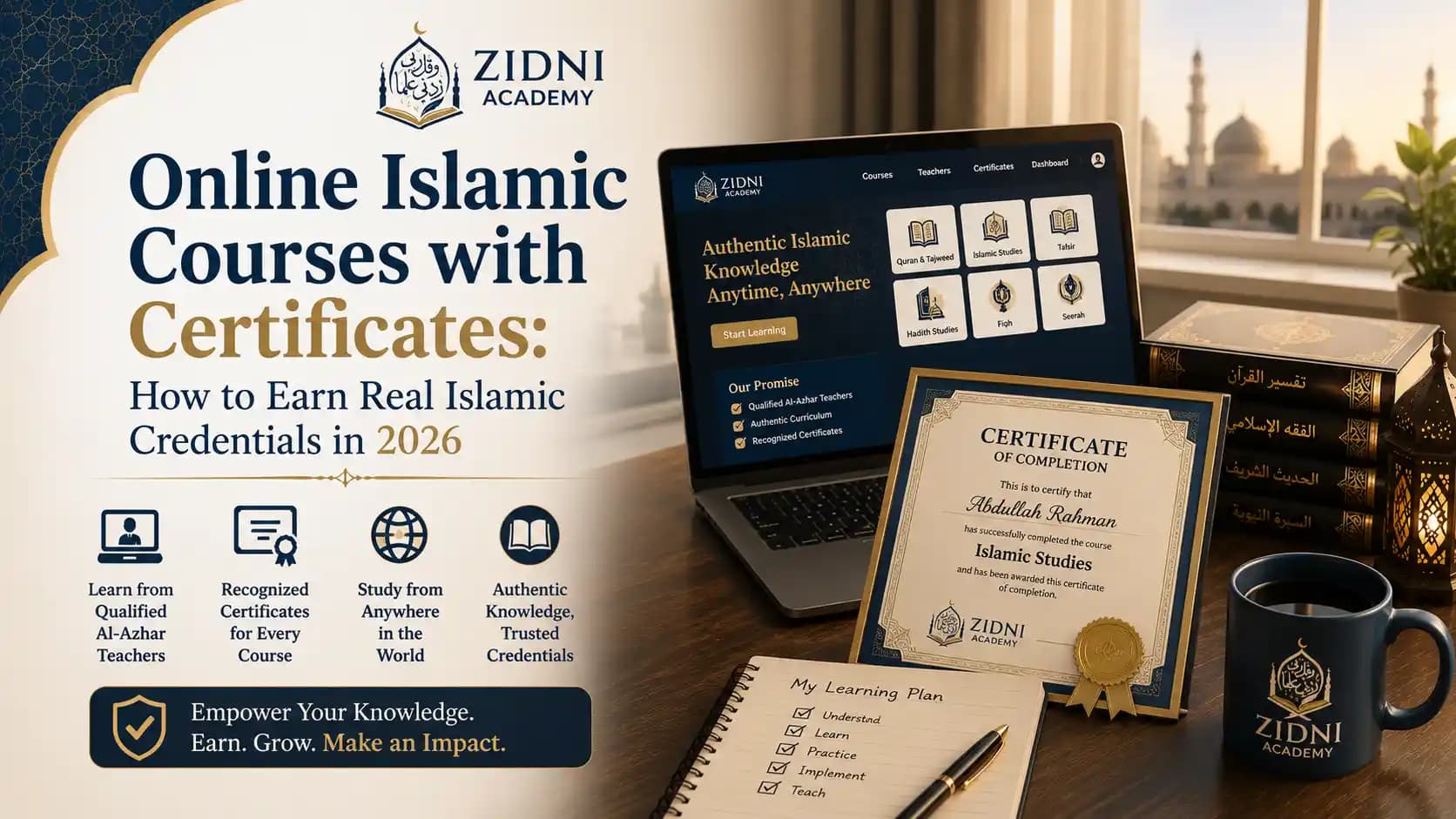
Online Islamic Courses with Certificates: How to Earn Real Islamic Credentials in 2026
The demand for online Islamic courses with certificates has grown sharply in recent years, as Muslims, new Muslims, parents, and working adults look for authentic religious education that actually fits around a job, a family, or a school timetable. Traditional Islamic learning used to depend entirely on geography and whichever scholar happened to be nearby. Today, students can study Quran, Tajweed, Fiqh, and Arabic from anywhere, with real credentials to show for it. This guide covers what these certificates actually mean, which levels exist, and how Zidni Academy structures its own certified programmes for kids, adults, and complete beginners.
What Are Online Islamic Courses with Certificates?
These are structured programmes delivered live over video, covering subjects like Quran recitation, Tajweed, Hifz, Fiqh, Aqeedah, Seerah, and Arabic language, where students receive an official document verifying what they've completed. Unlike a free YouTube playlist, a proper certified course follows a fixed curriculum, includes assessment, and results in a credential that means something beyond personal satisfaction.
Not every certificate carries the same weight, though, and understanding the difference matters before you enrol anywhere.
The Three Levels of Certification
A Certificate of Completion simply confirms attendance and coursework finished, useful as a personal record but not a qualification in itself. A Competency Certificate goes further, awarded only after assessments, oral recitation tests, or practical exams that prove the student actually mastered the material rather than just sitting through it. The highest level, Ijazah or Sanad certification, is a traditional Islamic authorisation that grants teaching permission and links the student to an unbroken chain of transmission going back to the Prophet ﷺ, reserved for those who complete rigorous memorisation and recitation standards under a qualified scholar.
Why Certification Actually Matters
A certificate isn't just a piece of paper for the wall. It changes what a student can do with what they've learned, and it changes how seriously they tend to take the learning process itself.
Credibility and recognition matter most for students planning to teach the Quran themselves eventually, assist at a local Islamic school, or lead a halaqa; a recognised certificate or Ijazah gives that role legitimacy it wouldn't otherwise have. Motivation and accountability come next, since knowing there's a real assessment at the end tends to keep students far more consistent than open-ended, ungraded study ever does. And for a smaller but genuine group of students, certification opens career and service opportunities, from teaching Tajweed part-time to supporting Islamic school programmes, none of which require relocating or enrolling in a full-time seminary.
Meet the Teachers Behind the Certificate
A certificate is only as credible as the teacher who signs off on it. At Zidni Academy, every instructor is a native Arabic speaker, and most are graduates of Al-Azhar University, the institution most Islamic academies point to as the gold standard for religious and Quranic education. Several teachers hold Ijazah with a connected Sanad, meaning the certification a student eventually receives is tied to a real, documented chain of transmission rather than an internal grading system with no external standard behind it.
Before teaching on the platform, every instructor is assessed on subject mastery, teaching methodology, and their ability to explain classical concepts in a way non-specialist students actually understand. Full profiles, specialisms, and years of experience are listed on the teachers page, so you can review exactly who would be issuing your certificate before enrolling.
Courses You Can Study Toward a Certificate
Certified programmes typically span several distinct subject areas, and most students combine more than one depending on their goals. Quran recitation courses build correct pronunciation and Makharij from the ground up, while dedicated Tajweed programmes cover the precise rules governing elongation, Qalqalah, and the characteristics of letters, available through Zidni Academy's Tajweed course for students who want that mastered properly rather than picked up loosely over time.
Beyond recitation, Islamic Studies courses cover Aqeedah, Fiqh, Hadith, Tafseer, and Seerah, giving students the theological and historical grounding that recitation alone doesn't provide. For students specifically drawn to Hadith study, a course like Forty Hadith of An-Nawawi offers a focused, classical starting point taught by a qualified scholar rather than a generalist overview.
Online Islamic Courses with Certificates for Kids
Children need a different pace and format entirely, and the best certified programmes for kids balance memorisation, Tajweed, and Islamic manners through repetition, short sessions, and genuine engagement rather than long lecture-style classes that lose a child's attention within minutes. Certification for children usually takes the form of level-based completion certificates, marking progress through foundational reading, basic Tajweed, and early Islamic studies, which keeps young learners motivated by giving them something tangible to work toward.
Zidni Academy's Islamic Studies course for kids is built specifically around this age group, with teachers trained to hold a young learner's attention over video call, a genuinely different skill from teaching an adult the same material.

Online Islamic Courses with Certificates for Adults
Adult learners generally want a faster pace, direct explanations of the reasoning behind rulings rather than simplified analogies, and flexibility around work and family commitments. Many adult students are correcting recitation they've carried since childhood, studying Arabic to access classical texts directly, or working systematically through Islamic Studies for the first time as adults, often after years without access to structured religious education.
Zidni Academy's Islamic Studies course for adults is structured around exactly this profile, moving at a pace that respects a learner's existing knowledge rather than starting everyone from the same baseline regardless of background.
Online Islamic Courses with Certificates for Beginners
Beginners are not expected to arrive with any prior knowledge, and a properly structured programme makes that explicit from the first session rather than assuming familiarity with Arabic letters or basic Islamic terminology. Teaching typically starts with reading fundamentals, simple pronunciation, and an introduction to core beliefs and practices, building level by level toward more advanced material.
This matters just as much for reverts and new Muslims as it does for lifelong Muslims returning to structured study after years away from it, and a good beginner track treats both groups with the same patience rather than assuming either has more background than they actually do. For sisters who prefer a female-led learning environment from the very first session, Islamic courses for women offer that same beginner-friendly structure with instructors who understand that context directly.
How Certification Actually Works
Certification combines structured, live instruction with genuine assessment rather than a certificate handed out automatically at the end of a payment cycle. For standard courses, this means attendance, coursework, and a practical or oral test demonstrating the student has actually retained what was taught, not simply sat through the sessions.
For Ijazah and Sanad specifically, the process is more rigorous: students undergo oral recitation tests, continuous assessment across the full memorisation or recitation target, and a final examination conducted personally by a qualified, Ijazah-holding teacher. Only once that's passed does the certification link the student's name into the documented chain of transmission, which is precisely what separates a genuine Ijazah from an informal completion badge.
Zidni Academy vs Other Certified Providers
What matters | Zidni Academy | Typical Group-Based Academy | Free Self-Paced Platform |
|---|---|---|---|
Teacher credentials | Al-Azhar graduates, several Ijazah holders | Mixed, not always verified | Rarely disclosed |
Assessment before certification | Oral tests and practical evaluation | Often minimal or automated quizzes | Usually none |
Class format | One-to-one | Often group-based | Self-paced, no live teacher |
Ijazah/Sanad available | Yes, on request for qualifying students | Rarely offered | Not available |
Suitable for complete beginners | Yes, dedicated beginner track | Sometimes | Often assumes prior knowledge |
How to Choose the Right Provider
With so many platforms now offering online Islamic courses with certificates, a short checklist cuts through most of the marketing claims. Start with the teacher's actual credentials, ideally Al-Azhar trained or equivalent, rather than a vague "qualified instructor" description with no institution named. Check whether certification requires genuine assessment or is awarded automatically at the end of a subscription period, since that distinction determines whether the certificate means anything at all.
Confirm whether Ijazah or Sanad is genuinely available for students who want to pursue it, not just Quran reading certificates dressed up with that language. And always take a free trial session before committing to a paid plan, since no course description replaces actually sitting in a class with the teacher who would eventually be signing your certificate.
Questions Students Ask Before Enrolling
Is an online Ijazah really as valid as one earned in person?
Yes, provided the recitation was genuinely heard, corrected, and approved by a qualified, Ijazah-holding teacher; the method of connection doesn't affect the validity of the chain of transmission, only whether the actual process of correction and approval took place properly.
Do I need any prior knowledge to start?
No. Most students, whether children, adult beginners, or reverts, start from zero, and a properly designed beginner track is built around that starting point rather than assuming background knowledge.
How long does it take to earn a certificate?
A standard completion or competency certificate can take a few months depending on the course and pace, while Ijazah or Sanad certification, particularly for full memorisation, is a multi-year commitment measured against strict recitation and retention standards.
Can I combine Quran, Arabic, and Islamic Studies certificates?
Yes, and many students do exactly that, since Arabic fluency supports Quranic understanding, and Islamic Studies gives the theological context that recitation alone doesn't provide.
Book Your Free Trial Session
The best way to judge whether a certified programme is right for you is to sit in a session with the teacher yourself before enrolling in anything. Book a free trial session today and see the curriculum, teaching style, and certification path firsthand.
Frequently Asked Questions
What is the difference between a certificate and an Ijazah?
A certificate confirms course completion or competency, while an Ijazah is a traditional authorisation to recite or teach the Quran, linked to a documented chain of transmission back to the Prophet ﷺ, and it requires a significantly higher standard of assessment.
Are online Islamic courses with certificates recognised for teaching purposes?
Yes, provided the issuing teacher holds genuine credentials and the certification process included real assessment rather than automatic completion, a certificate or Ijazah from a qualified instructor is generally accepted for teaching Quran or assisting at community and Islamic school programmes.
Can adults with no background in Arabic still earn a certificate?
Yes, adult beginner tracks are specifically designed for learners starting from zero, with the pace and curriculum adjusted so certification remains a realistic, achievable goal rather than something reserved for students with prior exposure.
Is there a female teacher option for certified courses?
Yes, female instructors are available for sisters and young girls who prefer a female-led learning environment, covering the same certified curriculum as the general track.
What happens if I don't pass the assessment for a certificate?
A reputable academy allows students to revisit material and retake assessments rather than issuing a certificate regardless of performance, since a certificate that doesn't reflect genuine competency isn't worth much to the student holding it.