
Why Online Islamic School For Kids Is A Great Option in the USA
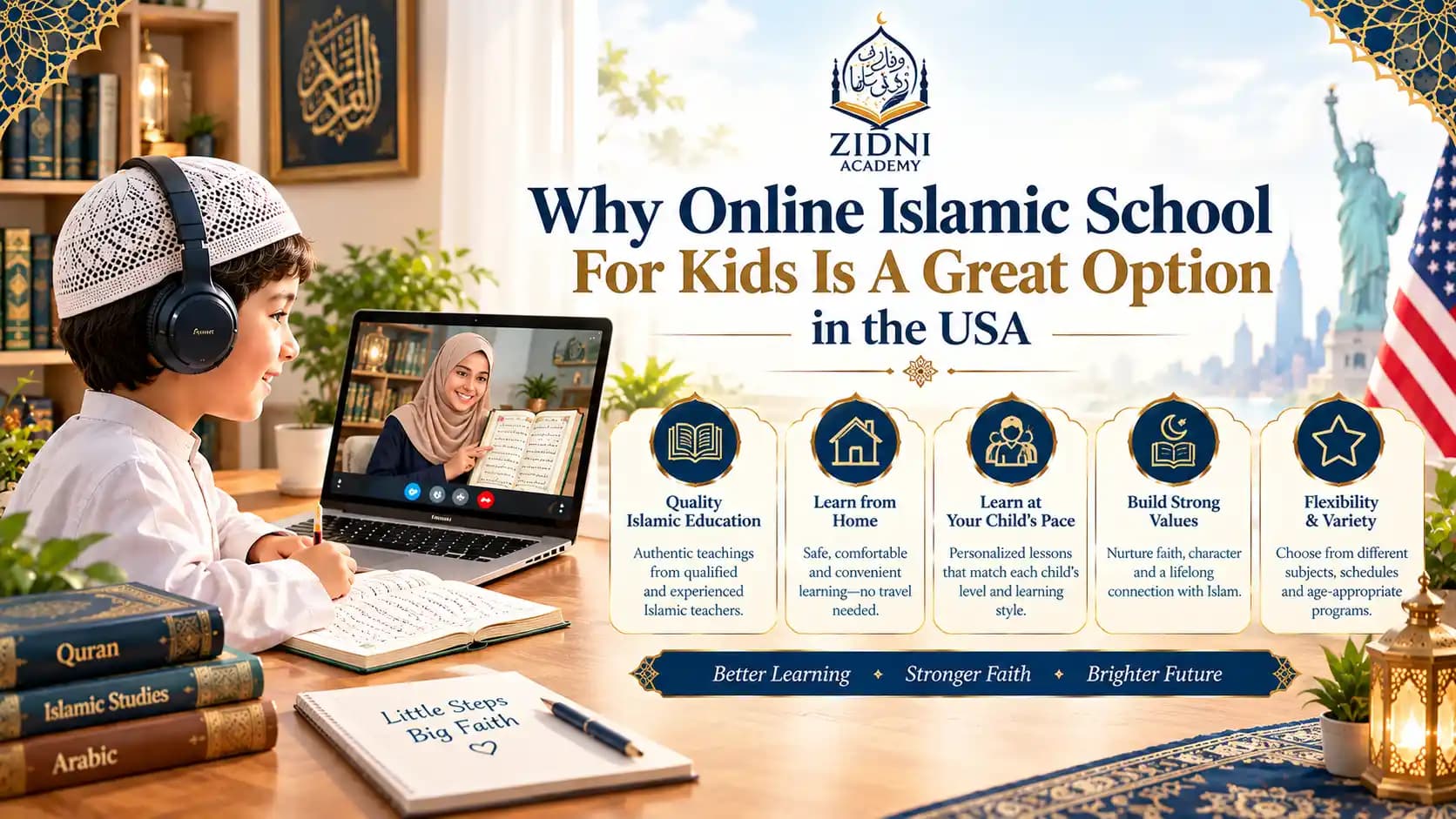
Why Online Islamic School For Kids Is A Great Option in the USA
For many Muslim families, choosing the right Islamic education for children is not as simple as finding the nearest weekend school. Parents may be balancing public or private school, homework, sports, family responsibilities, and limited access to qualified Islamic teachers. That is why an online Islamic school for kids can be a practical option for families in the United States. It can bring structured Quran, Islamic Studies, Arabic, and faith-based learning into the home while giving parents more flexibility over scheduling and learning support.
What Is an Online Islamic School for Kids?
An online Islamic school for kids is a structured learning program delivered through the internet instead of requiring children to travel to a physical Islamic school.
Depending on the program, children may study:
- Quran reading and recitation
- Quran memorization
- Tajweed
- Arabic
- Aqeedah and Islamic beliefs
- Fiqh and Islamic practices
- Seerah
- Islamic manners and character
- Daily duas and essential Islamic knowledge
The important distinction is between a single online Islamic class and a more structured learning program.
A quality program should have a clear curriculum, qualified teachers, age-appropriate instruction, measurable progress, and a learning path that parents can understand.
For Muslim families in the USA, this structure can be especially valuable when a local mosque or weekend program does not provide everything a child needs.
Why Online Islamic School for Kids Is Becoming a Practical Choice for USA Families
Muslim children in the United States may have very different access to Islamic education depending on where their family lives.
Some families live near established Islamic centers and full-time Muslim schools. Others may have only a weekend program nearby, while some families may have limited local options altogether.
Online education can reduce that geographic limitation.
Instead of choosing a teacher only because they are available locally, parents can compare programs based on:
- Teacher qualifications
- Curriculum quality
- Child's learning level
- Scheduling
- One-on-one or group format
- Parent communication
- Progress tracking
- Subject coverage
- Teaching language
- Child's comfort and engagement
This changes the question from “What Islamic school is closest to us?” to “What Islamic learning environment is the right fit for my child?”

7 Reasons Why Online Islamic School for Kids Is a Great Option
1. Learning From Home Saves Time and Travel
One of the clearest advantages of online Islamic education is convenience.
Your child does not need to travel to a mosque, Islamic center, or physical school for every lesson.
The learning environment can be set up at home, which can make Islamic education easier to fit around an American family's existing routine.
This can be particularly helpful when children already have:
- Full school days
- Homework
- Sports
- Clubs
- Family activities
- Weekend commitments
Instead of spending additional time commuting, the child can move from their normal routine into a scheduled online lesson.
The goal is not simply convenience. It is making consistent Islamic learning easier to maintain.
2. Flexible Scheduling Fits American Family Life
Children's schedules are rarely identical.
One family may need classes immediately after school. Another may prefer evenings or weekends. A homeschool family may have completely different learning hours.
A flexible online Islamic school for kids can make it easier to build Islamic education around the child's existing responsibilities rather than forcing every family into the same timetable.
When comparing programs, parents should ask:
- What days are available?
- Are evening classes possible?
- Does the schedule work in our US time zone?
- Can the child maintain consistent lessons?
- What happens if school activities conflict with a class?
The best schedule is not necessarily the one with the most available hours.
It is the one your child can follow consistently.
3. Children Can Receive More Personalized Attention
Not every child learns at the same speed.
One child may already read Arabic but struggle with Tajweed. Another may still be learning Arabic letters. A third may know several Surahs by heart but need stronger revision habits.
This is why personalized teaching can be particularly valuable.
In a one-on-one environment, the teacher can observe:
- Pronunciation
- Reading speed
- Memorization ability
- Attention span
- Areas of confusion
- Strengths and weaknesses
- Progress over time
Zidni Academy's children's programs use live one-on-one teaching, allowing lessons to be adapted to the student's current level rather than treating every child as if they start from the same point.
For children who are still building their Quran reading foundation, a structured Noorani Qaida approach can help develop the skills needed to move gradually from Arabic letters and sounds into Quranic reading.
4. Islamic Education Can Go Beyond Quran Memorization
A child's Islamic education should not be limited to memorizing Surahs.
Quran reading and memorization are important foundations, but children also need to understand how Islamic teachings relate to their daily lives.
A broader Islamic Studies curriculum may include:
- Aqeedah
- Fiqh
- Seerah
- Islamic manners
- Stories of the Prophets
- Daily Islamic practices
- Character development
For example, a child can learn the rules of Salah while also learning why Salah matters. They can study the Seerah while discussing patience, honesty, kindness, and responsibility.
Zidni Academy's Islamic Studies Courses for Kids cover Aqeedah, Seerah, basic Fiqh, and Akhlaq through interactive lessons designed for children.
This broader approach helps connect Islamic knowledge with the child's everyday life.
5. Parents Can Stay More Involved in Their Child's Progress
One concern parents sometimes have about online learning is:
“How will I know whether my child is actually progressing?”
That is why progress communication matters.
Parents should look for a program that provides a clear way to understand what the child has learned, what needs improvement, and what comes next.
Useful progress indicators can include:
- Quran reading accuracy
- Memorization progress
- Tajweed development
- Islamic Studies understanding
- Participation
- Areas requiring additional practice
At Zidni Academy, the children's Islamic Studies program includes monthly progress reports for parents, helping families stay informed about their child's development.
This turns online learning from something parents simply “send their child to” into a process they can understand and support.
6. Children Can Learn With Qualified Islamic Teachers
The quality of the teacher matters more than the fact that a class is online.
A beautiful platform cannot compensate for weak teaching.
Parents should ask:
Who is teaching my child?
Look for qualifications, Quranic knowledge, teaching experience, communication skills, and experience working with children.
For Islamic Studies, the teacher should also be able to explain concepts at the child's level rather than simply presenting adult material in front of a young learner.
Zidni Academy's children's Islamic Studies program is taught by Al-Azhar-certified teachers, giving parents an important qualification to consider when comparing online Islamic education providers.
For parents who want to understand the teaching team before enrolling, reviewing the academy's qualified Quran teachers can be a useful part of the decision process.
7. Online Learning Can Connect Quran and Islamic Studies
One of the strongest reasons to consider an online Islamic school for kids is the possibility of creating a connected learning journey.
Instead of treating every subject as completely separate, a child's learning path can develop progressively:
Quran Reading → Tajweed → Memorization → Islamic Studies → Deeper Understanding
For example, a child may learn to read Quran correctly, then improve recitation, begin memorization, and simultaneously study the Seerah and Islamic manners that help them understand the values they encounter in Islamic learning.
Families can build this progression according to their child's needs, adding Quran memorization when the child has developed an appropriate reading foundation.

Online Islamic School vs. Weekend Islamic School
Both options can be valuable.
The better choice depends on your child's needs, your family's schedule, and the quality of the available program.
Factor | Online Islamic School | Weekend Islamic School |
|---|---|---|
Travel | Usually none | Requires transportation |
Scheduling | Often more flexible | Usually fixed |
Teacher selection | Potentially wider | Depends on local availability |
Individual attention | Can be one-on-one | Often group-based |
Local community | Less in-person interaction | Stronger physical community |
Learning at home | Yes | No |
Progress tracking | Depends on provider | Depends on school |
Subject availability | Can be broader | Depends on local school |
This does not mean online education is automatically better.
A strong local Islamic school may be an excellent choice for a family that values in-person community and has access to qualified teachers.
The advantage of online learning is that it gives parents another option when local programs do not fit their needs.
Is an Online Islamic School Good for Young Children?
Yes, but the teaching method matters.
Young children generally need lessons that match their attention span, developmental stage, and ability to participate.
An effective children's program should avoid turning every lesson into a long lecture.
Instead, younger learners can benefit from:
- Short activities
- Repetition
- Storytelling
- Questions and answers
- Visual learning
- Recitation practice
- Interactive exercises
- Age-appropriate examples
- Positive encouragement
The objective is not merely to keep a child occupied during the lesson.
It is to help the child understand, remember, and apply what they learn.
What Should Kids Learn in an Online Islamic School?
There is no single curriculum that every family must follow.
However, a balanced program may include several areas.
Quran
Children can gradually develop:
- Arabic reading
- Quran recitation
- Tajweed
- Memorization
- Revision
For a child who is still learning Arabic letters, starting with Noorani Qaida can provide the foundation needed before progressing into independent Quran reading.
Once the child can read Quranic text, the next step may be improving pronunciation and applying Quran Tajweed correctly during recitation.
Islamic Studies
Islamic Studies can introduce children to:
- Aqeedah
- Salah
- Wudu
- Fiqh
- Seerah
- Islamic manners
- Stories of the Prophets
- Everyday Muslim practices
Arabic
Arabic can help children understand Quranic vocabulary and develop a stronger connection with the language of the Quran.
The appropriate level depends on whether Arabic is spoken at home and what the child already knows.
Character and Akhlaq
Children should also learn how Islamic values appear in real situations:
- Honesty
- Respect
- Patience
- Responsibility
- Kindness
- Helping others
This is where Islamic education becomes more than memorizing information.
How Online Islamic Education Can Support Muslim Children Growing Up in the USA
Growing up Muslim in the United States can mean that children spend much of their day in environments where Islamic education is not part of the school curriculum.
That does not mean parents need to isolate them from their wider community.
Instead, Islamic education can give children a foundation from which they can understand their faith confidently while participating in school, sports, friendships, and American society.
A useful Islamic education should help a child answer basic questions such as:
- What do Muslims believe?
- Why do we pray?
- How should I behave with others?
- Who was Prophet Muhammad ﷺ?
- Why do we follow the Quran and Sunnah?
- How do Islamic values affect my choices?
- What should I do when I face a situation at school?
The objective is not to make children afraid of the world around them.
It is to give them knowledge and character so they can navigate it with confidence.
What About Online Islamic School for Kids in the UK?
The same benefits can apply to Muslim families in the United Kingdom.
British Muslim families may also be balancing school, extracurricular activities, commuting, mosque programs, and family responsibilities.
Online Islamic education can provide another way to access structured Quran and Islamic Studies instruction without depending entirely on the availability of a nearby program.
However, the primary audience for this article is families in the United States, so the main recommendations here focus on the needs of USA families.
Can an Online Islamic School Work With Homeschooling?
Yes, depending on how the program is structured.
For Muslim families who homeschool, online Islamic education can become one component of a broader homeschool routine.
A child might study:
Morning: Mathematics and Language Arts
Midday: Science or Social Studies
Afternoon: Quran / Arabic / Islamic Studies
Evening: Family reading and revision
The advantage is that parents do not necessarily need to create every Islamic Studies lesson themselves.
A qualified teacher can provide structured instruction while parents continue supporting the child's learning at home.
For families building a Muslim homeschool curriculum, the most important question is whether the Islamic program complements the rest of the child's education rather than creating an unrealistic workload.
How to Choose the Best Online Islamic School for Your Child
Do not choose a program simply because its website says “best.”
Compare the actual learning experience.
1. Check Teacher Qualifications
Ask who teaches your child and what qualifications they hold.
2. Review the Curriculum
Look for a clear progression rather than disconnected lessons.
3. Ask How Your Child's Level Is Assessed
A five-year-old beginner and a twelve-year-old who already reads Quran should not necessarily follow the same starting point.
4. Check Whether Lessons Are Interactive
Children should have opportunities to answer, recite, ask questions, practise, and receive feedback.
5. Ask About Parent Progress Updates
You should know whether your child is progressing and what needs additional practice.
6. Consider Class Size
One-on-one teaching can provide a different level of personalization from a large group class.
7. Check Scheduling
Make sure the schedule fits your child's school and family routine.
8. Ask About a Trial Lesson
A trial can help you see whether the teacher's communication style is appropriate for your child before making a longer commitment.
What Questions Should Parents Ask Before Enrolling?
Before choosing an online Islamic school for kids, ask these questions:
- Who will teach my child?
- What Islamic qualifications do the teachers have?
- Is the curriculum designed specifically for children?
- How is my child's level assessed?
- Are Quran and Islamic Studies taught separately or together?
- Are lessons one-on-one or group-based?
- How often will my child have classes?
- Can we choose a suitable time?
- How is progress measured?
- Do parents receive progress updates?
- What happens if my child struggles with a topic?
- Is there a free trial?
- Can the program grow with my child?
These questions help parents compare the actual educational experience rather than comparing websites and advertisements.
When Is an Online Islamic School Probably a Good Fit?
An online program may be a particularly good fit if:
- Your local Islamic school is too far away.
- Weekend classes do not provide enough learning time.
- Your child's schedule is difficult to coordinate.
- You want more individualized Quran instruction.
- Your child needs a teacher who matches their current level.
- You want Quran and Islamic Studies in one broader learning path.
- Your family lives in an area with limited Islamic educational options.
- You want to remain closely involved in your child's progress.
On the other hand, a physical school may be preferable if your family strongly values daily in-person community, social interaction, and a full-time school environment.
The right choice depends on the child and family.
How Zidni Academy Supports Online Islamic Learning for Kids
For families looking for structured Islamic education online, Zidni Academy combines several learning paths for children.
Its Islamic Studies Courses for Kids cover Aqeedah, Seerah, basic Fiqh, and Akhlaq through live, interactive lessons designed for children. The program also provides monthly progress reports for parents, helping families follow their child's development.
Children can also build a broader Quran journey around their current level, from foundational reading through recitation, Tajweed, and memorization.
The advantage of this approach is that parents do not have to assume every child needs the same curriculum at the same pace.
A child who cannot yet read Arabic needs a different path from a child who already reads Quran fluently and needs stronger Tajweed or Hifz support.
For example, a child studying the life of the Prophet Muhammad ﷺ can also explore the related Seerah in greater depth as their Islamic knowledge develops.
A Practical Learning Path for a Muslim Child
Rather than trying to teach everything at once, parents can think about Islamic education as a long-term progression.
Stage 1: Quran Reading Foundation
Arabic letters, pronunciation, Harakat, and basic Quran reading.
Stage 2: Quran Recitation
Improving fluency and introducing Tajweed in a structured way.
Stage 3: Memorization
Building a sustainable Hifz and revision routine when the child's reading foundation is strong.
Stage 4: Islamic Studies
Developing knowledge of Aqeedah, Fiqh, Seerah, and Islamic manners.
Stage 5: Deeper Understanding
As children mature, they can gradually explore more advanced Islamic knowledge and Quranic understanding.
This progression gives parents a better way to think about online Islamic education for kids: not as a single class, but as a learning journey that develops with the child.
Are Online Islamic Classes Safe for Children?
Parents should treat online safety as part of choosing an educational provider.
Before enrolling, consider:
- Who communicates with the child?
- Is the class private or group-based?
- What platform is used?
- How does the academy handle scheduling and communication?
- Can parents remain involved?
- Does the provider have clear policies for children's learning environments?
Parents should also establish good home practices, such as having lessons in an appropriate shared or observable area and maintaining normal parental oversight.
Online education should make learning more accessible without removing parents from the process.
How Can Parents Keep Their Child Motivated?
Children rarely stay motivated because of “discipline” alone.
They need to feel that progress is possible.
Parents can help by:
- Setting realistic goals
- Celebrating small improvements
- Avoiding constant comparison with siblings or other children
- Keeping revision manageable
- Connecting lessons to everyday life
- Asking the child what they enjoyed learning
- Maintaining a predictable routine
- Choosing a teacher who communicates well with the child
A child who feels successful is more likely to continue learning.
The goal is to develop a lasting relationship with Quran and Islamic knowledge rather than creating short-term pressure.
Frequently Asked Questions About Online Islamic School for Kids
Why online Islamic school for kids instead of a local weekend school?
An online program can offer flexibility, eliminate travel, provide access to teachers outside your local area, and potentially offer more individualized instruction. A local weekend school may still be a better fit for families who prioritize in-person community.
Is an online Islamic school suitable for children in the USA?
Yes. Online Islamic education can be particularly practical for families in the USA who have limited local options or need classes that fit around school and extracurricular schedules.
What can children learn in an online Islamic school?
Depending on the provider, children may study Quran reading, Tajweed, memorization, Arabic, Aqeedah, Fiqh, Seerah, Islamic manners, and other Islamic subjects.
Is one-on-one online Islamic education better than group classes?
It depends on the child. One-on-one lessons can provide more individualized feedback and allow the teacher to adapt the lesson to the child's level. Group classes can provide peer interaction and a sense of community.
How do I know if an online Islamic school is good?
Look at teacher qualifications, curriculum structure, class format, progress tracking, scheduling, child engagement, parent communication, and whether a trial lesson is available.
Can online Islamic classes work for young children?
Yes, provided the lessons are age-appropriate, interactive, and structured around the child's attention span and learning level.
Can Muslim homeschool families use an online Islamic school?
Yes. Online Islamic education can become part of a Muslim homeschool curriculum by providing structured Quran, Arabic, or Islamic Studies instruction alongside the family's academic homeschool subjects.
Should my child learn Quran and Islamic Studies together?
They can complement each other. Quran builds recitation and memorization skills, while Islamic Studies can help children understand faith, worship, Seerah, and Islamic character. The right combination depends on the child's age, level, and family goals.
Is there a free trial for online Islamic classes?
Some academies offer trial lessons. Zidni Academy offers a free trial for families who want to explore the learning experience and determine whether the program is appropriate for their child.
Give Your Child an Islamic Education That Fits Your Family
Choosing an online Islamic school for kids does not mean choosing convenience over quality.
When the right program has qualified teachers, a structured curriculum, personalized instruction, appropriate learning activities, progress tracking, and a schedule that works for your family, online learning can become a practical part of your child's Islamic education.
For Muslim families in the USA, the real question is not simply whether online learning works.
It is whether the program you choose is right for your child.
If your child needs Quran reading, Tajweed, memorization, or a broader Islamic Studies foundation, start by identifying their current level and learning goals.
Book a Free Trial Lesson With Zidni Academy
Let your child experience a live lesson with a qualified teacher, discover the right learning path, and start building a stronger foundation in Quran and Islamic knowledge.
Book a free trial lesson today and take the first step toward a structured Islamic education for your child.