
When Was the Quran Written? A Complete History, Preservation, and Guide to Learning the Quran Today
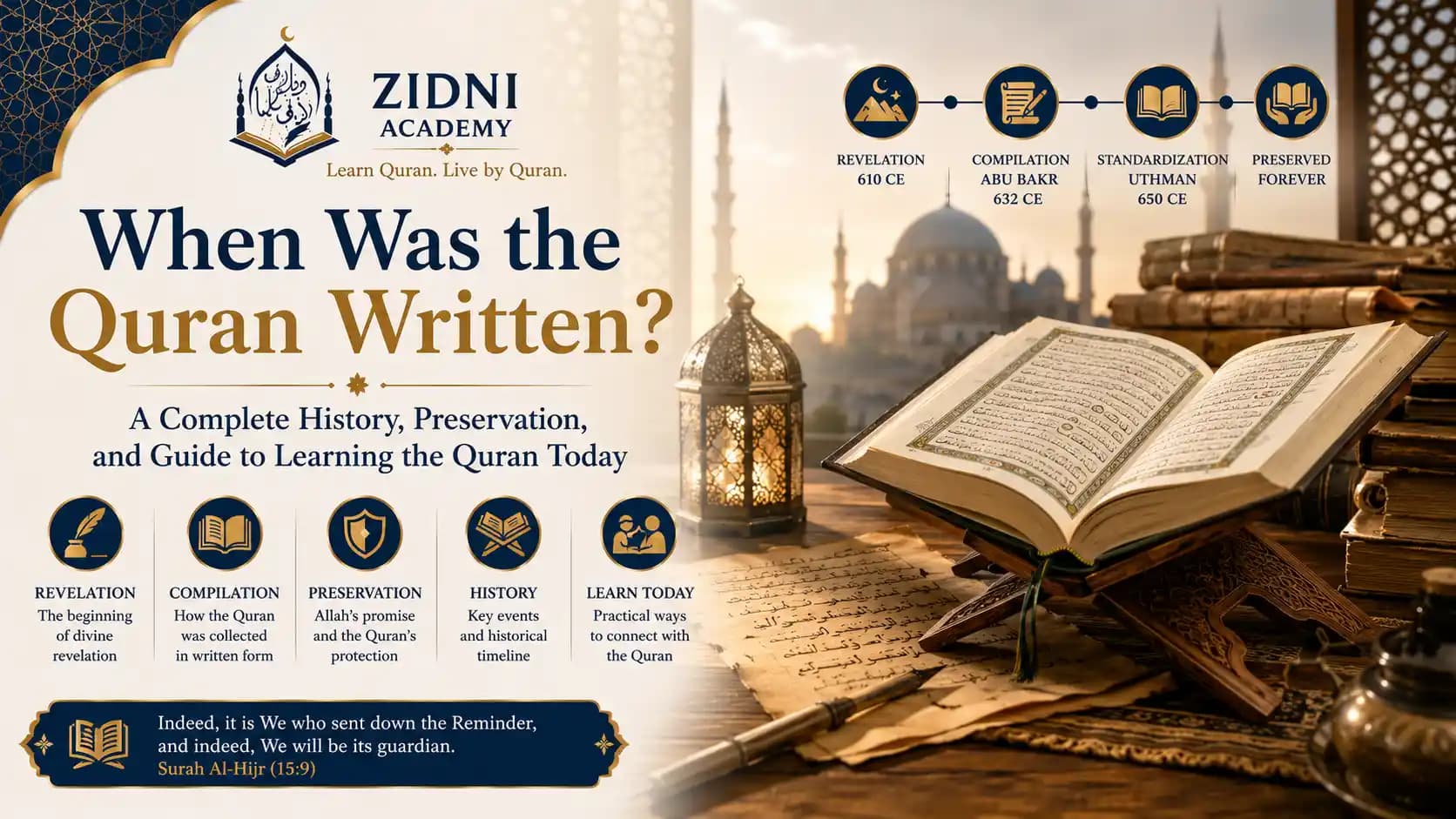
When Was the Quran Written? A Complete History, Preservation, and Guide to Learning the Quran Today
When was the Quran written, and how did it survive unchanged for over 1,400 years? This is one of the most asked questions about Islam's holy book — by curious non-Muslims, new reverts, and students of history alike. In this guide, we trace the full story: from the very first revelation to Prophet Muhammad ﷺ in 610 CE, through 23 years of gradual revelation, to the written compilation by his companions, and finally to the standardized text Muslims read today. We'll also answer the most common related questions, and show you how to learn to recite this preserved text correctly.
Want to learn the Quran with proper Tajweed? Explore our online Quran classes.
When Was the Quran Written and By Whom?
Muslims believe the Quran has no human author — it is considered the literal word of Allah (God), not the writing of any person, including Prophet Muhammad ﷺ. It was revealed gradually to the Prophet through the Angel Gabriel (Jibril) over a period of 23 years, between 610 and 632 CE.
Prophet Muhammad ﷺ did not write the Quran himself — historical accounts widely describe him as unable to read or write. Instead, his companions memorized the verses as they were revealed and recorded them on available writing materials of the time — including parchment, palm leaves, flat stones, and even the shoulder blades of camels. This combination of oral memorization and physical recording is central to understanding when the Quran was written and how its accuracy was preserved from the very beginning.
From Understanding the Quran’s History to Learning It Today
Understanding how the Quran was revealed, compiled, and preserved is an important part of appreciating its history. But learning to read and recite the Quran correctly is a journey that requires structured guidance and consistent practice.
If you're looking to improve your Quran reading, Tajweed, memorization, or recitation, Zidni Academy offers structured online Quran learning programs with qualified teachers and personalized learning plans

Revelation to Prophet Muhammad — The First Verses
The story of when the Quran was written begins with a single, transformative night. In 610 CE, while Prophet Muhammad ﷺ was in seclusion in the Cave of Hira near Mecca, the Angel Gabriel appeared to him with the first revelation — the opening verses of what would become Surah Al-'Alaq.
These first verses commanded the Prophet ﷺ to "Read" (or "Recite") in the name of his Lord who created — establishing reading, knowledge, and divine teaching as central themes from the very first moment of revelation. The Surah goes on to describe Allah as the one who taught humanity by the pen, and who taught man what he did not know.
This moment marks the true beginning of when the Quran was written — not as a single completed book delivered all at once, but as the start of a 23-year process of gradual, verse-by-verse and chapter-by-chapter revelation that would continue until shortly before the Prophet's death in 632 CE.
The Importance of Arabic in the Quran
Understanding when the Quran was written also requires understanding why it was revealed specifically in Arabic, and why this matters so deeply in Islamic belief.
The Quran repeatedly describes itself as a "clear Arabic Quran," emphasizing that its language is not incidental but essential to its meaning, rhythm, and miraculous literary structure. Muslims believe the precise wording, grammar, and even the sound patterns of the Arabic text carry meaning that cannot be fully replicated in translation — which is why authentic Quranic recitation has always been taught in its original Arabic, passed down through a continuous chain of teachers and students.
This is also why, even 1,400 years after it was written down, learning to recite the Quran in Arabic — not just reading a translation — remains central to Islamic practice for Muslims of every background, including the millions of English-speaking Muslims across the US, UK, Australia, Canada, and the Gulf today.
A History of the Writers of the Holy Quran — Who Were the Scribes?
A central part of answering when was the Quran written is identifying who physically wrote it down. While the Prophet Muhammad ﷺ received the revelation, he relied on a number of companions who served as scribes, recording each verse as it was revealed.
Zayd ibn Thabit stands out as the most prominent scribe of the Quran. He served as the Prophet's personal scribe and would later be entrusted with leading the major compilation efforts under both Caliph Abu Bakr and Caliph Uthman.
Other companions who recorded verses during the Prophet's lifetime included Ali ibn Abi Talib, Uthman ibn Affan, Mu'awiya ibn Abi Sufyan, and Ubay ibn Ka'b, among others. These scribes wrote on whatever materials were available — palm leaves, thin flat stones, pieces of leather, and animal bones — since paper as we know it was not yet widely available in 7th century Arabia.
Crucially, writing was never the only method of preservation. Alongside these written records, thousands of companions memorized the Quran by heart, creating a dual system of oral and written preservation that protected the text from any single point of failure.
Learn the Quran With Expert Guidance
Whether you're starting from the basics or looking to improve your Tajweed and memorization, a structured learning program can help you make consistent progress.
With Zidni Academy, you can:
✅ Learn Quran reading step by step
✅ Improve your Tajweed and pronunciation
✅ Study with qualified Quran teachers
✅ Follow a personalized learning plan
✅ Learn online from the comfort of your home
✅ Choose programs suitable for different ages and levels
The Compilation of the Holy Quran Into a Single Book
While individual verses were written down during the Prophet's lifetime, the Quran was not yet compiled into one single, organized book. That crucial step happened shortly after his death, answering an important part of when the Quran was written in its book form.
After the Prophet's death in 632 CE, many companions who had memorized the Quran were killed in early battles, most notably the Battle of Yamama. This loss deeply concerned Umar ibn al-Khattab, who urged Caliph Abu Bakr to compile the scattered verses into a single, unified written collection before more of the original memorizers were lost.
Abu Bakr assigned this critical task to Zayd ibn Thabit, who gathered the verses from multiple sources — written records and the memories of companions who had heard them directly from the Prophet — cross-checking each one carefully before including it in the final compilation. This compiled manuscript was later preserved by Hafsa, one of the wives of the Prophet ﷺ.
Standardization of the Holy Quran Under Caliph Uthman
As Islam spread rapidly beyond Arabia in the years following the Prophet's death, a new challenge emerged: Muslims in different regions began reciting the Quran with slight variations in dialect and pronunciation, creating concern about consistency.
Caliph Uthman ibn Affan recognized the need to standardize the written text once and for all. He once again appointed Zayd ibn Thabit, alongside several other companions, to produce an official, standardized version of the Quran — using Hafsa's preserved manuscript as the base text, carefully verified against the memorization of trusted companions.
The committee chose to base the standardized text on the dialect of the Quraysh tribe — the Prophet's own tribe from Mecca — ensuring consistency across the growing Muslim world. Multiple identical copies of this standardized text, now known as the Uthmanic Codex, were then sent to major cities including Mecca, Medina, Kufa, and Basra, with instructions that other partial or variant manuscripts be set aside in favor of this single, authoritative version.
Every printed copy of the Quran that exists today — whether in the US, UK, Saudi Arabia, the UAE, Qatar, Kuwait, or anywhere else in the world — is fundamentally derived from this Uthmanic standardization completed within a few decades of the Prophet's death.
Continue Exploring Quran Studies
Learning about the history and preservation of the Quran is an important first step, but it is only the beginning of a deeper journey. As your understanding grows, you may want to improve your Quran recitation, study the rules of Tajweed, explore the meanings of the verses, or begin memorizing the Quran with proper guidance. Building your knowledge gradually allows you to strengthen both your recitation and your connection with the Book of Allah. If you're ready to take the next step, start with our Learn Quran With Tajweed Online course to develop a strong foundation for accurate and confident Quran recitation.
The Preservation of the Holy Quran Across 1,400 Years
Perhaps the most remarkable part of the story of when the Quran was written is what happened after the Uthmanic standardization: the text has remained essentially unchanged for over fourteen centuries.
This extraordinary preservation rests on two parallel systems working together continuously, generation after generation:
Written preservation — From the original Uthmanic copies, countless manuscripts were carefully copied by hand for centuries, and later printed, with rigorous attention to accuracy at every stage.
Oral preservation through memorization — Alongside the written text, millions of Muslims throughout history have memorized the entire Quran by heart — known as Huffaz (memorizers) — creating a living human chain of verification that exists independently of any physical manuscript.
This dual system means that even if every physical copy of the Quran were somehow destroyed, the text could be fully reconstructed from the memories of the global community of Huffaz — a built-in safeguard unique among the world's major religious texts.
When Was the Quran Written — A Timeline Summary
To bring the full story together, here is a clear timeline answering when the Quran was written, from first revelation to final standardization:
610 CE — The first revelation is given to Prophet Muhammad ﷺ in the Cave of Hira, marking the beginning of the Quran's revelation.
610–632 CE — The Quran is revealed gradually, verse by verse and chapter by chapter, over approximately 23 years, with companions memorizing and recording each revelation as it came.
632 CE — Prophet Muhammad ﷺ passes away, with the full Quran revealed but not yet compiled into a single organized book.
632–634 CE — Caliph Abu Bakr orders the first complete written compilation of the Quran, led by Zayd ibn Thabit, in response to the loss of memorizers at the Battle of Yamama.
650–656 CE — Caliph Uthman ibn Affan commissions the standardization of the Quranic text, producing the Uthmanic Codex that forms the basis of every Quran printed today.
Why This History Matters for How You Recite the Quran Today
Understanding when the Quran was written isn't just an academic exercise — it directly shapes how Muslims approach learning to recite it correctly today. Because the Quran was preserved through a continuous, verified chain of memorization and recitation — not casual reading — authentic Quran education has always emphasized learning directly from a qualified teacher, not simply reading the text silently alone.
This is precisely the model that Zidni Academy continues today: certified Al-Azhar teachers who themselves received their knowledge through a documented chain of teachers, passing on correct pronunciation, Tajweed, and recitation exactly as it has been transmitted since the Uthmanic standardization.
For students in the US, UK, Australia, Canada, Belgium, the UAE, Saudi Arabia, Kuwait, and Qatar who want to connect with this living tradition — not just read about its history — our Learn To Read Quran Online course starts from the very first Arabic letter, while our Learn Quran With Tajweed Online program teaches the precise pronunciation rules that have preserved the Quran's recitation unchanged for over fourteen centuries.
What Should You Learn After Understanding the History of the Quran?
Learning when the Quran was written is only the beginning of your Quran journey. The next step is learning how to read the Quran correctly in its original Arabic, understand the rules of Tajweed, and gradually build confidence in recitation. Many students also continue to Quran memorization and Tafseer to develop a deeper connection with Allah's words. By following a structured learning path with qualified teachers, you move beyond historical knowledge into practical worship and lifelong Quranic understanding.
Continue Your Quran Journey
After discovering how the Quran was revealed, preserved, and transmitted across generations, many readers choose to begin learning it with qualified teachers. Whether your goal is reading the Quran correctly, mastering Tajweed, memorizing the Quran, or understanding its meanings, Zidni Academy offers personalized one-on-one online programs taught by certified Al-Azhar scholars.
Why Does Knowing the History of the Quran Matter Today?
Understanding the history of the Quran is more than learning historical events—it strengthens your faith by showing how Allah preserved His revelation throughout the centuries. Knowing how the Quran was carefully transmitted and protected increases your confidence in its authenticity and inspires a deeper appreciation for every verse you recite. It also motivates many Muslims to learn Arabic, improve their Quran recitation, and begin memorizing the Quran with greater purpose. As your knowledge grows, you naturally seek a deeper understanding of the meanings and wisdom behind Allah's words. A great next step is our Quran Tafseer Course, where you study the Quran verse by verse with certified Al-Azhar scholars and develop a stronger connection with its guidance.
Ready to Learn the Quran? Start With a Free Trial
Whether you're a complete beginner or want to improve your Tajweed and Quran recitation, Zidni Academy offers live 1-on-1 online Quran lessons with certified Al-Azhar teachers.
Frequently Asked Questions
Q: When was the Quran written and by whom?
The Quran was revealed gradually to Prophet Muhammad ﷺ between 610 and 632 CE through the Angel Gabriel. Muhammad ﷺ did not write it himself; his companions memorized and recorded the verses on materials like parchment and palm leaves. It was later compiled into a single book under Caliph Abu Bakr and standardized under Caliph Uthman.
Q: Who were the scribes of the Holy Quran?
The most prominent scribe was Zayd ibn Thabit, the Prophet's personal scribe, who later led both the compilation under Abu Bakr and the standardization under Uthman. Other companions who recorded verses included Ali ibn Abi Talib, Uthman ibn Affan, Mu'awiya ibn Abi Sufyan, and Ubay ibn Ka'b.
Q: What was the first revelation given to Prophet Muhammad?
The first revelation came in 610 CE in the Cave of Hira, consisting of the opening verses of Surah Al-'Alaq, which command the Prophet to "Read" in the name of his Lord and describe Allah as the one who taught humanity by the pen.
Q: How was the Quran compiled into a single book?
After the Prophet's death, Caliph Abu Bakr ordered Zayd ibn Thabit to compile the scattered verses into one unified manuscript, cross-checking written records against the memorization of trusted companions, following concerns about losing memorizers in early battles.
Q: What was the standardization of the Quran under Uthman?
As Islam spread and dialect variations emerged, Caliph Uthman commissioned a committee led by Zayd ibn Thabit to produce an official standardized text based on the Quraysh dialect. Identical copies were sent to major cities, forming the Uthmanic Codex that all Qurans today are based on.
Q: How has the Quran been preserved for over 1,400 years?
The Quran has been preserved through two parallel systems: careful written transmission of manuscripts, and continuous oral memorization by millions of Muslims (Huffaz) throughout history, creating a verification system that protects the text from corruption.
Q: Why does Arabic matter so much in the Quran?
The Quran describes itself as revealed specifically in clear Arabic, with its precise wording and structure considered inseparable from its meaning. This is why authentic Quranic recitation has always been taught in Arabic, passed down through a continuous chain of qualified teachers.
Q: How can I learn to recite the Quran the way it has been preserved?
Zidni Academy offers live, 1-on-1 Quran lessons with certified Al-Azhar teachers who themselves received their knowledge through a documented chain of transmission. A free trial session is available for beginners with no prior Arabic background.