
Ayatul Kursi in English Language — Full Meaning, Benefits, and How to Recite It Correctly
Ayatul Kursi in English Language — Full Meaning, Benefits, and How to Recite It Correctly
Searching for Ayatul Kursi in English language to understand its meaning, power, and benefits? You've come to the right place. Ayatul Kursi — the Verse of the Throne — is widely considered the greatest verse in the entire Quran. In this guide, you'll find Ayatul Kursi in English language broken down word by word, the reasons it holds such immense spiritual power, what happens when it's recited regularly, and the correct way to learn it — in the Arabic it was revealed in — with proper Tajweed. If you want to recite this verse the way it deserves to be recited, Zidni Academy can help you get there.
What Is the Full Verse of Ayatul Kursi?
Ayatul Kursi is verse 255 of Surah Al-Baqarah, the second chapter of the Quran. It is named "the Verse of the Throne" because of its description of Allah's Kursi (Throne) encompassing the heavens and the earth.
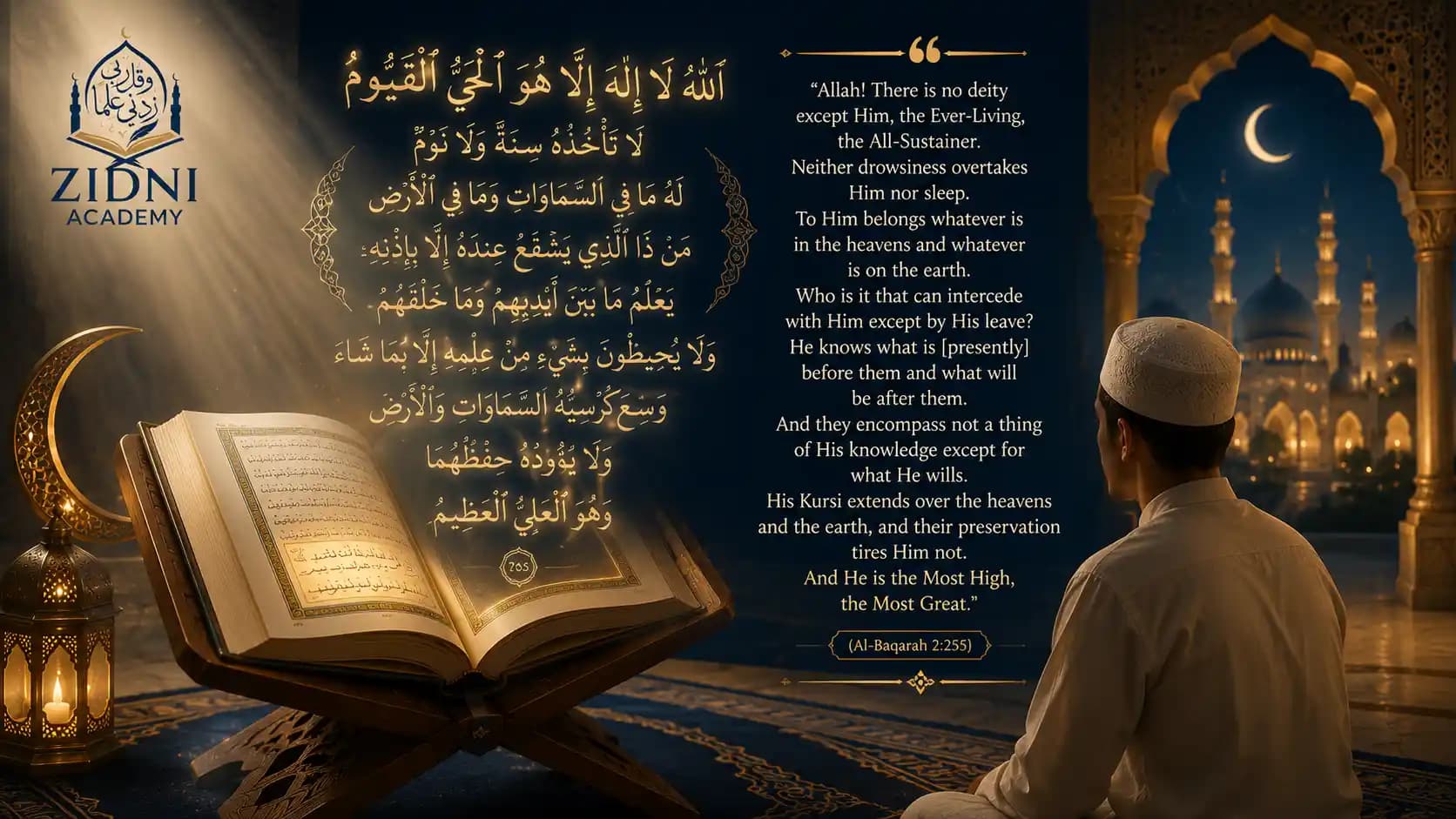
Below is Ayatul Kursi in English language — note that this is a translation of meaning, not a substitute for the original Arabic recitation, which carries linguistic and spiritual qualities that cannot be fully captured in any translation:
"Allah! There is no deity except Him, the Ever-Living, the Sustainer of all existence. Neither drowsiness overtakes Him nor sleep. To Him belongs whatever is in the heavens and whatever is on the earth. Who is it that can intercede with Him except by His permission? He knows what is before them and what will be after them, and they encompass nothing of His knowledge except what He wills. His Kursi extends over the heavens and the earth, and their preservation tires Him not. And He is the Most High, the Most Great."
This English rendering captures the meaning of the verse — understanding it deeply is the first step. Reciting it correctly in Arabic, with proper Tajweed, is what completes the act of worship the way it was revealed.
Is It Okay to Recite Ayatul Kursi in English?
This is one of the most common questions from Muslims who first encounter Ayatul Kursi in English language — and the honest, important answer is this:
For understanding the meaning — Reading Ayatul Kursi in English language to understand what it says is encouraged and valuable. Understanding deepens your connection to what you recite.
For ritual recitation (in prayer, for protection, or as an act of worship) — The Quran must be recited in its original Arabic. The Quran is the literal word of Allah, revealed specifically in Arabic, and the spiritual rewards, the linguistic miracle, and the precise meaning of each word are inseparable from the Arabic text itself. A translation — however accurate — is an interpretation of meaning, not the Quran itself.
This is why every authentic Islamic tradition teaches Ayatul Kursi in its original Arabic — and why learning the correct Arabic recitation, even if Arabic is not your first language, is considered one of the most valuable things a Muslim can do.
The good news: with the right teacher and the right method, moving from knowing Ayatul Kursi in English language to reciting it correctly in Arabic — even with zero prior Arabic knowledge — is entirely achievable, often within just a few sessions.
What Is the English Version of Ayatul Kursi? — Word-by-Word Understanding
Beyond the full translation, breaking down Ayatul Kursi in English language word by word helps deepen your appreciation of the verse:
"Allahu la ilaha illa Huwa" — "Allah, there is no deity except Him" — the opening declaration of pure monotheism (Tawheed), the foundation of the entire verse.
"Al-Hayyul-Qayyum" — "The Ever-Living, the Sustainer of all existence" — two of Allah's names describing His eternal life and His role in sustaining everything that exists.
"La ta'khudhuhu sinatun wa la nawm" — "Neither drowsiness overtakes Him nor sleep" — emphasizing Allah's complete and constant awareness, unlike any created being.
"Lahu ma fis-samawati wa ma fil-ard" — "To Him belongs whatever is in the heavens and whatever is on the earth" — establishing Allah's complete ownership and sovereignty over all creation.
"Man dhal-ladhi yashfa'u 'indahu illa bi-idhnihi" — "Who can intercede with Him except by His permission?" — affirming that no one can intervene on another's behalf without Allah's explicit permission.
"Wa la ya'uduhu hifzuhuma" — "Their preservation tires Him not" — describing how maintaining the entire universe causes Allah no fatigue whatsoever.
"Wa Huwal-'Aliyyul-'Adheem" — "And He is the Most High, the Most Great" — the closing declaration of Allah's supreme greatness and elevation above all creation.
Reading Ayatul Kursi in English language this way, phrase by phrase alongside the Arabic, is one of the most effective ways to understand exactly what you are reciting once you begin learning the verse properly in Arabic.
Why Is Ayatul Kursi So Powerful?
Ayatul Kursi's power comes from both its content and its authenticated status in Islamic teaching:
It contains the greatest concentration of Allah's attributes — In a single verse, Ayatul Kursi describes Allah's eternal life, complete knowledge, total sovereignty, and supreme greatness — more densely than almost any other verse in the Quran.
The Prophet ﷺ himself declared its greatness — It was reported that the Prophet Muhammad ﷺ identified Ayatul Kursi as the greatest verse in the Quran when asked directly by one of his companions.
It is recited for protection — Muslims recite Ayatul Kursi for protection from harm, especially before sleeping and after the five daily prayers, based on authentic Hadith encouraging this practice.
Its theological completeness — The verse addresses Allah's existence, His names and attributes, His knowledge, His power, and His greatness — making it a complete theological statement in a single passage.
How Strong Is Ayatul Kursi? — What the Hadith Say
The strength of Ayatul Kursi is established through authentic Hadith — sayings and teachings of the Prophet Muhammad ﷺ — that describe its unique status and benefits. These reports describe Ayatul Kursi's connection to protection from harm, its recitation alongside daily prayers, and its standing as the greatest single verse in the Quran.
What matters most for any Muslim seeking to benefit from these teachings is reciting the verse correctly — in Arabic, with proper Tajweed — exactly as it was revealed, since the spiritual benefits described in these traditions are tied to the actual recitation of the Quranic Arabic text, not its English translation alone.
What Are the Miracles of Ayatul Kursi?
Many scholars and students of the Quran describe several remarkable qualities of Ayatul Kursi:
Comprehensive Tawheed in one verse — Few verses in the entire Quran establish the oneness of Allah as comprehensively and eloquently as Ayatul Kursi does in its opening and closing statements.
Its place in Surah Al-Baqarah — Ayatul Kursi sits within the longest chapter of the Quran, and its content and language are considered by scholars of Tafsir to represent a high point of theological eloquence within that chapter.
Its widespread use in daily Muslim life — Few verses are as frequently recited by Muslims worldwide — after prayers, before sleep, for protection — making it one of the most memorized and recited verses across every Muslim community globally.
The descriptive imagery of the Kursi — The verse's description of Allah's Throne encompassing the heavens and the earth, with their preservation causing Him no fatigue, is considered among the most powerful imagery in the entire Quran describing Allah's majesty.
What Happens If You Read Ayatul Kursi Every Day?
Many Muslims incorporate Ayatul Kursi into their daily routine — particularly after the five daily prayers and before sleeping — based on the authentic Hadith encouraging this practice for protection and spiritual benefit.
Beyond the spiritual dimension, regular recitation also has practical learning benefits: consistent daily recitation is one of the most effective ways to memorize any portion of the Quran correctly and permanently. Repetition with correct Tajweed — guided by a qualified teacher — builds both memorization and pronunciation accuracy simultaneously.
For Muslims who first learned Ayatul Kursi in English language and now want to recite it correctly in Arabic every day, learning it properly from the start — rather than picking up pronunciation habits from informal sources — is the foundation that makes consistent recitation meaningful and rewarding. Many students who begin with a single verse like Ayatul Kursi go on to pursue a complete Quran Memorization Course, using the same correct-from-the-start approach to memorize Surah by Surah with proper Tajweed.
How to Recite Ayat Al-Kursi Correctly — The Tajweed Essentials
Reciting Ayatul Kursi correctly requires applying several Tajweed rules that appear throughout the verse. Here are the key rules a learner needs to master:
Correct Makharij (Articulation Points)
Letters like Qaf (ق) in "Al-Qayyum," Ayn (ع) in "yashfa'u," and Ha (ح) in "Hifzuhuma" require precise articulation points that don't exist in English and must be learned through direct demonstration and correction.
Madd Rules
The elongated vowels throughout the verse — such as in "As-samawati" and "Al-'Ard" — must be held for their correct duration, neither too short nor too long.
Qalqalah
Words containing the Qalqalah letters require the distinctive echo/vibration sound that gives Quranic recitation its characteristic texture.
Correct Stopping Points (Waqf)
Knowing where to pause naturally within the verse — without breaking the flow of meaning — is an essential skill that a live teacher demonstrates and corrects in real time.
This is precisely why moving beyond Ayatul Kursi in English language into live Arabic recitation with a qualified teacher produces dramatically better results than learning from written transliteration or audio alone. A teacher hears your specific pronunciation and corrects it before incorrect habits form. If you want to build this skill systematically rather than verse by verse, our Learn Quran With Tajweed Online course covers every rule above — Makharij, Madd, Qalqalah, and Waqf — in a structured curriculum that applies directly to Ayatul Kursi and every other verse you'll recite afterward.
Can Ayatul Kursi Be Read in English? — A Clear Summary
To bring together everything covered above about Ayatul Kursi in English language and its proper recitation:
Reading Ayatul Kursi in English language — Yes, and it is encouraged, for the purpose of understanding the meaning of what you will recite in Arabic.
Reciting it as an act of worship, in prayer, or for spiritual benefit — This must be done in the original Arabic, exactly as it was revealed, to receive the spiritual benefits described in the Hadith and to fulfill the verse's purpose as an act of Quranic recitation.
The most effective path for English-speaking Muslims — and for Muslims of any background who did not grow up reciting Arabic — is to start with Ayatul Kursi in English language to understand its meaning, then learn the correct Arabic pronunciation with a qualified teacher, using the translation alongside to deepen understanding of every word being recited. For complete beginners with zero Arabic background, a structured program like Learn To Read Quran Online builds this foundation from the very first letter, so that reciting verses like Ayatul Kursi correctly becomes achievable within just a few sessions.
From Ayatul Kursi in English Language to Confident Arabic Recitation — With a Certified Teacher
At Zidni Academy, helping students move from reading Ayatul Kursi in English language to reciting it correctly in Arabic is built around one core principle: live correction from a certified Al-Azhar teacher, not self-study from written transliteration.
Why this matters specifically for Ayatul Kursi:
This verse is one of the most frequently recited passages by Muslims worldwide — meaning incorrect pronunciation habits, once formed, are repeated daily for years. Learning it correctly from the start prevents this entirely.
What a session learning Ayatul Kursi looks like at Zidni Academy:
Your teacher breaks the verse into manageable segments, demonstrates the correct pronunciation of each word — including the Makharij that don't exist in English — and listens to you repeat each segment, correcting in real time until your recitation is accurate.
Once individual segments are mastered, your teacher guides you through reciting the complete verse fluently, with correct Tajweed applied naturally from beginning to end — exactly as the verse is meant to be recited.
For students who want to continue beyond Ayatul Kursi, the same teacher can guide you through Juz Amma, foundational Tajweed rules, and a complete path toward fluent, confident Quran recitation.
Why Learn Quran Recitation with Zidni Academy
Al-Azhar Certified Teachers — Every teacher holds a degree from Al-Azhar University — the world's most respected institution for Quranic sciences — ensuring the Tajweed and pronunciation you learn is authentic and correctly transmitted.
Live, Private 1-on-1 Sessions — Your teacher hears your recitation directly and corrects you in real time — something no app, video, or transliteration guide can replicate.
Available for Complete Beginners — No Arabic background needed. Many of our students start by reading Ayatul Kursi in English language to understand it, then come to us with exactly this goal: learning to recite it correctly, before building outward into broader Quran study. Parents often begin this journey alongside their children through Online Quran Classes for Kids, while adults looking to build their own recitation from scratch can join Online Quran Classes for Adults.
Flexible Scheduling Worldwide — Whether you're in the US, UK, Canada, Australia, or anywhere across the Gulf, sessions are scheduled at the time that works for your life.
Female Teachers Available — Certified female Al-Azhar teachers are available for sisters who prefer a female instructor, in fully private sessions through our Online Quran Classes for Sisters.
Free Trial Session — Book a completely free trial session to experience live, personalized Quran instruction — no payment required, no commitment.
Frequently Asked Questions
Q: Is it okay to recite Ayatul Kursi in English?
Reading Ayatul Kursi in English language to understand its meaning is encouraged. However, reciting it as an act of worship, in prayer, or for the spiritual benefits described in Hadith must be done in the original Arabic — since the Quran's spiritual and linguistic qualities are inseparable from its Arabic text. Learning correct Arabic pronunciation with a qualified teacher is the recommended path.
Q: What is the full verse of Ayatul Kursi?
Ayatul Kursi is verse 255 of Surah Al-Baqarah. In English language, its meaning describes Allah as the Ever-Living, the Sustainer of all existence, who never sleeps or tires, to whom belongs everything in the heavens and earth, and whose Throne encompasses all creation. The full Arabic text should be learned with a qualified teacher to ensure correct recitation.
Q: Why is Ayatul Kursi so powerful?
Ayatul Kursi is considered the greatest verse in the Quran due to its comprehensive description of Allah's attributes, its theological completeness addressing Allah's existence, knowledge, and sovereignty, and its widespread recitation for protection based on authentic Hadith.
Q: What happens if you read Ayatul Kursi every day?
Many Muslims recite Ayatul Kursi daily — particularly after prayers and before sleep — based on Hadith describing its protective benefits. Daily recitation also reinforces correct memorization and pronunciation when learned properly with a qualified teacher from the start.
Q: How strong is Ayatul Kursi according to Islamic teaching?
Authentic Hadith describe Ayatul Kursi's unique status as the greatest verse in the Quran, with reported benefits relating to protection and its place in daily recitation after prayers. These benefits are tied to its correct Arabic recitation.
Q: What is the English version of Ayatul Kursi?
Ayatul Kursi in English language is a translation of meaning describing Allah's eternal life, complete knowledge, total sovereignty over creation, and supreme greatness. It is used for understanding the verse — while ritual recitation requires the original Arabic text.
Q: How do I recite Ayat Al-Kursi correctly?
Correct recitation requires applying Tajweed rules including precise Arabic articulation points, correct Madd (elongation) lengths, Qalqalah pronunciation, and proper stopping points. These are best learned through live correction from a certified teacher who can hear and correct your specific pronunciation.
Q: Can Ayatul Kursi be read in English instead of Arabic?
For understanding the meaning, yes — many people first encounter Ayatul Kursi in English language for exactly this reason. For recitation as an act of worship or for the spiritual benefits described in Hadith, the verse must be recited in its original Arabic. Many English-speaking Muslims successfully learn correct Arabic pronunciation with a qualified teacher, even starting with zero Arabic background.
Q: What are the miracles of Ayatul Kursi?
Scholars highlight its comprehensive expression of Tawheed (the oneness of Allah), its theological completeness in a single verse, its widespread daily recitation across the global Muslim community, and its powerful imagery describing Allah's Throne and majesty.
Q: How can I learn to recite Ayatul Kursi correctly after reading it in English?
The most effective way is through a live, certified Quran teacher who can demonstrate correct pronunciation, listen to your recitation, and correct errors in real time. Zidni Academy offers free trial sessions with Al-Azhar certified teachers, available to complete beginners with no prior Arabic knowledge required.