
Day of Arafah 2026 — The Complete Guide to Fasting, Dua, and Worship
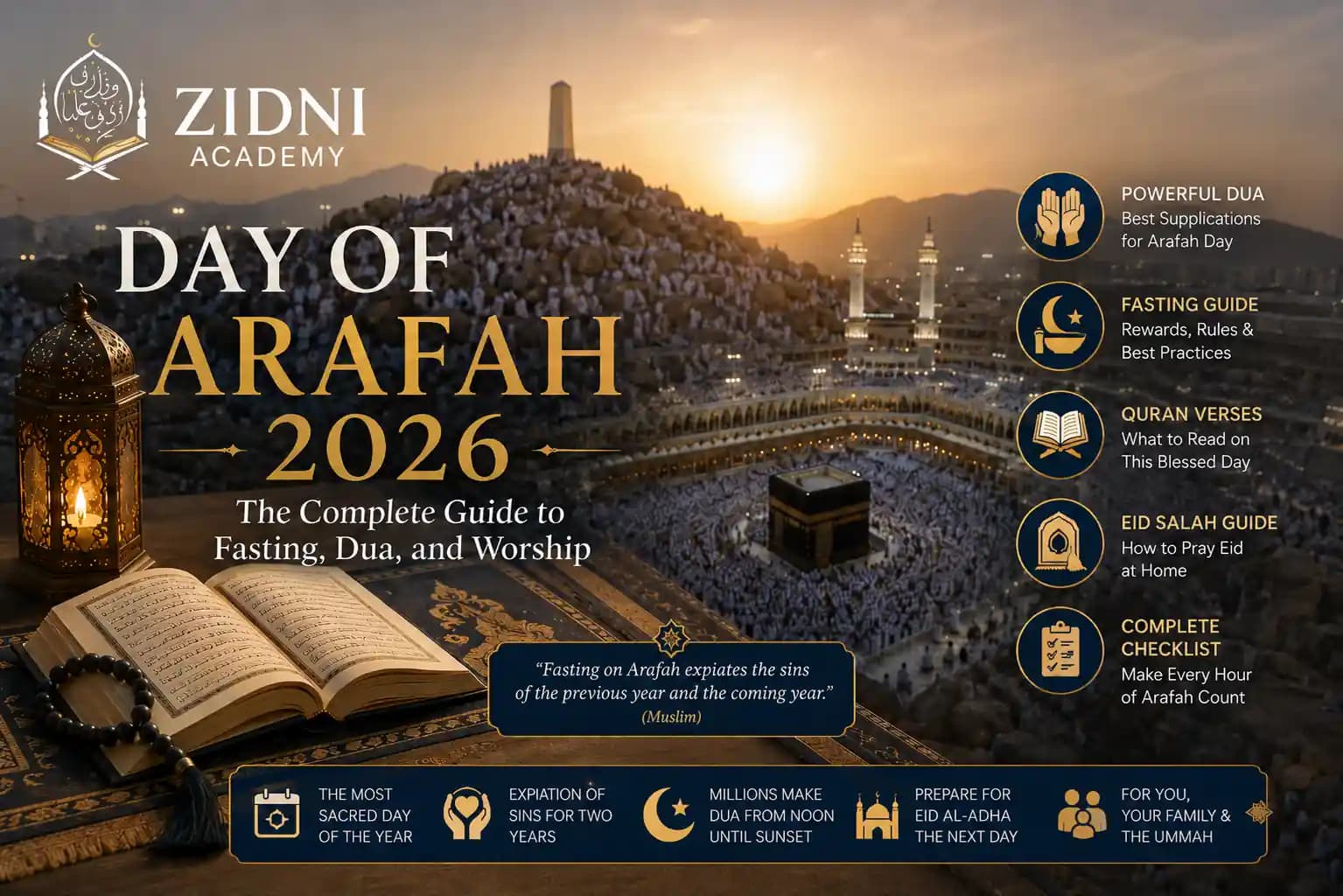
Day of Arafah 2026 — The Complete Guide to Fasting, Dua, and Worship
The Day of Arafah is the most sacred day of the Islamic year — a day the Prophet Muhammad ﷺ described as the day when Allah descends to the nearest heaven and boasts of His servants to the angels. In 2026, this blessed day falls on Tuesday, May 26, 2026. —which scholars describe as a doubly virtuous occasion. Whether you're fasting, making dua, reciting Quran, or preparing for Eid prayer the following morning, this guide gives you everything you need to make the most of every hour of this extraordinary day.
When Is the Day of Arafah 2026?
The Day of Arafah falls on the 9th of Dhul Hijjah every year — the second day of the Hajj pilgrimage, when millions of pilgrims gather on the plain of Arafah outside Makkah and stand in supplication from noon until sunset.
In 2026, the Day of Arafah is expected to fall on:
Country / Region | Expected Date |
|---|---|
Saudi Arabia | Tuesday 26 May 2026 |
UAE | Tuesday 26 May 2026 |
Qatar | Tuesday 26 May 2026 |
Kuwait | Tuesday 26 May 2026 |
UK & USA | Tuesday 26 May 2026 |
Jordan & Egypt | Tuesday 26 May 2026 |
Note: The exact date may vary by one day depending on moon sighting in each country. Always confirm with your local Islamic authority or mosque.
What Is the Reward of Fasting on the Day of Arafah?
The Prophet Muhammad ﷺ was asked about fasting on the Day of Arafah and said: "It expiates the sins of the previous year and the coming year." (Muslim)
This single hadith captures why fasting on Arafah is one of the most highly recommended acts of worship in the entire Islamic calendar — for Muslims who are not performing Hajj. In one day of fasting, two full years of minor sins are expiated. No other voluntary fast carries this level of reward in any authentic Islamic text.
Key points about fasting Arafah 2026:
- It is a Sunnah Mu'akkadah (confirmed Sunnah) for non-pilgrims
- Pilgrims performing Hajj do not fast on this day
- The fast runs from Fajr to Maghrib — exactly like Ramadan
- It is permissible to fast alone without the community
How to Fast on the Day of Arafah 2026
Fasting on the Day of Arafah follows the same rules as any voluntary fast:
1. Make your intention (niyyah) the night before
The majority of scholars recommend making the intention for voluntary fasting before Fajr. Silently intending in your heart that you are fasting the Day of Arafah seeking Allah's pleasure is sufficient.
2. Eat suhoor before Fajr
Suhoor is recommended — the Prophet ﷺ said: "Take suhoor, for in suhoor there is blessing." (Bukhari & Muslim)
3. Abstain from food, drink, and all things that break the fast from Fajr to Maghrib
The fast is broken at Maghrib — the same time as Ramadan.
4. Maximise worship throughout the day
Unlike Ramadan where the nights are precious, on Arafah the day itself is the focus — particularly the time from Dhuhr to sunset, which mirrors when the pilgrims are standing on the plain of Arafah.
Fasting Arafah 2026 in the UAE and Gulf:
For students and working professionals in the UAE, Qatar, Kuwait, and Saudi Arabia — the Day of Arafah 2026 falls on Tuesday, making it a public holiday in many Gulf countries and creating an ideal opportunity for extended worship without interrupting work schedules.
What Is the Best Dua for the Day of Arafah?
The most famous and authentic dua for the Day of Arafah was taught by the Prophet ﷺ himself. He said: "The best supplication is the supplication of the Day of Arafah, and the best thing I and the Prophets before me have said is:"
لَا إِلَهَ إِلَّا اللَّهُ وَحْدَهُ لَا شَرِيكَ لَهُ، لَهُ الْمُلْكُ وَلَهُ الْحَمْدُ وَهُوَ عَلَى كُلِّ شَيْءٍ قَدِيرٌ
Transliteration: Lā ilāha illallāhu waḥdahu lā sharīka lah, lahu'l-mulku wa lahu'l-ḥamdu wa huwa 'alā kulli shay'in qadīr
Translation: "There is no god but Allah alone, with no partner. To Him belongs all sovereignty and all praise, and He has power over all things."
This is the best dua for the Day of Arafah — and it should be repeated abundantly throughout the day, especially between Dhuhr and Maghrib.
Arafah Fasting Dua — What to Say and When
The Day of Arafah is a day of supplication from its beginning to its end. Here is a complete guide to what to read and when:
From Fajr to Dhuhr
- Pray Fajr in congregation or at home with full focus
- Read your morning adhkar (Ayat Al-Kursi, the three Quls, morning duas)
- Recite Quran — Surah Al-Ikhlas, Al-Falaq, An-Nas, Al-Baqarah if possible
- Make personal dua in your own language — this is the time to ask for everything
From Dhuhr to Asr — The Golden Hour
This is the period that mirrors the standing of the pilgrims on Arafah. Maximize:
- The Arafah dua above (repeat abundantly)
- Tahleel: Lā ilāha illallāh
- Tahmeed: Alḥamdulillāh
- Takbeer: Allāhu Akbar
- Tasbeeḥ: Subḥānallāh
- Personal dua for yourself, your family, and the Ummah
From Asr to Maghrib — The Final Stretch
The last hour before Maghrib is considered among the most powerful times for dua acceptance. Do not spend this time in idle conversation or distraction. Save your most heartfelt supplications for these final moments before breaking your fast.
Dua for Arafah Day in English — For New Muslims and Non-Arabic Speakers
Making dua in your own language is not only permitted — it is encouraged. Allah hears every language, and the sincerity of your heart matters infinitely more than the language of your words.
Here are core supplications for Arafah day in English:
For forgiveness:
"O Allah, You are Al-Ghafoor Al-Raheem — the Most Forgiving, the Most Merciful. I ask You to forgive all my sins, the ones I remember and the ones I have forgotten, the ones I committed openly and the ones I kept hidden."
For the Ummah:
"O Allah, have mercy on the Muslim Ummah. Guide those who are astray, heal those who are sick, free those who are oppressed, and unite our hearts on Your path."
For personal needs:
Pour your heart out to Allah in whatever language comes naturally to you. The Day of Arafah is the day to ask for what you've been too hesitant to ask on any other day — because this is the day Allah boasts of His servants and answers their supplications most abundantly.
What to Read on the Day of Arafah — Quran Verses
The Day of Arafah is one of the best days to recite Quran. Here are the most recommended verses and Surahs for this blessed day:
Arafah Day Quran Verses — Surah Al-Baqarah (2:255) — Ayat Al-Kursi
The greatest verse in the Quran — recited for protection and closeness to Allah. Recite it after every prayer and as often as possible throughout the day.
Surah Al-Ikhlas, Al-Falaq, and An-Nas
The Prophet ﷺ recommended reciting these three Surahs three times each morning and evening. On Arafah day, increase their recitation throughout the day.
Surah Al-Kahf
Many scholars recommend reciting Surah Al-Kahf on Tuesday — and when Arafah falls on a Tuesday as it does in 2026, reciting Al-Kahf carries double significance.
The Last Two Verses of Surah Al-Baqarah (2:285–286)
"Allah does not burden a soul beyond that it can bear..." — these two verses are a Sunnah to recite every evening and carry special virtue on sacred days.
Surah Al-Fatiha
Read Al-Fatiha with full presence and reflection. On the Day of Arafah, every letter of this Surah is a conversation with Allah — its seven verses are His response to your words.
What Is the Difference Between Arafah Day and Eid Al-Adha?
Many Muslims — especially new Muslims — confuse the Day of Arafah with Eid Al-Adha. Here is the clarification:
Day of Arafah | Eid Al-Adha | |
|---|---|---|
Date | 9th of Dhul Hijjah | 10th of Dhul Hijjah |
In 2026 | Tue, 26 May 2026 | Wednesday, May 27, 2026 |
What it is | The greatest day of worship | The festival day of sacrifice |
Fasting | Highly recommended (for non-pilgrims) | Forbidden — no fasting on Eid |
Eid Prayer | Not applicable | Performed in the morning |
For pilgrims | Standing on the plain of Arafah | Slaughtering the sacrifice |

How to Pray Eid Salah at Home — Complete Guide for 2026
The morning after the Day of Arafah is Eid Al-Adha. Many Muslims — particularly those in non-Muslim majority countries — need to know how to pray Eid salah at home or in small congregations. Here is a complete guide:
How Do I Pray Eid Salah as a New Muslim?
Eid prayer (Salat Al-Eid) is a congregational prayer performed in the morning of Eid day. If you cannot access a mosque or community prayer, you can pray it at home — though the congregation is preferred.
Basic structure of Eid prayer:
- Two Rak'ahs (units of prayer)
- Additional Takbeers (saying "Allahu Akbar") beyond the standard prayer
- Performed after sunrise, before Dhuhr
How Many Takbeer in Eid Prayer?
The Eid prayer contains additional Takbeers in both Rak'ahs:
First Rak'ah:
- Opening Takbeer (Takbeerat Al-Ihram) — 1
- Additional Takbeers before recitation — 6 extra Takbeers (according to the majority of scholars)
- Al-Fatiha and Surah recitation as normal
Second Rak'ah:
- Standing Takbeer — 1
- Additional Takbeers before recitation — 5 extra Takbeers
- Al-Fatiha and Surah recitation as normal
Note: There are minor differences between madhabs on the exact number. The Maliki school says 6+5, Hanbali says 6+5, Hanafi says 3+3. Follow your madhab or local scholarly opinion.
What Is the Difference Between Eid Prayer and Regular Prayer?
Feature | Regular (Fard) Prayer | Eid Prayer |
|---|---|---|
Number of Rak'ahs | Varies (2–4) | 2 Rak'ahs |
Extra Takbeers | None | 6 in first, 5 in second |
Khutbah | Before prayer (Jumu'ah) | After prayer (Eid) |
Timing | Fixed five times daily | Once yearly, after sunrise |
Congregation | Preferred but not required | Strongly preferred |
Adhan | Yes (for fard prayers) | No adhan or iqamah |
Do I Need Wudu for Eid Prayer?
Yes — Wudu (ritual purification) is required for Eid prayer, exactly as it is for any Salah. There is no difference between Eid prayer and regular prayer in this regard.
Before attending Eid prayer, it is also Sunnah to:
- Perform Ghusl (full bath)
- Wear your best clothes
- Apply perfume (for men)
- Eat something sweet (dates are traditional) before going — unlike Eid Al-Fitr where eating before prayer is obligatory, on Eid Al-Adha it is preferred to eat after the sacrifice
How Do I Pray Eid Salah at
Home?
If you cannot attend a mosque or community Eid prayer, you can pray at home with family:
Step-by-step:
- Make intention for Eid prayer (niyyah in your heart)
- Stand facing Qiblah
- Say opening Takbeer (Allahu Akbar) and raise your hands
- Say 6 additional Takbeers, raising your hands and pausing briefly between each
- Recite Al-Fatiha and a Surah (Al-A'la is traditional for first Rak'ah)
- Complete the Rak'ah normally (rukoo, sujood)
- Stand for second Rak'ah, say 5 additional Takbeers
- Recite Al-Fatiha and a Surah (Al-Ghashiyah is traditional)
- Complete the second Rak'ah and give salaam
No khutbah is required when praying at home.
Day of Arafah Checklist — Make Every Hour Count
Use this checklist to prepare for the Day of Arafah 2026:
The night before (Tuesday 26 May 2026 ):
- Make intention to fast Arafah
- Set alarm for Suhoor
- Write a personal dua list — things you want to ask Allah for
- Read or listen to a short reminder about Arafah
Suhoor (before Fajr, May 26, 2026):
- Eat a light suhoor with dates and water
- Make your fast intention explicit
- Pray Tahajjud if you can rise early enough
After Fajr:
- Pray Fajr with full focus
- Read morning adhkar completely
- Begin Quran recitation — aim for at least one Juz
Dhuhr to Maghrib — the heart of the day:
- Repeat the Arafah dua abundantly
- Make tahleel, tahmeed, takbeer, tasbeeḥ
- Make personal dua for yourself, family, and Ummah
- Recite Surah Al-Kahf (it's a Friday)
- Give sadaqah (charity) — even a small amount
Breaking fast at Maghrib:
- Break fast with dates and water following the Sunnah
- Say: Allahumma laka sumtu wa bika amantu wa 'alayka tawakkaltu wa 'ala rizqika aftartu
Evening of Eid (after Maghrib):
- Begin saying Takbeeraat Al-Tashriq: Allahu Akbar, Allahu Akbar, lā ilāha illallāh, Allahu Akbar, Allahu Akbar, wa lillāhi'l-ḥamd
- Prepare your Eid clothes for tomorrow
- Sleep early to wake refreshed for Eid prayer
 Why the Day of Arafah Falling on a Tuesday in 2026 Is Special
The Day of Arafah falling on a Tuesday is considered especially auspicious by Islamic scholars. Friday is the best day of the week — the day of Jumu'ah, the day Adam was created and entered Jannah, and the day that contains the blessed hour when dua is answered.
When Arafah falls on Tuesday, scholars have noted that it amplifies the rewards of worship, and some have described it as a convergence of the two greatest regular times of worship in Islam. Make the most of every moment of this rare convergence in 2026.
Prepare Your Quran and Tajweed for the Sacred Days
The Day of Arafah is one of the best opportunities to reconnect with the Quran — both in recitation and in meaning. If you want to ensure your Quran recitation is correct, and that you're reciting the Arafah duas and Quranic verses with proper Tajweed, our certified Al-Azhar teachers at Zidni Academy are available year-round.
Whether you're a beginner wanting to recite Al-Fatiha correctly, or an advanced student preparing for Ijazah — start with a free trial session and let a certified teacher guide your recitation.
Frequently Asked Questions
Q: What is the best dua for the Day of Arafah?
The best dua for the Day of Arafah, as taught by the Prophet ﷺ, is: "Lā ilāha illallāhu waḥdahu lā sharīka lah, lahu'l-mulku wa lahu'l-ḥamdu wa huwa 'alā kulli shay'in qadīr" — meaning "There is no god but Allah alone, with no partner. To Him belongs all sovereignty and all praise, and He has power over all things." The Prophet ﷺ said this is the best thing he and all the Prophets before him have said.
Q: How to fast on the Day of Arafah?
Fasting on Arafah follows the same rules as voluntary fasting: make the intention before Fajr, abstain from food and drink from Fajr to Maghrib, and break the fast at sunset. It is recommended for all Muslims who are not performing Hajj. The reward is the expiation of the sins of the previous and coming year, as stated in an authentic hadith.
Q: What is the reward of fasting the Day of Arafah?
The Prophet ﷺ said fasting on Arafah expiates the sins of the previous year and the coming year (Muslim). It is one of the most rewarding single-day voluntary fasts in the Islamic calendar — available to every Muslim who is not on Hajj.
Q: What Quran verses to read on the Day of Arafah?
The most recommended Quran recitations for Arafah day include: Ayat Al-Kursi (2:255), Surah Al-Ikhlas, Al-Falaq and An-Nas, Surah Al-Kahf (especially when recited throughout sacred days such as Arafah), and the last two verses of Surah Al-Baqarah (2:285–286). Any Quran recitation is rewarded, but these carry special emphasis.
Q: How do I pray Eid salah at home?
Eid prayer at home consists of two Rak'ahs with extra Takbeers — 6 additional Takbeers in the first Rak'ah and 5 in the second, before reciting Al-Fatiha in each. Pray facing the Qiblah with family if possible. No adhan, iqamah, or khutbah is required when praying at home.
Q: How do I pray Eid salah as a new Muslim?
Eid salah is two Rak'ahs performed after sunrise on Eid morning. It is like a regular two-Rak'ah prayer but with extra Takbeers (6 in the first Rak'ah and 5 in the second) before the Fatiha recitation. If you are unsure, follow someone experienced or watch a short instructional video. The key is intention and participation — Allah accepts from the sincere.
Q: How many Takbeer in Eid prayer?
According to the majority of scholars (Maliki, Shafi'i, Hanbali), there are 6 additional Takbeers in the first Rak'ah and 5 in the second, in addition to the opening Takbeer and the Takbeer for rukoo. The Hanafi school says 3 in the first and 3 in the second. Follow your madhab or local scholarly guidance.
Q: What is the difference between Eid prayer and regular prayer?
Eid prayer differs from regular prayer in several ways: it has additional Takbeers (6+5 or 3+3), it has no adhan or iqamah, the khutbah comes after the prayer instead of before, and it is performed once a year after sunrise on Eid morning. Wudu is still required, and the basic structure (Al-Fatiha, Surah, rukoo, sujood) remains the same.
Q: Do I need wudu for Eid prayer?
Yes. Wudu (ritual purification) is required for Eid prayer, exactly as it is for any Salah. It is also Sunnah to perform full Ghusl (bath), wear your best clothes, and apply perfume before Eid prayer.