
How Long Does It Take to Read Quran? A Complete Guide for Kids in the USA & UK
How Long Does It Take to Read Quran? A Complete Guide for Kids in the USA & UK
How long does it take to read Quran? If you already read Arabic fluently, reading the entire Quran may take roughly 25–40 hours, depending on your reading speed, pauses, and recitation style. But for parents in the USA and UK, there is another important question: how long does it take a child to learn to read the Quran in the first place?
That timeline is very different.
A beginner needs to learn Arabic letters, sounds, connected letters, Quranic words, and eventually accurate recitation. This guide explains realistic timelines for children, adults, Quran reading, Tajweed, completing the whole Quran, and memorisation—so you can set a goal that helps your child progress without turning Quran learning into a race.
How Long Does It Take to Read the Quran?
For someone who can already read Arabic and is comfortable with Quranic script, a complete reading of the Quran can take approximately 25–40 hours.
The actual time depends on:
- Reading speed
- Arabic reading fluency
- Familiarity with Quranic vocabulary
- Recitation pace
- Tajweed accuracy
- Pauses and repetitions
- Whether the reader is simply reading or reciting carefully
A fluent adult may move through the Mushaf much faster than a child who is still developing reading skills.
So if someone asks, “How Long Does It Take To Read The Quran?”, the simplest answer is:
A fluent reader may need around 25–40 hours to complete the Quran, but a beginner or child learning to read needs a much longer learning journey.
That distinction is especially important for parents.
How Long Does It Take to Read the Whole Quran?
The answer depends on how much you read each day.
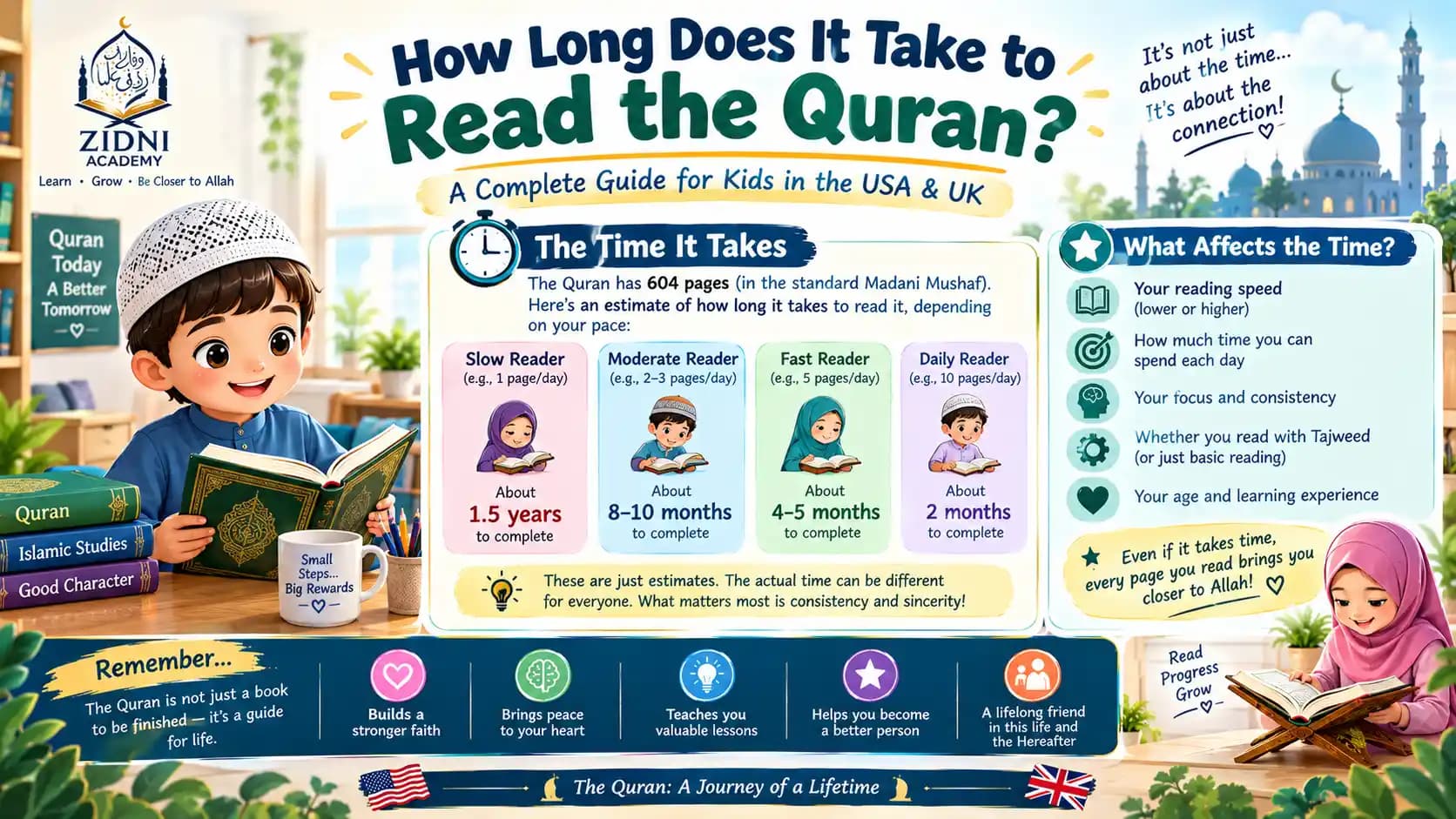
The standard Medina-style Mushaf contains 604 pages, so you can create a simple reading schedule based on your daily target.
Daily Reading | Approximate Time to Finish |
|---|---|
1 Juz daily | About 30 days |
10 pages daily | About 2 months |
5 pages daily | About 4 months |
2 pages daily | About 10 months |
1 page daily | About 20 months |
These are mathematical planning estimates, not religious requirements.
For an experienced adult reader, completing the Quran in a month may be a realistic personal goal. For a child, however, the better objective may be building a consistent Quran reading habit rather than finishing a specific number of pages.
How Long Does It Take to Read the Entire Quran With Tajweed?
If you are asking how long does it take to read the entire Quran while applying Tajweed carefully, expect the process to take longer than simply moving quickly through the pages.
Tajweed requires attention to areas such as:
- Makharij
- Letter characteristics
- Madd
- Ghunna
- Qalqalah
- Noon Sakinah and Tanween
- Meem Sakinah
- Tafkheem and Tarqeeq
- Waqf and Ibtida
For children, this slower pace can actually be beneficial.
A child who pauses to correct pronunciation is not necessarily “behind.” They may be building the foundation needed for accurate Quran recitation later.
If your child already recognizes Arabic letters but needs to improve pronunciation and Quranic reading, a structured Quran reading program for beginners can provide a more appropriate starting point than simply asking the child to read more pages.

How Long Does It Take a Child to Learn to Read the Quran?
This is a completely different question from how long it takes to finish the Quran.
A child starting from zero may need to learn:
Arabic letters → sounds → Harakat → connected letters → words → short Surahs → fluent Quran reading
For young children, the process often takes several months before they become comfortable reading basic Quranic text, while reaching confident fluency can take considerably longer.
Age is only one factor.
A child's timeline can also depend on:
- Whether Arabic is spoken at home
- Previous exposure to Arabic letters
- Number of lessons each week
- Home practice
- Attention span
- Teacher feedback
- Pronunciation difficulties
- Consistency
This is why parents should be cautious about anyone promising that every child will become a fluent Quran reader within a fixed number of weeks.
How Long Does It Take to Learn Quran Reading for Kids?
For children in the USA and UK, Quran learning usually works best when it fits naturally around school, homework, sleep, and family life.
A young child might begin with short lessons and gradually increase the amount of reading.
A practical progression can look like this:
Stage 1: Arabic Letters
The child learns to recognize and pronounce the letters.
Stage 2: Harakat
The child learns how short vowel marks change pronunciation.
Stage 3: Connected Letters
The child learns how Arabic letters connect inside words.
Stage 4: Quranic Words
The child starts combining what they have learned into real Quranic words.
Stage 5: Short Surahs
The child begins reading familiar Quranic passages.
Stage 6: Fluency and Tajweed
The child gradually improves accuracy, rhythm, stopping, and application of Tajweed.
If your child is still at the first stages, beginning with structured Noorani Qaida classes can make more sense than measuring progress by how many Quran pages they can complete.
How Long Does It Take to Read the Quran for a Beginner?
A complete beginner should not be expected to follow the same timetable as someone who has been reading Quran for years.
For a beginner, the first goal is not speed.
It is decoding Arabic correctly.
For example, a child may spend time learning the difference between similar sounds before they can comfortably read a full Quranic sentence.
That early work matters.
If a child learns incorrect pronunciation and repeats it every day, correcting the mistake later may be more difficult than establishing the correct sound from the beginning.
This is why one-to-one instruction can be especially valuable during the early stages of Quran reading.
How Long Does It Take to Recite the Quran?
How long does it take to recite the Quran? There is no single answer because recitation speed differs from one person to another.
A fluent reader may recite relatively quickly.
A child learning Tajweed may recite slowly because they are concentrating on:
- Correct pronunciation
- Letter characteristics
- Madd
- Ghunna
- Stopping correctly
- Repeating difficult words
That slower pace should not automatically be treated as a problem.
In Quran learning, accuracy comes before speed.
Once the child becomes comfortable with the letters, words, and rules, fluency can develop naturally.
How Many Pages of Quran Should a Child Read Each Day?
There is no universal number of pages that every child should read.
Instead, choose a target according to the child's age and level.
For example:
Child's Stage | Practical Starting Point |
|---|---|
Complete beginner | 5–10 minutes |
Early reader | 10–15 minutes |
Developing reader | 15–20 minutes |
Confident reader | 20–30 minutes |
Advanced student | Individual page/Juz goal |
These are planning examples, not fixed requirements.
For younger children, even a short daily practice session can be valuable when it is consistent.
The important question is not:
“How many pages did my child finish?”
It is:
“Is my child becoming more accurate and confident?”
How Long Should a Child Practice Quran Each Day?
For children, consistency is usually more useful than occasional long sessions.
A simple routine could be:
10 minutes reading + 5 minutes review
or:
15 minutes reading + 5 minutes memorisation
For older children:
20–30 minutes of structured Quran practice
may be more appropriate.
If your child has a difficult school day, reducing the practice time can be better than turning Quran into a source of daily conflict.
The objective is to create a relationship with the Quran that can continue for years.
How Long Does It Take to Read the Whole Quran in 30 Days?
A 30-day Quran completion plan generally means reading approximately one Juz each day.
With a 604-page Mushaf, that works out to roughly 20 pages per day.
For an experienced adult reader, this can be divided across the five daily prayers.
For example:
4 pages after each prayer × 5 prayers = 20 pages per day
But this should not automatically become a child's target.
A child who is still learning Quran reading may benefit much more from reading two pages accurately than rushing through twenty pages without understanding the words or applying correct pronunciation.
How Long Does It Take to Memorise Quran?
How long does it take to memorise Quran? This is a different question from reading.
Reading the entire Quran can be measured in hours.
Full Quran memorisation is normally measured in years because memorisation requires both new learning and continuous revision.
For children studying alongside mainstream school, current educational guidance gives a broad range of around 5–7 years for full Hifz in a part-time structure, although individual timelines vary substantially.
A child might spend only 30–60 minutes a day on Hifz but continue that routine consistently for years.
That can be more sustainable than an extremely intensive schedule that leaves little time for school, sleep, family, or revision.
Reading Quran vs. Memorising Quran
Parents sometimes confuse these two goals.
Reading the Quran | Memorising the Quran |
|---|---|
Reading from the Mushaf | Reciting without looking |
Can be measured in pages/minutes | Measured through new memorisation and revision |
Full completion can take weeks or months | Full Hifz generally takes years |
Main goal is accurate reading | Main goal is accurate retention |
Suitable as a daily habit | Requires a structured revision system |
A child can therefore become a good Quran reader without immediately beginning full Hifz.
In fact, establishing strong reading skills first can make later memorisation more manageable.
What Is the Best Age for a Child to Start Quran Reading?
There is no single perfect age for every child.
Some children are ready to begin recognizing Arabic letters at a very young age.
Others need more time to develop attention and readiness for structured lessons.
The better question is:
Can the child participate in a short, positive, consistent learning routine?
For young children, learning can begin through:
- Listening to Quran
- Recognizing Arabic letters
- Repeating short sounds
- Learning short Surahs
- Listening to stories from the Quran
- Practicing simple Islamic vocabulary
Formal reading skills can then develop gradually.
How Can Parents Help Children Learn Quran Faster?
The goal should not be to make the child rush.
Instead, make the learning process more efficient.
Practice a Little Every Day
Short daily practice can be easier to maintain than a long session once a week.
Review Before Adding New Material
Review prevents the child from repeatedly starting over.
Correct Pronunciation Early
If a child consistently mispronounces a letter, teacher feedback can prevent that mistake from becoming a habit.
Use Familiar Surahs
Reading familiar passages can build confidence and fluency.
Keep the Routine Predictable
A child who knows when Quran time happens is often less resistant to beginning.
Celebrate Progress
Praise improvement rather than comparing the child with siblings, classmates, or other students.
Why Children Often Need a Teacher
A parent may notice that a child is reading slowly.
But the real issue might be:
- Confusion between Arabic letters
- Weak Makharij
- Difficulty joining letters
- Lack of fluency
- Unfamiliarity with Quranic words
- A Tajweed problem
A qualified teacher can identify the actual problem rather than simply telling the child to read faster.
This is one reason a structured Quran teacher for children can make the learning process more focused.
The teacher can adjust the lesson according to the child's actual level instead of following the same pace for every student.
Can Online Quran Classes Help Children Read Better?
Yes, online learning can provide a structured environment when the program is designed around the child's needs.
For families in the USA and UK, online classes can also solve practical problems such as:
- Finding a suitable teacher
- Scheduling around school
- Avoiding travel
- Maintaining regular lessons
- Giving children individual attention
The key is not simply whether the lesson is online.
The key is whether the child receives live instruction, correction, practice, and a clear learning path.
For a child who is still building basic reading skills, a structured online Quran reading course for kids can be more useful than giving the child a Quran and asking them to practice independently.
When Should a Child Start Tajweed?
Tajweed does not have to mean teaching every advanced rule immediately.
A child can gradually develop correct pronunciation while learning to read.
Once the child can comfortably decode Quranic words, the teacher can progressively introduce rules and correct their application during recitation.
This creates a natural progression:
Reading foundation → Correct pronunciation → Basic Tajweed → Fluent recitation → Advanced Tajweed
Parents should therefore avoid thinking of reading and Tajweed as completely separate subjects.
They develop together over time.
How Zidni Academy Helps Children Build Quran Reading Skills
For Muslim families in the USA and UK, Zidni Academy provides a structured learning path for children who need to build Quran reading skills step by step.
The academy's approach combines live one-to-one lessons, qualified Al-Azhar teachers, flexible scheduling, and progressive Quran learning, allowing the teacher to work on the child's actual level rather than simply assigning a fixed number of pages.
For a child who is still learning the foundations, the learning path can begin with Arabic letters and Quran reading before progressing toward more confident recitation and Tajweed.
This matters because the goal is not simply to answer how long does it take to read Quran.
The goal is to help the child reach the point where they can read accurately, recite confidently, and continue learning independently.
A Practical Quran Learning Path for Children
A structured child's journey can look like this:
Level 1 — Quran Reading Foundations
Arabic letters, sounds, Harakat, and connected letters.
Level 2 — Quran Reading
Words, short Surahs, and increasing reading confidence.
Level 3 — Tajweed
Makharij, common Tajweed rules, and practical correction.
Level 4 — Fluent Recitation
Longer passages, Waqf, pacing, and improved accuracy.
Level 5 — Hifz
New memorisation combined with systematic revision.
This approach prevents parents from treating every Quran goal as one question.
Reading, recitation, Tajweed, and memorisation are connected—but they are not the same skill.
What Should Parents Ask Before Booking Quran Classes?
If your child needs help with Quran reading, don't ask only:
“How quickly can my child finish the Quran?”
Ask:
- What is my child's current Quran level?
- Can the teacher assess pronunciation?
- Will the teacher correct Makharij?
- How much home practice is recommended?
- How is progress measured?
- What happens if my child struggles with Arabic letters?
- When will Tajweed be introduced?
- Can the schedule work around school?
- Can the program later progress toward Hifz?
- Can we try a lesson before committing?
These questions help parents evaluate the learning process, not just the promised result.
How Long Does It Take to Read the Quran? A Simple Answer for Parents
If your child already reads Quran fluently, completing the entire Mushaf may take around 25–40 hours, depending on reading speed and recitation style.
If your child is a beginner, the answer is completely different.
They first need to develop:
Arabic reading → pronunciation → fluency → Tajweed → independent recitation
And if the family later chooses memorisation, Hifz becomes a separate long-term journey based on new memorisation plus revision.
So don't measure your child's Quran journey only by how many pages they finish.
Measure:
- Accuracy
- Fluency
- Confidence
- Consistency
- Retention
- Ability to recite independently
Frequently Asked Questions
How long does it take to read the whole Quran?
For a fluent Arabic reader, a complete reading may take approximately 25–40 hours, depending on speed and recitation style. A daily Juz-based schedule can spread completion across approximately 30 days.
How long does it take to read the entire Quran?
It depends on the daily reading target. With a 604-page Mushaf, reading 20 pages a day gives an approximately 30-day completion schedule, while smaller daily targets extend the timeline.
How long does it take to recite the Quran?
There is no fixed time. Experienced readers may recite faster, while children and learners applying Tajweed may need more time because they are concentrating on pronunciation and stopping correctly.
How long does it take a child to learn to read Quran?
It varies according to age, starting level, practice, lesson frequency, teacher support, and consistency. A child starting from zero should normally be given a gradual learning plan rather than a fixed promise of completion.
How long does it take to memorise Quran?
Full Hifz generally takes years rather than weeks or months. Children studying alongside school may follow a part-time timeline of several years, with current guidance giving approximately 5–7 years as one realistic range.
Can a child finish reading the Quran in 30 days?
A child who already reads fluently may be able to follow a 30-day reading plan. A complete beginner should not be expected to learn Quran reading from zero and become fluent within one month.
How many pages should a child read each day?
There is no universal target. A small, consistent amount that the child can read accurately is usually more useful than a large target that creates stress.
Is it better for children to read Quran quickly?
Not necessarily. Accuracy, correct pronunciation, Tajweed, confidence, and consistency are more important than simply increasing reading speed.
Should children learn Quran reading before memorising?
Strong reading and pronunciation skills can provide a useful foundation for memorisation. Hifz also requires a reliable revision system, not only the ability to read new verses.
Give Your Child a Clear Quran Learning Plan
The question “how long does it take to read Quran?” is useful—but only after you know what stage your child is actually at.
If your child is still learning Arabic letters, the priority is building the reading foundation.
If your child can already read but struggles with pronunciation, the next step may be Tajweed and teacher correction.
If your child reads confidently and wants to memorise, a structured Hifz plan may be appropriate.
At Zidni Academy, parents can start with a free trial lesson so a qualified teacher can understand the child's current level and recommend an appropriate learning path.
Instead of guessing how long your child will need, start by finding out where your child should start.
Book a free trial lesson and give your child a structured path from Quran reading to confident recitation.