
How to Learn Quran Fast and Easy — 9 Proven Methods That Actually Work
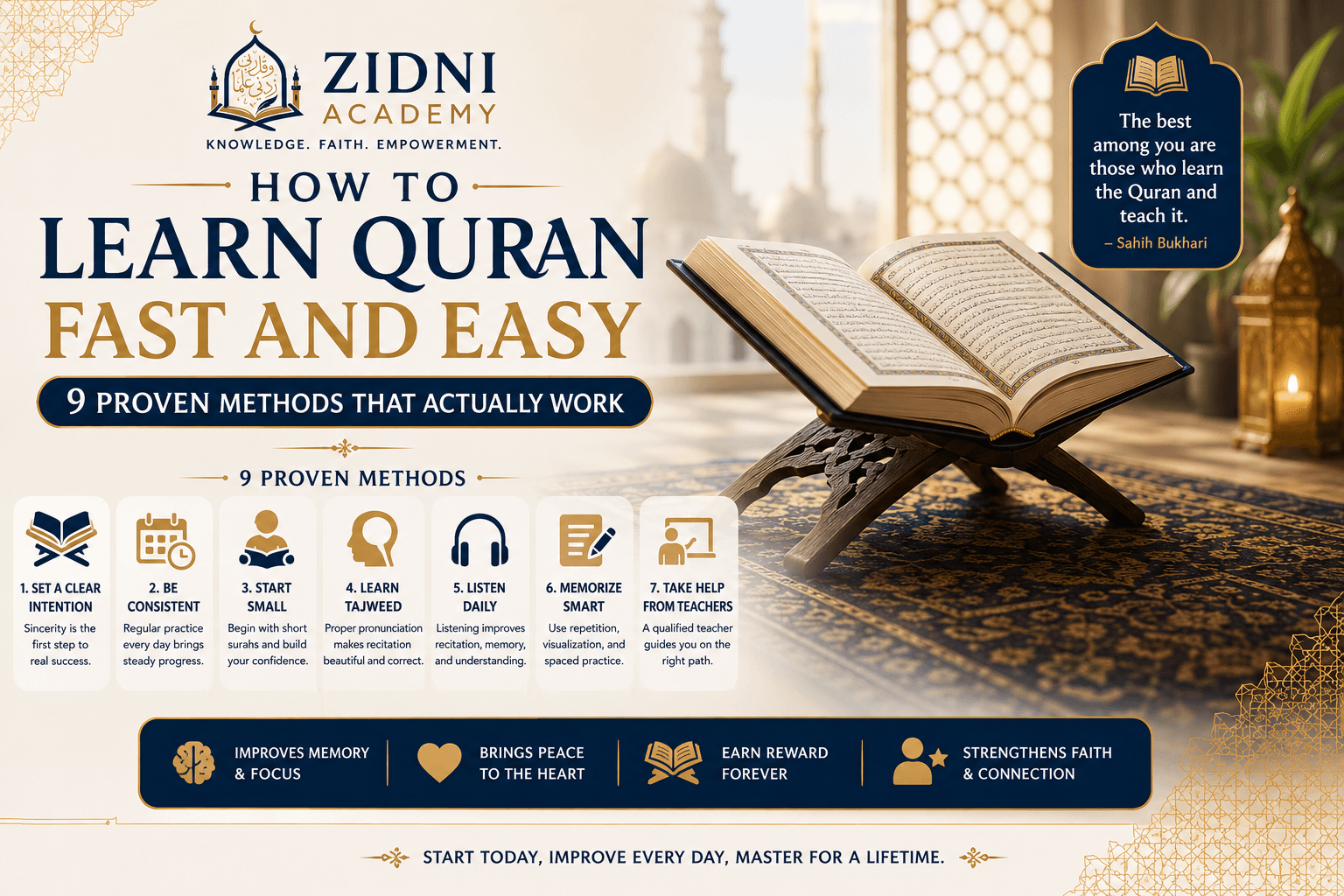
How to Learn Quran Fast and Easy — 9 Proven Methods That Actually Work
Searching for how to learn Quran fast and easy without wasting months on the wrong approach? You're in the right place. Whether you're in the US, UK, Australia, Canada, Belgium, or anywhere across the Gulf, the desire to learn or memorize the Quran quickly is universal — but the methods that actually work are often misunderstood. This guide breaks down 9 proven, realistic methods for learning Quran fast and easy, explains popular memorization techniques people search for, and answers the most common questions about speed, benefits, and what genuinely accelerates progress with a qualified teacher.
What Does "Fast and Easy" Really Mean for Quran Learning?
Before diving into methods, it's worth being honest about what learning Quran fast and easy actually looks like in practice. "Fast" doesn't mean instant, and "easy" doesn't mean effortless — it means efficient, well-structured, and free of the wasted time that comes from learning without guidance or using the wrong approach for your goal.
The fastest path to real Quran fluency or memorization always combines three things: a clear, proven method; consistent daily practice; and a qualified teacher who corrects errors before they become habits. Skip any one of these three, and progress slows dramatically — no matter how many "hacks" or shortcuts you try.
9 Fast Ways to Memorize the Quran
1. Start With Tajweed, Not Just Memorization
The single biggest mistake that slows down Quran memorization is memorizing first and correcting pronunciation later. Learning Tajweed rules alongside memorization — not after it — means every verse you commit to memory is correct from day one, eliminating the need to "re-learn" verses later, which is one of the most time-consuming setbacks in Hifz.
2. Use Short, Repeated Sessions Instead of Long, Rare Ones
Research on memory consolidation consistently shows that several short, focused sessions (15-30 minutes) spread across the day or week produce stronger retention than one long session. Reciting a new verse 10 times in one sitting is far less effective than reciting it 10 times across three separate sessions throughout the day.
3. Always Connect New Verses to Recently Memorized Ones
Rather than memorizing isolated verses, link each new verse to what you memorized immediately before it. Reciting the new verse together with the previous 2-3 verses every time reinforces the flow and sequence — making the material far harder to forget and much faster to recall under pressure.
4. Listen Before You Recite
Listening to a correct, fluent recitation of a verse several times before attempting it yourself trains your ear to recognize correct Tajweed and rhythm. This single step dramatically reduces the number of repetitions needed to memorize the verse accurately.
5. Write the Verse While You Memorize It
For visual learners especially, writing out the Arabic text of a verse by hand while memorizing it engages a different part of memory than recitation alone — creating a stronger, more multi-dimensional memory trace that speeds up long-term retention.
6. Revise Daily, Without Exception
The fastest Hifz students aren't necessarily the ones who memorize the most new material each day — they're the ones who never skip revision of what they've already memorized. Daily revision prevents the silent decay that forces students to re-memorize forgotten portions later, which is the single biggest hidden time-waster in Quran memorization.
7. Set a Specific, Realistic Daily Target
Vague goals like "memorize as much as I can" produce inconsistent results. A specific daily target — whether it's 3 verses, half a page, or a full page depending on your level — creates measurable accountability and makes consistent daily progress far more achievable.
8. Recite in Prayer Immediately
As soon as you've memorized a new short Surah or passage, begin reciting it in your daily prayers right away. This adds powerful, naturally repeated reinforcement five times a day — reinforcement that happens automatically as part of your existing routine, with zero extra study time required.
9. Get Live Correction From a Qualified Teacher
This is, without exception, the single most important factor in learning Quran fast and easy. A teacher catches pronunciation errors and forgotten words immediately — preventing the repeated mistakes that, left uncorrected, can take months to unlearn later. Every other method on this list works significantly better when paired with regular sessions with a certified teacher.
How to Memorize the Quran Very Quickly — What People Search For
Many students searching for how to learn Quran fast and easy come across specific numbered "methods" online — like the 3x3 method, the 20/20 method, or the "6446 method." Here's an honest breakdown of what these terms generally refer to, and what actually matters behind them:
The "3x3 method"
typically refers to reciting a new verse or short passage three times, then reviewing it again three more times later in the day — a simple spaced-repetition pattern that does have genuine memory science behind it (repetition spread across time beats repetition crammed together).
The "20/20 method"
generally describes splitting study time into 20 minutes of new memorization and 20 minutes of revision in each session — a practical way of ensuring revision never gets neglected in favor of only adding new material.
The "6446 method"
and similar numbered systems you may encounter online are popular online shorthand for specific repetition counts or daily page targets — but there's no single official scholarly method by this name, and numbers like these vary wildly between different teachers and programs.
The honest takeaway:
the underlying principles behind all of these — spaced repetition, balancing new memorization with revision, and consistent daily practice — are genuinely effective and well-supported. But no numbered formula replaces what actually accelerates memorization most: working with a real teacher who adapts the pace, repetition count, and revision schedule to your specific memory and learning style.
How to Become a Hafiz in 2 Years — Is It Realistic?
Becoming a Hafiz (someone who has memorized the entire Quran) in 2 years is achievable for students who can commit to intensive, near-daily sessions with a structured revision system — but it requires a serious time commitment, not a shortcut.
To complete the full Quran (approximately 600 pages) in 2 years, a student needs to memorize roughly 1 page per day on average, while simultaneously reviewing everything previously memorized on a rotating schedule. This pace is realistic for students — often young people in full-time Islamic education, or highly motivated adults with significant daily study time — but it is genuinely demanding.
For most working adults and students balancing other responsibilities, a more sustainable and equally valid timeline is 3 to 5 years, with consistent daily sessions of 30-60 minutes. The goal of "fast" memorization should never come at the cost of accuracy or long-term retention — a Hafiz whose memorization is shaky after rushing provides far less benefit than one whose pace was realistic but whose memorization is rock solid.
What Is the Easiest Way to Learn the Quran for Beginners?
For complete beginners asking how to learn Quran fast and easy, the easiest and most effective sequence follows this order:
Step 1 — Learn the Arabic alphabet and Makharij (articulation points).
This is the non-negotiable foundation. Skipping it to "save time" guarantees incorrect pronunciation habits that take far longer to fix later.
Step 2 — Learn the Harakat (short vowels).
Once you know the letters, the vowel system unlocks the ability to read any Quranic word.
Step 3 — Apply basic Tajweed immediately.
Don't wait until you can "read well" to start Tajweed — learn the fundamental rules from your very first words.
Step 4 — Start with the shortest, most familiar Surahs
. Surahs from Juz Amma that you may already recognize from daily prayer are the easiest entry point into real Quranic recitation.
Step 5 — Practice daily with a teacher who corrects you live.
This single step is what separates beginners who progress quickly from those who plateau after the first few weeks.
This is also the easiest way to learn the Quran for non-Arabic speakers specifically — the sequence above works identically whether you're a native Arabic speaker or starting from zero.
Does the Quran Lower Cortisol and Reduce Anxiety?
A commonly searched question alongside how to learn Quran fast and easy is whether reciting or listening to the Quran has measurable calming effects. Several research studies — particularly in psychology and Islamic studies journals — have examined Quranic recitation's effects on stress and found associations between listening to or reciting the Quran and reduced physiological markers of stress, including cortisol levels, in some study populations.
From an Islamic perspective, this aligns with what the Quran describes about itself — as a source of guidance, comfort, and tranquility for believers, particularly through the practice of reciting it with presence and reflection (tadabbur), not simply as background sound.
Which Surah reduces stress most?
Many Muslims report particular peace from Surah Ar-Rahman, Surah Yasin, and Surah Al-Fatiha — though this is a deeply personal experience that varies between individuals, and any consistent, mindful Quran recitation tends to produce a calming effect over time as part of one's regular spiritual practice.
It's worth noting clearly: the Quran is a source of spiritual guidance and comfort, not a substitute for appropriate medical or psychological treatment for anxiety or other mental health conditions. Many Muslims find that recitation complements, rather than replaces, appropriate care when needed.
What Happens If You Read the Quran Every Day?
Daily Quran reading — even without memorization as the specific goal — produces compounding benefits over time:
Reinforced familiarity — Even casual daily reading builds growing familiarity with Quranic Arabic, vocabulary, and recurring phrases, making future memorization and comprehension significantly easier.
Improved Tajweed through repetition — Daily reading, especially with a teacher's periodic correction, naturally improves pronunciation accuracy over time, simply through consistent practice.
Spiritual consistency — Many Muslims describe daily Quran reading as an anchor for their day — a consistent point of connection to their faith regardless of how busy or difficult the day becomes.
Gradual memorization, even unintentionally — Many Muslims find that frequently read Surahs become memorized naturally over time, even without deliberate memorization effort — simply through the power of repeated exposure.
Interesting Quran Facts People Search For
Several curiosity-driven questions about the Quran often come up alongside how to learn Quran fast and easy searches — here are accurate answers to the most common ones:
Which country has the most Hafiz?
Indonesia is widely cited as having one of the largest populations of Huffaz (Quran memorizers) in the world, given its position as the country with the largest Muslim population globally, alongside strong Hifz education traditions in countries like Egypt, Pakistan, and across the Arab world.
What word is repeated most frequently in the Quran?
Different scholarly analyses point to different specific words depending on counting methodology (root forms vs. exact word forms), but Allah's name itself appears more than 2,600 times, while words related to faith, guidance, and mercy appear with notably high frequency throughout the text.
Is it haram to say "OMG"?
This question, while seemingly unrelated, often comes up in searches about everyday Islamic conduct. Many scholars caution against using exclamations that invoke God's name casually or disrespectfully — including phrases like "Oh my God" used as a flippant expression — encouraging Muslims to use Allah's name only with intention and reverence, such as in genuine remembrance (dhikr) or sincere supplication.
What Is the 7-7-7 Rule in Islam?
This phrase circulates online with varying explanations, and it's important to be clear that there is no single, universally agreed-upon "7-7-7 rule" as an established Islamic teaching or numbered system in classical scholarship. The number 7 does appear meaningfully throughout Islamic tradition — the seven heavens, the seven circuits of Tawaf around the Kaaba, and various Hadith referencing groupings of seven — but searches for a specific "7-7-7 rule" often stem from informal social media content rather than verified Islamic sources.
If you've encountered a specific claim under this name, the most reliable approach is verifying it against a qualified Islamic scholar or trusted, sourced reference — rather than treating viral online claims as established religious rulings.
The Fastest Way to Actually Learn Quran — With a Real Teacher
After covering methods, techniques, and the search terms people commonly look for, the most important truth about how to learn Quran fast and easy remains simple: every method works significantly better — and far faster — with a qualified teacher guiding you.
At Zidni Academy, our certified Al-Azhar teachers combine the proven techniques covered in this guide — Tajweed-first learning, structured revision, realistic daily targets, and live correction — into a personalized program built around your specific pace and goals.
For complete beginners
wanting the fastest, most correct start, our Learn To Read Quran Online — Beginner course builds your foundation from the very first Arabic letter.
For students focused specifically on memorization,
our Quran Memorization Course uses the proven three-part Sabak, Sabak Para, and Manzil revision system that protects your progress as you advance.
For those ready for an accelerated, intensive pace
our Online Intensive Hifz Course is designed for students who genuinely want to complete the Quran in 6 to 12 months with daily structured sessions.
All sessions are live, private, and 1-on-1 — available to students across the US, UK, Australia, Canada, Belgium, and the Gulf at flexible times that fit your life. Book a completely free trial session to experience the difference a real teacher makes, with no payment required upfront.
Frequently Asked Questions
Q: How can I learn the Quran fast and easy as a beginner?
Start with the Arabic alphabet and correct pronunciation (Makharij), learn basic Tajweed immediately rather than afterward, begin with short familiar Surahs, and practice daily with a teacher who corrects you live. This sequence prevents the wasted time of unlearning bad habits later.
Q: What is the fastest way to memorize the Quran?
The fastest sustainable approach combines short repeated sessions, daily revision without exception, connecting new verses to previously memorized ones, listening before reciting, and consistent correction from a qualified teacher. No shortcut replaces these fundamentals.
Q: How to become a Hafiz in 2 years — is it realistic?
It is achievable for students who can commit to intensive near-daily sessions, memorizing roughly one page per day on average while maintaining a rotating revision schedule. For most people balancing work or studies, a 3 to 5 year timeline is more sustainable and equally valid.
Q: What is the easiest way to learn the Quran?
The easiest path follows a clear sequence: Arabic alphabet, basic vowels (Harakat), foundational Tajweed rules, short familiar Surahs, and consistent daily practice with live correction from a qualified teacher — rather than attempting memorization or fluent reading without this foundation.
Q: Does reading the Quran reduce stress or anxiety?
Several studies have found associations between Quranic recitation and reduced physiological stress markers, and many Muslims report a calming, grounding effect from consistent, mindful recitation. However, the Quran complements rather than replaces appropriate medical or psychological care when needed.
Q: What happens if I read the Quran every day?
Daily reading builds growing familiarity with Quranic Arabic, gradually improves Tajweed through repetition, often leads to unintentional memorization of frequently read Surahs, and provides many Muslims with a consistent source of spiritual grounding.
Q: Which country has the most Hafiz (Quran memorizers)?
Indonesia is widely cited as having one of the largest populations of Huffaz globally, given its position as the country with the largest Muslim population, alongside strong Hifz traditions in Egypt, Pakistan, and across the Arab world.
Q: Is there a real "7-7-7 rule" or "6446 method" in Islam?
These are informal numbered terms that circulate online rather than established scholarly methodologies. The underlying principles some of them describe — like balancing new memorization with revision — are valid, but specific numbered "rules" by these names should be verified against trusted Islamic sources rather than accepted at face value.
Q: What is the best way to start learning Quran fast with a teacher?
Book a free trial session with a certified teacher who can assess your current level immediately and design a personalized, realistic pace for your goals. Zidni Academy offers exactly this, with Al-Azhar certified teachers available for complete beginners through advanced memorization students.