
How to Become a Muslim — A Complete Step-by-Step Guide
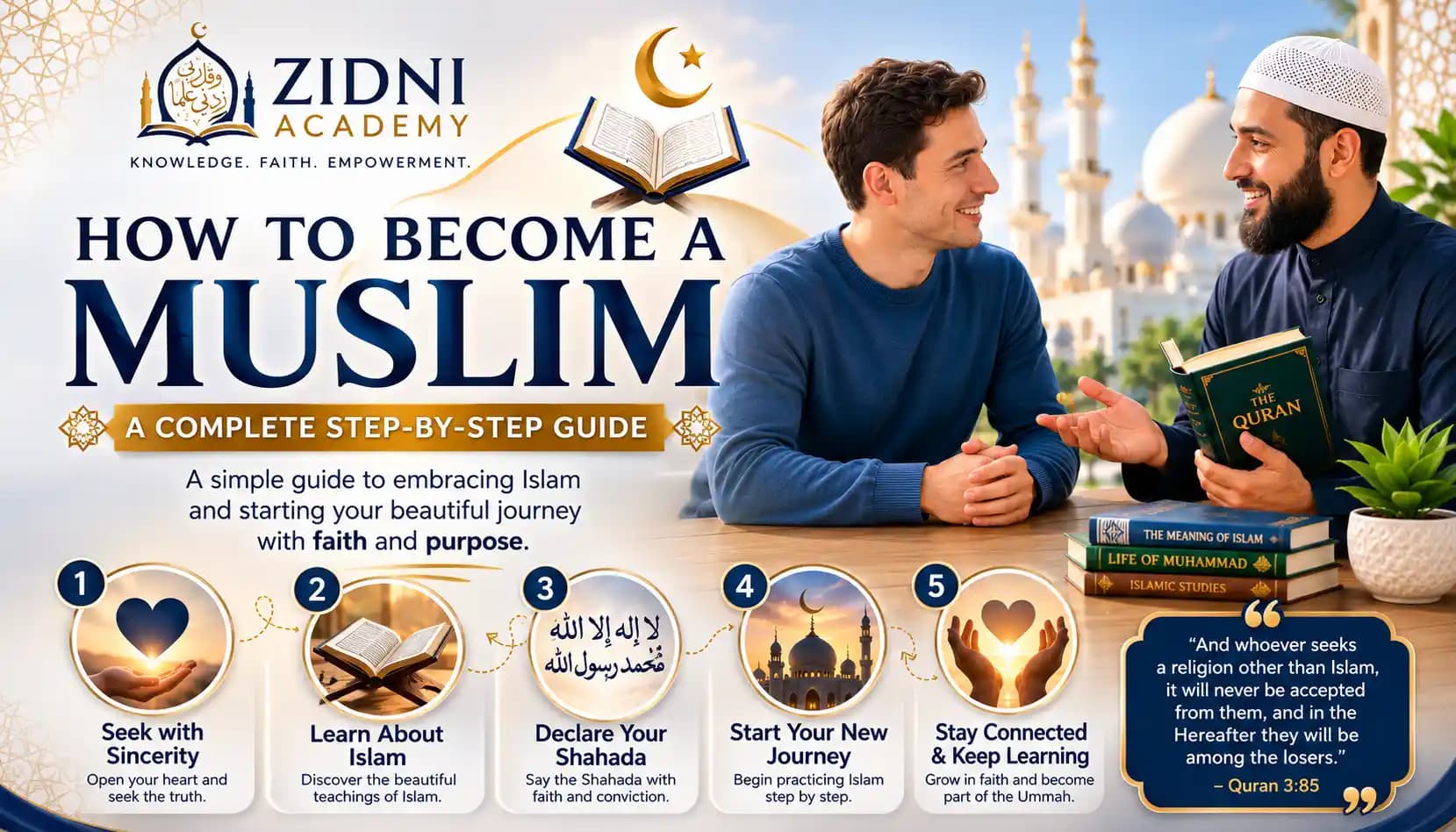
How to Become a Muslim — A Complete Step-by-Step Guide
Wondering how to become a Muslim? Whether you're in the United States, the United Kingdom, Australia, Canada, Belgium, or anywhere else in the world, embracing Islam is a deeply personal journey — and one that follows a clear, well-established path. This guide walks you through every step of how to become a Muslim: from learning about the faith and reflecting honestly on your beliefs, to declaring the Shahada and beginning your new life as a Muslim. We'll also answer the most common questions people ask, and show you how to take your very first steps in Quran study with real support behind you.
What Is Required to Become a Muslim?
Becoming a Muslim is, at its core, remarkably simple in its essential requirement: sincerely believing and declaring the Shahada (the testimony of faith) — "There is no god but Allah, and Muhammad is the Messenger of Allah."
There is no committee approval needed, no waiting period required by Islam itself, and no specific nationality, ethnicity, or background prerequisite. Islam is open to every person, anywhere in the world, regardless of age, race, or circumstance.
That said, becoming a Muslim with full understanding and lasting commitment involves more than simply saying the words — it involves genuine belief, sincere intention, and ideally, some foundational knowledge of what you're committing to. The 13 steps below walk you through this process thoroughly.
How to Become a Muslim — 13 Essential Steps
Step 1 — Learn About Islam
Before taking any formal step, take time to genuinely learn about Islam — its core beliefs, the Five Pillars, the life of Prophet Muhammad ﷺ, and the basic teachings of the Quran. Read translations of the Quran, watch lectures from credible scholars, and ask questions of practicing Muslims you trust. This foundational learning ensures that your eventual decision is informed, not impulsive.
Step 2 — Self-Reflection
Take honest time for self-reflection. Ask yourself why you're drawn to Islam, what beliefs genuinely resonate with you, and whether you're ready for the lifestyle and worldview changes that sincere practice involves. This step is not about doubt — it's about ensuring your commitment is rooted in genuine conviction rather than a fleeting moment of inspiration.
Step 3 — Find a Local Mosque
Locate a mosque (masjid) near you. In the US, UK, Australia, Canada, and Belgium, most major cities have an Islamic center or mosque that welcomes newcomers warmly. A simple online search for "mosque near me" or "Islamic center near me" is usually enough to find several options.
Step 4 — Visit the Mosque
Visit the mosque in person if possible. Many mosques have specific times for visitors or community events, and most Imams and community members are happy to welcome someone exploring Islam. Don't worry about feeling out of place — mosques regularly welcome curious visitors and those considering conversion.
Step 5 — Contact the Imam
Reach out to the Imam (the mosque's religious leader) directly, either by visiting, calling, or emailing the mosque. Let them know you're interested in learning more about Islam or considering converting. Imams are generally very approachable and experienced in guiding newcomers through exactly this process.
Step 6 — Meet with the Imam
Schedule a meeting with the Imam to discuss your questions, your understanding of Islamic beliefs, and your readiness to take the Shahada. This conversation is supportive, not an exam — the Imam's role is to ensure you understand what you're committing to and to answer any remaining questions sincerely and clearly.
Step 7 — Declaration of Faith (Shahada)
This is the central, defining moment of how to become a Muslim. You declare the Shahada: "Ash-hadu an la ilaha illallah, wa ash-hadu anna Muhammadan rasulullah" — "I bear witness that there is no god but Allah, and I bear witness that Muhammad is the Messenger of Allah." This declaration, made sincerely and with genuine belief, is what makes a person a Muslim.
Step 8 — Witnesses
While not religiously required for the Shahada itself to be valid before Allah, it is customary and recommended to have witnesses present — typically the Imam and members of the community — when you declare your faith. This formalizes your entry into the Muslim community and often becomes a cherished, supported memory of your conversion.
Step 9 — Choosing a Muslim Name
Many new Muslims choose to adopt a Muslim name, though this is not a religious requirement. Some keep their existing name if it doesn't carry meanings contrary to Islamic belief, while others choose a new name that reflects their new identity. This decision is entirely personal.
Step 10 — Embrace Islamic Practices
Begin incorporating the Five Pillars of Islam into your daily life: Shahada (faith), Salah (the five daily prayers), Zakat (charity), Sawm (fasting during Ramadan), and Hajj (pilgrimage, when able). Start gradually if needed — learning to pray correctly, for example, takes practice, and most communities are patient and supportive of new Muslims learning these practices step by step.
Step 11 — Learn About Islamic Jurisprudence
As you settle into your new faith, begin learning about Islamic jurisprudence (Fiqh) — the practical rulings that guide daily life, worship, family matters, and ethical conduct. This deepens your understanding beyond the basics and helps you navigate everyday questions with confidence.
Step 12 — Be a Part of the Muslim Community
Actively engage with the Muslim community around you — attending Friday prayers (Jumu'ah), community events, and gatherings. This community connection provides support, friendship, and accountability that make practicing Islam sustainable and joyful, rather than isolating.
Step 13 — Seek Knowledge
Islam places enormous emphasis on the pursuit of knowledge throughout life — not just at the beginning. Continue learning the Quran, Arabic, Tajweed, Hadith, and Islamic history for the rest of your life. This ongoing journey of learning is, in many ways, never truly finished.
What Are the 5 Rules to Be a Muslim?
If you're asking what is required to become a Muslim in practical terms, the foundation is the Five Pillars of Islam — the core obligations every Muslim observes:
1. Shahada — The declaration of faith, the foundational step covered above.
2. Salah — Performing the five daily prayers at their prescribed times.
3. Zakat — Giving a portion of one's wealth (typically 2.5% of savings annually) to those in need.
4. Sawm — Fasting during the month of Ramadan, from dawn until sunset.
5. Hajj — Performing the pilgrimage to Mecca at least once in a lifetime, for those who are physically and financially able.
These Five Pillars represent the practical framework within which a Muslim's life is structured — and new Muslims typically learn to incorporate them gradually, with guidance from their local community.
What Are the 10 Rules of Islam?
Beyond the Five Pillars, many people ask about broader ethical and behavioral principles in Islam. While Islam doesn't have an official numbered list called "the 10 rules," the following ten principles are widely recognized as foundational to Islamic conduct:
- Belief in One God (Allah) and rejection of all forms of polytheism.
- Establishing the five daily prayers.
- Honoring one's parents and family.
- Speaking truthfully and avoiding lies.
- Being just and fair in all dealings.
- Avoiding harm to others, including backbiting and slander.
- Giving charity to the poor and needy.
- Fulfilling promises and contracts.
- Avoiding what is forbidden (haram), including alcohol and unlawful gains.
- Treating all of creation, including animals and the environment, with kindness and responsibility.
These principles flow directly from the Quran and the Sunnah, and they form the ethical backbone that complements the ritual obligations of the Five Pillars.
How Many Wives Can a Muslim Have?
Islamic law permits a Muslim man to marry up to four wives simultaneously, provided he can treat each wife with justice and fairness and is financially capable of supporting each one equitably. This is mentioned in the Quran (Surah An-Nisa, 4:3), with an explicit condition: if a man fears he cannot deal justly with multiple wives, he is instructed to marry only one.
It's worth noting that polygyny is permitted, not obligated — the vast majority of Muslim marriages worldwide are monogamous, and the practice varies significantly across different cultures and countries, with some Muslim-majority countries restricting or regulating it through civil law.
What Is the #1 Sin in Islam?
In Islamic teaching, the gravest sin a person can commit is Shirk — associating partners with Allah, or worshipping anything other than Allah alongside or instead of Him. This is considered the most serious sin because it violates the very foundation of Islamic belief: pure monotheism (Tawheed).
The Quran states that Allah forgives all sins except Shirk if a person dies upon it without repentance (Surah An-Nisa, 4:48). This is why the Shahada — the declaration that there is no god but Allah — is the very first and most essential step in how to become a Muslim: it is the direct rejection of Shirk and the affirmation of pure monotheism.
Other major sins in Islam include murder, adultery, theft, abandoning prayer, and consuming intoxicants — but Shirk holds a uniquely central position as the sin from which all other forms of wrongdoing, in a sense, deviate.
How Hard Is It to Convert to Muslim?
In terms of the formal process, converting to Islam is not difficult at all — declaring the Shahada sincerely is the entire religious requirement, and it can be done in moments, with or without witnesses, in a mosque or even privately.
What can feel challenging for many new Muslims is the lifestyle adjustment that follows: learning to pray five times daily, adjusting dietary habits (avoiding pork and alcohol), navigating relationships with family members who may not understand or support the decision, and learning a significant amount of new religious knowledge and practice.
The good news is that no new Muslim is expected to master everything immediately. Islamic communities widely recognize that practice deepens gradually, and most mosques and Islamic centers have specific support systems, classes, and mentorship programs designed specifically for new Muslims navigating this transition.
Can Muslims Kiss Before Marriage?
This is one of the most commonly asked questions by those learning how to become a Muslim, and Islamic teaching is direct on this matter: physical intimacy, including kissing, between unmarried individuals who are not closely related (mahram) is considered impermissible in Islam.
Islam emphasizes modesty and the avoidance of physical contact between unrelated men and women outside of marriage, viewing this as part of protecting both individuals and the sanctity of marriage itself. Relationships intended for marriage in Islam typically follow a process that emphasizes getting to know a potential spouse through conversation, family involvement, and shared values — rather than physical intimacy — before the marriage contract (Nikah) is formalized.
This guidance, like many Islamic rulings, comes from a framework centered on protecting individuals and relationships rather than restricting personal freedom arbitrarily — and new Muslims are encouraged to learn the reasoning behind these guidelines as part of their broader Islamic education.
Facing Challenges as a New Muslim
Every new Muslim faces some degree of challenge during their transition — and knowing this in advance makes the journey considerably easier:
Family and social reactions — Some family members may be confused, concerned, or even unsupportive initially. Patience, clear communication, and demonstrating that your character has only improved through your faith often helps over time.
Learning Arabic and the Quran — Many new Muslims feel daunted by the idea of learning Arabic well enough to recite the Quran and prayers correctly. This is completely normal — and entirely achievable with the right guidance and consistent practice.
Building a new community — Finding genuine friendship and belonging within the Muslim community takes time, especially in areas where local Muslim populations are smaller, such as in parts of Belgium, Australia, or smaller cities across the US, UK, and Canada.
Maintaining consistency — The five daily prayers, fasting, and other practices require building new habits — and like any significant life change, consistency takes deliberate effort in the early months.
None of these challenges are insurmountable, and millions of converts across the US, UK, Canada, Australia, Belgium, the UAE, and around the world have navigated this journey successfully — with strong, supportive communities helping every step of the way.
Connect Quran Classes with Zidni Academy
One of the most meaningful steps a new Muslim can take — addressed in Step 13 above, "Seek Knowledge" — is learning to read and recite the Quran correctly. This is where Zidni Academy comes in.
At Zidni Academy, we specialize in guiding complete beginners — including new Muslims with zero Arabic background — through the entire journey: from the Arabic alphabet, to correct pronunciation (Tajweed), to confidently reciting your first Surah. Our certified Al-Azhar teachers have years of experience working specifically with reverts and non-native speakers, understanding exactly the questions and challenges that come with starting fresh.
Live, private 1-on-1 sessions — Your teacher's full attention is on you, answering every question without judgment and adapting entirely to your pace.
No Arabic background required — Whether you just declared the Shahada yesterday or months ago, your Quran journey starts exactly where you are.
Flexible scheduling worldwide — Available across all time zones in the US, UK, Canada, Australia, Belgium, UAE, and beyond.
Male and female teachers available — So every new Muslim's comfort and preference is respected from the very first session.
Ready to take Step 13 seriously? Explore Learn To Read Quran Online — Beginner to start from your very first Arabic letter, or Islamic Online Classes for a complete foundation covering Quran, Tajweed, and the basics of Islamic practice that every new Muslim needs. Book your free trial session today — no payment required, no commitment.
Frequently Asked Questions
Q: What are the requirements to become a Muslim? The only religious requirement to become a Muslim is sincerely believing and declaring the Shahada: "There is no god but Allah, and Muhammad is the Messenger of Allah." There is no age, nationality, or background restriction — and witnesses, while customary, are not strictly required for the declaration to be valid.
Q: How do you become a Muslim for beginners? Start by learning about Islam's core beliefs and practices, reflect honestly on your readiness, visit a local mosque, and speak with an Imam. When you're ready, declare the Shahada sincerely. From there, gradually begin learning the five daily prayers, basic Quran recitation, and the Five Pillars of Islam — most communities support new Muslims patiently through this process.
Q: How hard is it to convert to Muslim? The formal conversion process itself is simple — sincerely declaring the Shahada takes only moments. The ongoing adjustment to a new lifestyle, including prayer, dietary changes, and learning new religious knowledge, takes more time but is achievable gradually, with strong community and educational support widely available.
Q: What are the 10 rules of Islam? While there's no single official list, ten widely recognized principles include: belief in one God, performing the five daily prayers, honoring parents, speaking truthfully, being just, avoiding harm to others, giving charity, fulfilling promises, avoiding what is forbidden, and treating all creation with kindness.
Q: What is the #1 sin in Islam? The gravest sin in Islam is Shirk — associating partners with Allah or worshipping anything besides Him. This is considered the most serious sin because it directly violates the foundational principle of Islamic monotheism (Tawheed).
Q: Can Muslims kiss before marriage? Islamic teaching holds that physical intimacy, including kissing, between unmarried individuals who are not closely related is not permissible. Islam encourages getting to know a potential spouse through conversation and family involvement rather than physical contact before marriage.
Q: What qualifies you to be a Muslim? Sincere belief in and declaration of the Shahada qualifies a person as Muslim. This single act of faith — testifying to the oneness of Allah and the prophethood of Muhammad ﷺ — is the entry point into Islam, regardless of one's prior background or knowledge level.
Q: How many wives can a Muslim have? Islamic law permits a Muslim man to marry up to four wives, provided he can treat each one justly and support them equitably. The Quran instructs that if a man cannot fulfill this condition fairly, he should marry only one wife.
Q: What should a new Muslim learn first after the Shahada? After declaring the Shahada, new Muslims typically begin learning the five daily prayers, basic Quran recitation (often starting with short Surahs), and the foundational beliefs and practices of Islam. Many academies, including Zidni Academy, offer structured beginner programs designed specifically for this stage.
Q: How can I start learning the Quran as a new Muslim? Zidni Academy offers live, 1-on-1 Quran lessons specifically suited to complete beginners, including new Muslims with no prior Arabic knowledge. A free trial session lets you meet a certified teacher and begin your personalized learning plan immediately, with no payment required upfront.